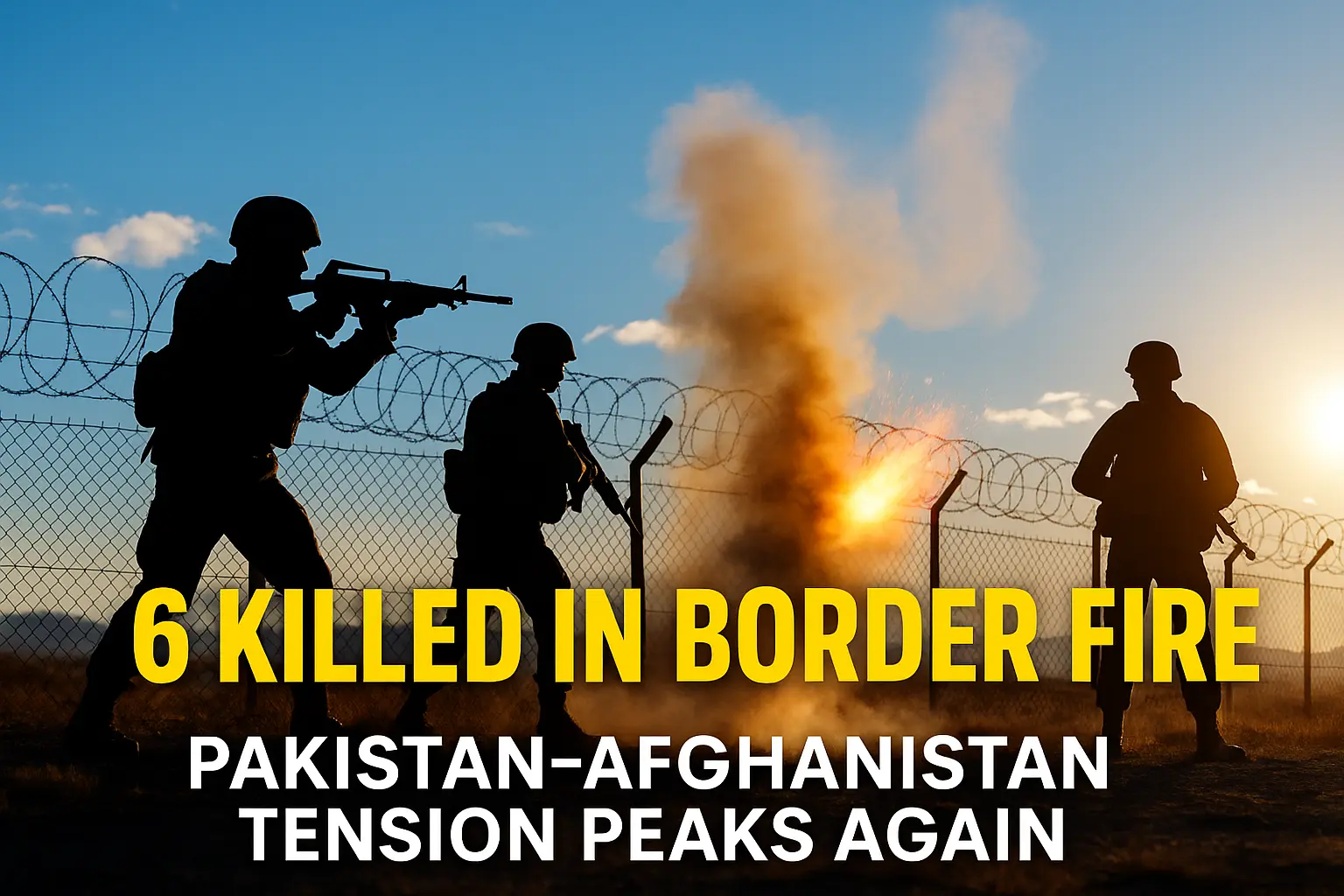

Tensions along the Pakistan–Afghanistan border have been climbing steadily in recent months, despite repeated attempts at restoring calm through diplomatic channels. The latest exchange of fire, which left six Afghan nationals dead, has once again highlighted how fragile the situation remains. Each new incident wipes away whatever progress the peace talks manage to make, reinforcing the sense that the frontier is stuck in a cycle of confrontation rather than moving toward stability.
II. What Happened: The Latest Clash
The clash erupted along a sensitive stretch of the Durand Line where both sides have maintained an unusually high state of alert. Afghan authorities confirmed the deaths of six Afghan nationals, while Pakistan reported no losses on its side. As in past exchanges, the two governments offered sharply different accounts of how the incident began — a familiar pattern in a region where the absence of neutral observers makes verification nearly impossible.
III. India’s Increasing Influence Is Not Letting Peace Prevail
One of the less-discussed but increasingly influential factors behind the instability is India’s expanding presence inside Afghanistan. New Delhi’s diplomatic and intelligence footprint has grown noticeably, and Pakistan sees this as an attempt to apply strategic pressure from both the eastern and western fronts. This perception complicates every round of talks between Islamabad and Kabul. Even modest diplomatic progress tends to unravel when either side believes external actors are shaping decisions behind the scenes. This shifting regional geometry is now a defining feature of South Asian security politics.
IV. Afghan Claims About Pakistani Casualties
In the aftermath of the incident, Afghan officials suggested that Pakistani forces had suffered losses. These claims, however, remain unsupported by evidence. Kabul has often released elevated casualty figures during moments of heightened tension, and without independent monitoring, such statements are difficult to assess. The ambiguity leaves room for speculation but adds little clarity to the situation.
V. Pakistan’s Position: “No Confirmed Casualties”
Pakistan rejected reports of its own casualties and maintained that its troops returned fire only after being targeted. The Pakistani side kept its public messaging brief, choosing not to disclose operational details. Islamabad’s restrained tone appears aimed at preventing the clash from spiraling into a larger diplomatic showdown — particularly at a time when multiple actors are watching the border closely.
VII. Civilian Toll and Local Impact
Beyond the political back-and-forth, the latest confrontation has taken a visible toll on communities living along the border. The deaths of six Afghan civilians have added to a growing sense of insecurity. Border crossings have been intermittently closed, trade flows disrupted, and several families have been displaced. For locals, the recurring instability has become a direct threat to livelihoods and mobility, turning the area into one of South Asia’s most unpredictable zones.
VIII. Comparison With Previous Incidents
The episode fits a familiar pattern. Earlier clashes in 2025 also produced contradictory claims and little verifiable information. Over time, this cycle has eroded trust to the point where even routine military movements are interpreted as provocations. The lack of transparency has made it difficult to establish any sustained confidence-building measures.
IX. Impact on the Region
Instability along the Pakistan–Afghanistan border rarely stays confined to the immediate area. It affects key regional trade corridors, including routes tied to CPEC and broader China–Central Asia connectivity projects. Militant groups have historically exploited periods of tension to expand their presence, raising concerns about cross-border infiltration. Refugee movements add further pressure on both states, complicating humanitarian planning. Meanwhile, regional powers — particularly India, China, and Gulf states — view the border situation through their own strategic lenses, often shaping outcomes in subtle but significant ways. The cumulative effect is a widening arc of uncertainty across South and Central Asia.
X. Strategic Implications for Regional Stability
For Pakistan and Afghanistan, the clash underscores how quickly the security landscape can shift. Pakistan faces the dual challenge of countering militancy at home while managing a volatile frontier. Afghanistan, still navigating post-transition power dynamics, struggles to maintain consistent border policy. The incident also raises concerns for China, whose long-term infrastructure and transit plans depend on stable western routes through Pakistan. Without a reliable mechanism to prevent miscalculations, the risk of escalation remains high.
XI. What We Still Don’t Know
Much remains unclear. There is still no independently verified account of what triggered the exchange or whether the incident will influence upcoming rounds of talks. Both countries have avoided providing detailed explanations, leaving analysts with limited information. Until a formal mechanism for verification is established, the space will continue to be filled by speculation rather than facts.
XII. Conclusion
The deaths of six Afghan nationals in the latest border clash have once again highlighted how fragile the Pakistan–Afghanistan relationship remains. With competing regional agendas, limited trust, and an absence of credible monitoring, the frontier continues to experience tension that neither side seems fully able to contain. A sustainable pathway to peace will require not only dialogue but also the insulation of bilateral ties from external pressures — something both states have struggled to achieve.