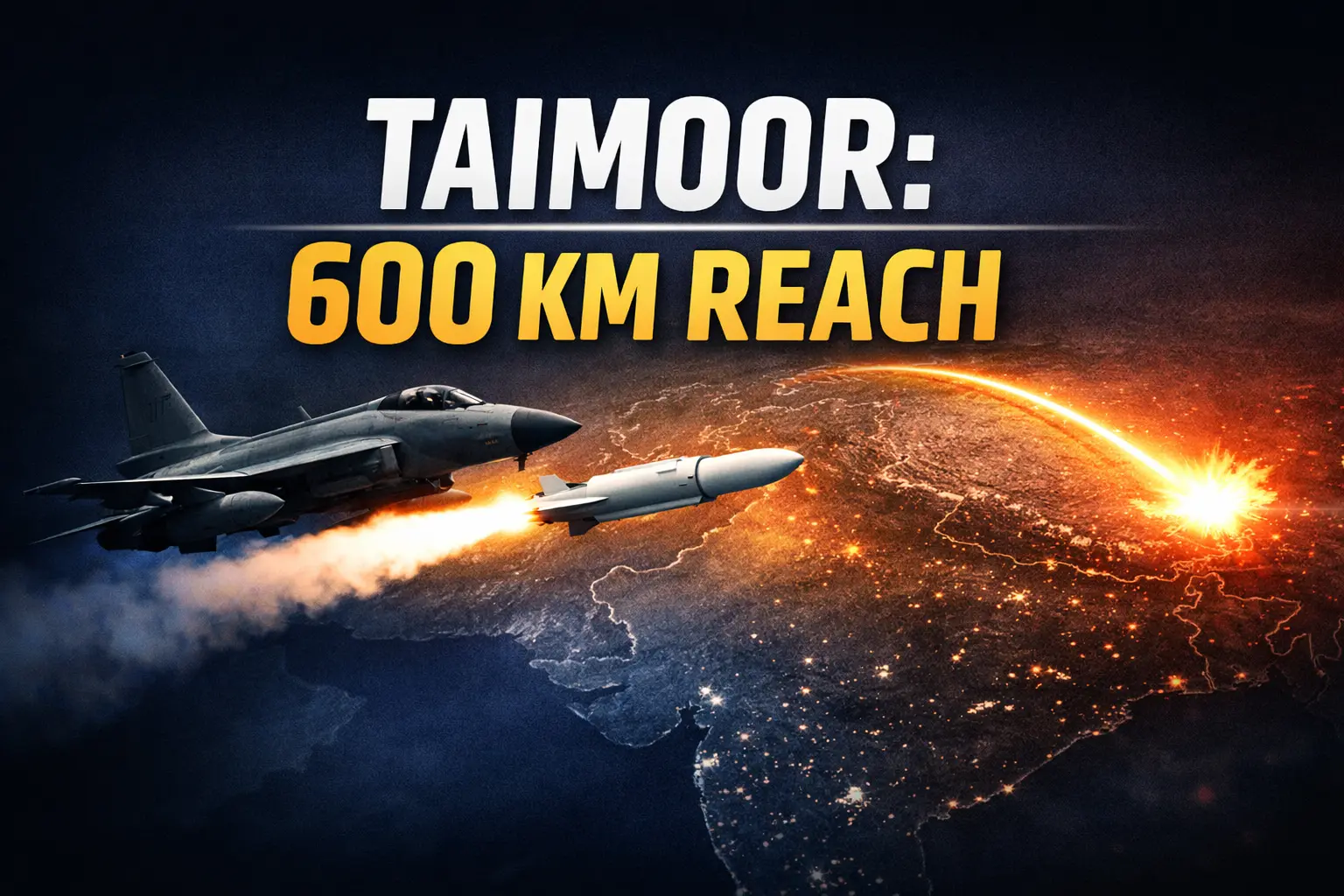

When Pakistan tested the Taimoor air-launched cruise missile, it was not just another routine announcement by the military. Confirmed by Inter-Services Public Relations, the test quietly signaled a major evolution in Pakistan’s conventional strike capability. In a region where airspace is heavily defended and escalation risks are high, a long-range air-to-surface missile with a 600 km reach changes how wars are planned—and how they may be avoided.
For Pakistan, this test was less about headlines and more about strategic positioning, deterrence credibility, and operational freedom in a tense South Asian security environment.
What Was Tested?
The missile tested was the Taimoor Air-Launched Cruise Missile (ALCM), a conventionally armed, precision-guided weapon designed to be released from fighter aircraft. Unlike short-range air-to-ground weapons that require aircraft to fly close to enemy defenses, Taimoor is a true stand-off strike missile. Once launched, it flies independently at low altitude, following terrain and navigating toward its target with high accuracy.
Crucially, Taimoor is indigenously developed, reflecting Pakistan’s growing focus on self-reliance and seamless integration with locally supported aircraft such as the JF-17 Thunder. Its role is clear: deliver precision effects from a distance, without exposing pilots or platforms to unnecessary risk.
Key Technical Capabilities
What sets the Taimoor missile apart is its approximately 600-kilometer range, placing it among the longest-range operational air-launched cruise missiles in South Asia. This range is complemented by a terrain-hugging flight profile, making detection by radar difficult, especially in cluttered environments. Advanced guidance—based on inertial navigation with satellite assistance—allows the missile to strike fixed, high-value targets with accuracy.
Taken together, these features make Taimoor not just a weapon, but a strategic tool designed for survivability, precision, and controlled escalation.
Strategic Meaning of the 600-km Range
A 600-km air-to-surface missile fundamentally reshapes air warfare geometry. Pakistan Air Force aircraft can now launch strikes from deep within national airspace, often under the protection of friendly fighters and ground-based air defenses. There is no need to cross borders or challenge dense enemy air defense networks head-on.
Strategically, this gives Pakistan escalation control. A strike can be delivered without immediately triggering a wider air battle or political crisis. At the same time, the extended range dramatically expands the target envelope. Command centers, air bases, logistics hubs, radar sites, and other rear-area military assets—previously considered relatively safe—are now within reach.
The psychological impact is equally important. A missile like Taimoor forces adversaries to defend depth, not just frontlines. It increases uncertainty, stretches defensive resources, and complicates planning. Importantly, the 600-km range sits in a deliberate sweet spot: long enough to be effective and safe, yet clearly conventional, avoiding the destabilizing signaling associated with ballistic missiles.
Role of the Pakistan Air Force
For the Pakistan Air Force, Taimoor reinforces a shift toward missile-centric, network-enabled airpower. Aircraft increasingly act as launch platforms rather than penetration tools. Intelligence, surveillance, reconnaissance, and electronic warfare now play a central role in enabling precision strikes from distance.
This approach reduces pilot risk, preserves valuable aircraft, and allows sustained pressure during prolonged crises—an essential advantage in modern, technology-driven conflicts.
Aircraft Integration Strategy
Pakistan’s strategy emphasizes platforms it can fully control, upgrade, and sustain without political constraints.
Aircraft
Integration Status
Strategic Logic
JF-17 Block-III
Highly likely
Indigenous integration, modern avionics, ideal for ALCMs
JF-17 Block-II
Likely
Proven strike role, software flexibility
Mirage III/V
Transitional
Historic cruise missile carriers, aging airframes
F-16
Unlikely
Political and weapons-integration restrictions
J-10C
Potential
Advanced platform, would require custom integration
This reflects a broader doctrinal shift toward sovereign strike capability.
Comparison with Indian Air-to-Surface Missiles
To understand Taimoor’s strategic value, it must be viewed alongside India’s air-launched strike arsenal.
| Missile | Country | Approx. Range | Launch Aircraft | Strategic Character |
|---|---|---|---|---|
| Taimoor ALCM | Pakistan | ~600 km | JF-17 (expected) | Deep stand-off, escalation control |
| BrahMos-A | India | ~300–400 km | Su-30MKI | High-speed, offensive signaling |
| Nirbhay (air-launched, planned) | India | ~1,000 km | Under development | Long-range, not yet operational |
| Rampage | India | ~250 km | Multiple fighters | Tactical stand-off |
| SPICE-2000 | India | ~100 km | Multiple fighters | Precision glide weapon |
While BrahMos-A emphasizes speed and penetration, Taimoor emphasizes reach, survivability, and restraint—two very different philosophies of deterrence.
Message to Adversaries and Allies
The Taimoor missile sends a calm but firm message. Pakistan is not seeking dramatic escalation or shock value. Instead, it is building credible, precise, and controlled conventional options. To adversaries, it signals that rear areas are no longer immune. To allies and partners, it reflects technological maturity and a preference for stability through deterrence rather than provocation.
Future Outlook
Taimoor is likely to be inducted in phases, with improvements in guidance, counter-measures, and platform integration over time. Variants optimized for maritime strike or enhanced electronic warfare environments may follow. Collectively, these developments point toward a layered, flexible, and modern strike doctrine.
Conclusion
The real importance of the Taimoor air-launched cruise missile lies not just in its 600-km range, but in what that range enables strategically. It gives Pakistan freedom of action, strengthens conventional deterrence, and preserves escalation control in one of the world’s most sensitive regions. In modern warfare, power is no longer about flying into danger—it is about reaching deep, striking precisely, and staying in control.