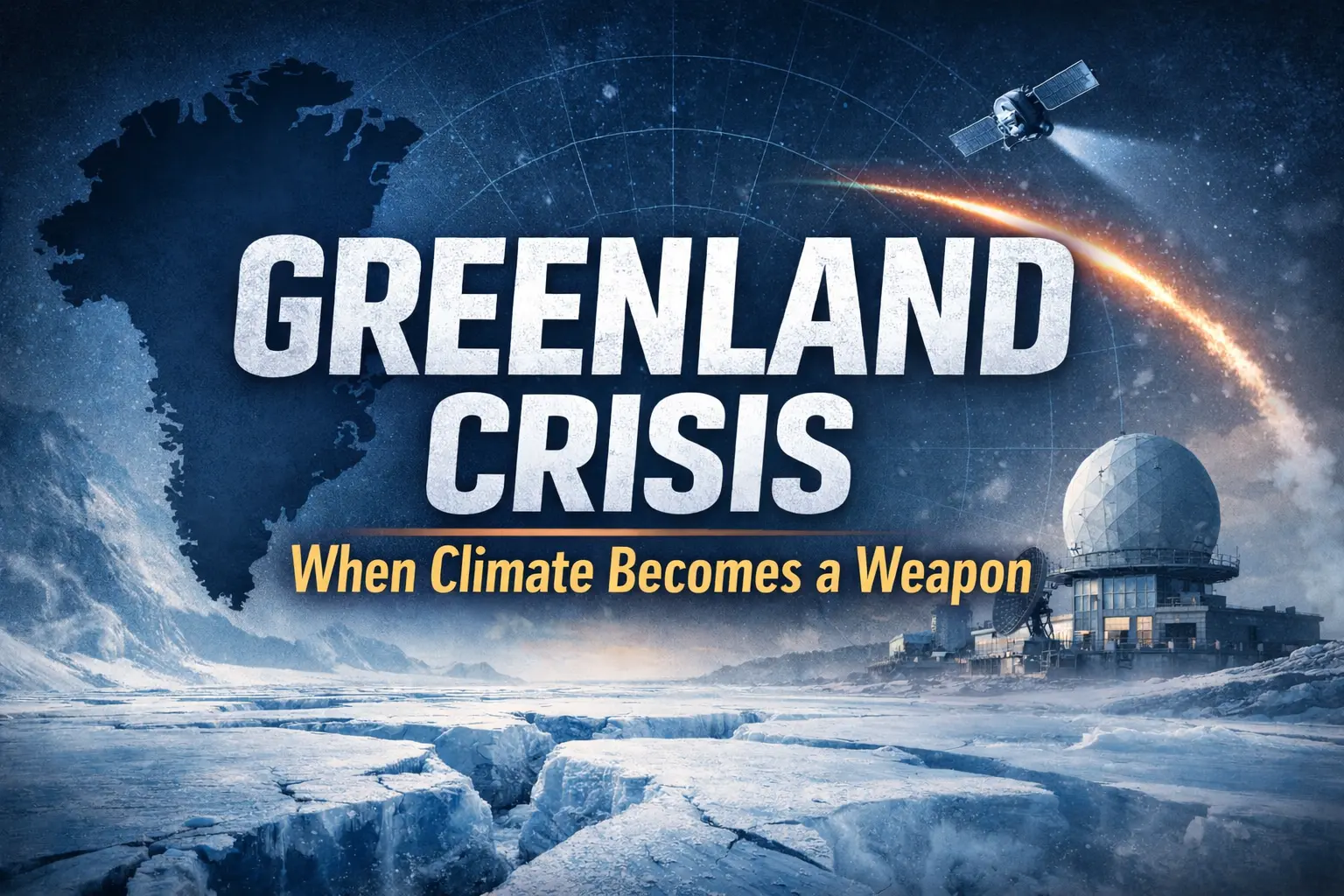

Greenland did not change overnight—the world’s priorities did. What was once dismissed as a frozen periphery has now become a strategic nerve center where climate collapse, military planning, and psychological warfare intersect. The Greenland Crisis is not merely about ice melting; it is about power shifting.
As polar ice retreats, so does the illusion that geography no longer matters in global politics. Greenland is now a symbol—a signal to allies, rivals, and domestic populations—that the Arctic is the next theater of competition. In modern geopolitics, perception often precedes conflict, and Greenland has quietly become a message board for great powers testing intent, resolve, and dominance.
Geographic & Political Background of Greenland
Greenland is vast, empty, and unforgiving—but strategically priceless. With a population smaller than a mid-sized town, Greenland sits atop territory larger than Western Europe. This imbalance between land, people, and power makes it inherently vulnerable.
Politically tied to Denmark, Greenland’s autonomy exists within limits. Defense and foreign policy remain outside local control, creating a psychological fault line. Every foreign investment offer, military visit, or diplomatic statement reinforces a quiet question among Greenlanders: Who truly decides our future?
In psywar terms, Greenland is not weak—it is exposed.
Climate Change: Ice Melt and Global Consequences
Climate change is the accelerator, not the cause, of the Greenland Crisis. Melting ice is not only raising sea levels; it is stripping away natural defenses that once shielded the Arctic from human competition.
For Greenlanders, this is deeply personal. Hunting routes vanish, traditions erode, and uncertainty replaces stability. For global powers, the same melting ice is framed as opportunity—new shipping lanes, new military access, new leverage.
This dual narrative—existential threat for locals, strategic opening for outsiders—is a classic psywar condition. Climate becomes both a human tragedy and a strategic weapon, shaping narratives to justify expansion, presence, and control.
Strategic Location: Control of the Arctic Gateway
Greenland’s geography is its destiny. Sitting between North America and Europe, it is the unsinkable aircraft carrier of the Arctic. Control Greenland, and you monitor missile trajectories, airspace, satellites, and emerging sea lanes.
This is why Greenland is central to NATO’s northern defense architecture. Early-warning radars and space-tracking systems positioned here are not defensive luxuries—they are strategic necessities.
From a psywar perspective, presence itself is power. Every base, radar, or exercise in Greenland signals deterrence to rivals and reassurance to allies—often without a single shot fired.
The Mineral & Resource Race
Greenland’s underground wealth is its most dangerous asset. Rare earth elements, uranium, and strategic metals critical for fighter jets, missiles, electric vehicles, and artificial intelligence lie beneath its thawing surface.
The global race for these resources is not about profit alone—it is about supply-chain dominance. Whoever controls rare earth access controls future industries and military technologies.
Inside Greenland, this race is framed as economic survival versus environmental destruction. Outside, it is framed as strategic necessity. This clash of narratives is psywar at its core: development vs exploitation, sovereignty vs dependency, choice vs pressure.
United States’ Strategic Interest
The United States does not see Greenland emotionally—it sees it structurally. Missile defense, space surveillance, and Arctic control converge here. The infamous proposal to “buy Greenland” was less a joke and more a strategic tell.
Washington’s concern is not hypothetical. A rival foothold in Greenland would compress U.S. response time, undermine deterrence, and shift the Arctic balance.
Thus, American engagement is designed to send a clear psywar message: Greenland is already inside the U.S. security perimeter. Diplomacy softens the tone; military reality enforces it.
China and Russia: Expanding Arctic Influence
China approaches Greenland quietly—through investments, research stations, and infrastructure bids. Its strategy is psychological as much as economic: normalize presence before opposition hardens. By branding itself a “near-Arctic state,” China reshapes perception before reshaping reality.
Russia, by contrast, is overt. It militarizes openly, revives Arctic bases, and conducts exercises designed for visibility. Russia’s message is blunt: the Arctic is already militarized—by us.
Together, China and Russia create a pressure environment where Greenland becomes a silent contest of wills, not an open battlefield.
Denmark–Greenland Relations Under Strain
Denmark is caught between alliance loyalty and moral responsibility. Every decision taken in Copenhagen is interpreted in Greenland through a lens of trust versus control.
Economic dependency complicates independence dreams, yet rising strategic value fuels nationalist sentiment. In psywar terms, ambiguity is dangerous. If Greenlanders believe decisions are made about them, not with them, internal cohesion weakens—making external influence easier.
The crisis thus exposes a deeper question: can small societies retain agency in an era of great-power competition?
Global Implications of the Greenland Crisis
The Greenland Crisis is a preview of future conflicts shaped by climate, technology, and psychology rather than ideology alone. Arctic shipping routes could redraw global trade. Military deployments could normalize confrontation in previously neutral spaces.
Most importantly, Greenland demonstrates how environmental change is weaponized strategically. Climate stress becomes leverage; geography becomes destiny again. What unfolds here will be replicated in Antarctica, Africa, and island states worldwide.
Conclusion: Greenland as the Frontline of the Future
Greenland is no longer a distant land of ice—it is a mirror reflecting the future of global conflict. A future where power competes quietly, influence spreads subtly, and psychological dominance matters as much as military strength.
For Greenlanders, the crisis is about dignity and survival. For global powers, it is about positioning and control. The tragedy—and the danger—lies in how easily human lives become footnotes in strategic calculations.
The Greenland Crisis reminds us that in the modern world, the first battlefield is perception, the second is territory, and the third is the human soul.