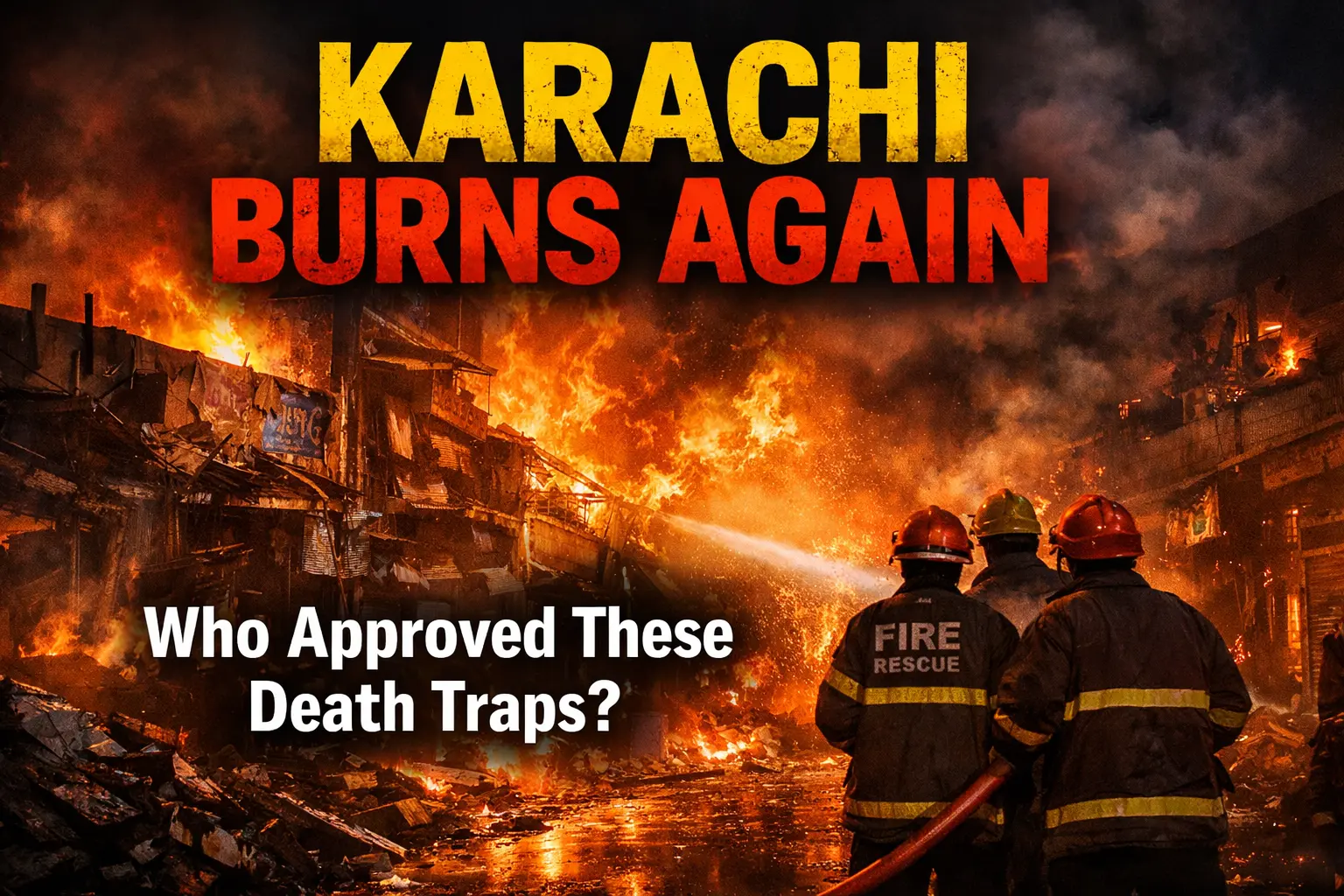
For residents of Karachi, fires in markets are no longer shocking news alerts. They are familiar heartbreaks — scenes of smoke, screaming traders, frantic families, and shopkeepers standing helplessly before the ruins of their life’s work.
The fire at Gul Plaza was not just another accident. It was a reminder of everything this city has failed to fix — and everyone it has failed to protect.
For some, it meant the loss of stock.
For others, the loss of income.
For a few, it meant never coming home again.
A City That Keeps Ignoring Its Own Warnings
Over the last decade, Karachi has watched its commercial centers burn one after another. The names change, but the story never does:
Gul Plaza. Hafeez Center. Cooperative Market. Chawla Market. Chase Up. Rimpa Plaza. Millennium Mall. Clifton Shopping Centre.
Different locations. Different years.
The same smoke. The same tears.
Every fire exposes the same violations — tangled electrical wiring, overloaded circuits, blocked staircases, locked exits, and the complete absence of fire alarms or sprinkler systems.
These are not hidden dangers. They are visible failures that survived only because someone allowed them to.
Behind Every Burnt Shop Is a Broken Life
For many shopkeepers, these markets were not businesses — they were inheritances of struggle. Years of savings invested, loans taken, children educated, families fed.
When fire destroys a shop in Karachi:
•There is usually no insurance
•No meaningful compensation
•No rehabilitation plan
Many workers sleep inside these buildings to protect goods overnight. When fires break out, locked staircases and barred windows turn workplaces into death traps.
Those who die are later described as “casualties.”
But to their families, they were fathers, sons, brothers.
Gul Plaza Burned Twice — That Is Not an Accident
What makes Gul Plaza especially tragic is that it had already burned once.
A building that has suffered a major fire should never be allowed to operate again without strict safety audits, complete rewiring, and structural compliance checks.
That this did not happen tells us something deeply disturbing.
When a building burns twice, the second fire is not bad luck.
It is criminal negligence repeating itself.
Who Signed the Papers? Who Issued the NOCs?
This is the most important question — and the one authorities avoid.
A proper, independent inquiry must identify:
•Officials who issued No Objection Certificates (NOCs) without ensuring fire safety compliance
•Authorities who approved unsafe building designs
•Inspectors who ignored violations
•Owners and builders who chose profit over people
Negligence that leads to death is not an administrative mistake.
It is a crime.
Until those who approved these buildings are brought to justice, every inquiry is meaningless.
Seventeen Years of Control, No Safety Culture
For nearly 17 years, Pakistan Peoples Party has governed Sindh and controlled Karachi’s regulatory framework.
During this time:
•Fire safety laws existed mostly on paper
•Illegal constructions were normalized
•Inspections became formalities
•Fire brigade capacity remained outdated
After every tragedy, promises were made. Committees were formed. Then silence followed.
When no one is punished, negligence becomes normal — and deadly.
Karachi Pays the Price, Literally and Figuratively
Karachi generates most of Pakistan’s revenue, yet remains one of its most unsafe megacities.
The city lacks:
•Empowered local government
•Independent safety regulators
•Accountability mechanisms
It is treated as an economic engine, not a city of human beings.
What Justice and Reform Should Look Like
Real change is not complicated. It requires courage.
•Criminal trials for approving authorities in fatal incidents
•Permanent sealing of unsafe markets
•Mandatory insurance for commercial buildings
•Independent fire safety authority
•Public audits of high-risk structures
These are basic urban safety standards — not luxuries.
Conclusion: These Fires Are Not Inevitable
Karachi’s market fires are not destiny. They are the result of choices — made in offices, signed on files, stamped on NOCs.
The flames are not just burning buildings.
They are burning trust, livelihoods, and lives.
Until those who allowed unsafe buildings to exist are held accountable, the city will keep mourning — and the smoke will keep rising.