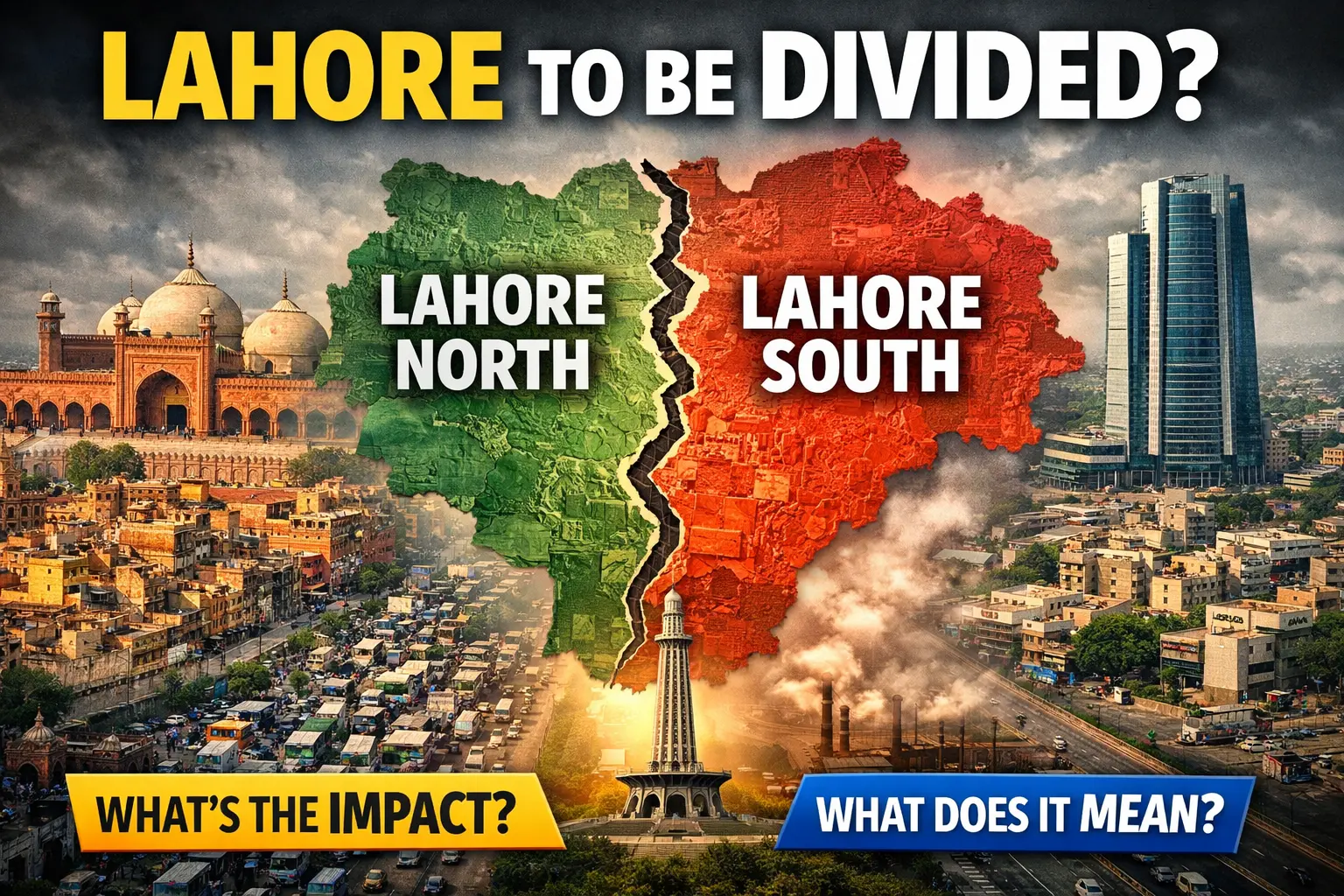
Lahore, Pakistan’s cultural capital and second-largest city, may soon undergo a major administrative transformation. According to senior officials within the district administration, the Punjab government is close to finalising a plan to divide Lahore into two separate administrative districts — Lahore North and Lahore South. If formally approved, the restructuring is expected to be implemented after the Basant season, marking one of the most significant governance reforms in the city’s recent history.
Officials confirm that the Lahore administration has already submitted detailed data to the provincial government, including population figures, tehsil boundaries, administrative infrastructure, and governance challenges. While the government has not publicly disclosed the exact criteria for bifurcation, sources indicate that the proposal has received approval at the highest levels of the Punjab government.
Why Lahore Can No Longer Function as a Single District
Over the past two decades, Lahore has expanded at an unprecedented pace. What was once a manageable metropolitan district has grown into a sprawling megacity with an estimated population of around 25 million. This explosive growth has placed enormous pressure on infrastructure, public services, and administrative capacity.
Senior bureaucrats argue that governing such a massive urban population through a single district administration is no longer practical. Traffic congestion, parking shortages, pollution, smog, illegal encroachments, waste management failures, and delays in service delivery have become routine complaints.
According to one senior official, expecting one deputy commissioner to manage Pakistan’s second-largest city is “administratively unrealistic.” The proposed division into two districts is therefore being presented not as a political experiment, but as a structural necessity for effective urban governance.
Proposed Administrative Framework: Lahore North and Lahore South
Under the current plan being discussed at the provincial level, the division will be based on existing tehsil boundaries.
Proposed Lahore North District
Lahore North is expected to include:
•Wagah
•Ravi
•Saddar
•Shalimar
•Lahore City
•Lahore Cantt
This district would encompass Lahore’s older, densely populated areas, major commercial zones, heritage localities, and sensitive border-adjacent regions.
Proposed Lahore South District
Lahore South would comprise:
•Iqbal Town
•Model Town
•Raiwind
•Nishtar
These areas include newer residential developments, expanding suburban zones, and rapidly growing commercial corridors.
Officials believe this division will allow each district administration to focus on area-specific challenges, rather than managing the entire city through a single centralized structure.
A History of Delays and Deferred Proposals
The idea of dividing Lahore is not new. It has been debated repeatedly since 2017 but consistently delayed due to political instability, bureaucratic resistance, and financial concerns.
In 2017, a proposal to divide Lahore into four districts was developed after the city’s population crossed 10 million. A committee led by the Lahore commissioner concluded that the city had become unmanageable due to unchecked urban expansion. However, political uncertainty led to the proposal being dropped.
The idea resurfaced in 2019 and 2020, initially proposing three districts and later narrowing it down to two. By December 2020, the two-district model was declared administratively viable. Detailed planning included impact assessment studies, creation of new tehsils, and measures to preserve Lahore’s historical and cultural identity. Despite substantial groundwork, the proposal stalled due to lack of political will.
In 2022–23, the plan was revived once again under then Chief Minister Parvez Elahi, this time suggesting three districts. However, the proposal lacked clarity and was eventually deferred.
The 2024 Interim Step: Expansion of Tehsils
Instead of dividing Lahore into districts, the Punjab government took an interim step in August 2024 by increasing the number of tehsils from five to ten. Newly added tehsils included Nishtar, Wagah, Iqbal Town, Ravi, and Saddar, alongside existing ones such as Raiwind, Model Town, Lahore Cantt, Lahore City, and Shalimar.
While this move was intended to decentralize governance, many officials viewed it as a temporary measure that did not address the core issue of district-level administrative overload.
What This Means for Lahore’s Residents
For most Lahoris, administrative changes often feel abstract. However, the proposed division into Lahore North and Lahore South could have direct and visible effects on everyday life.
Faster Resolution of Civic Complaints
Currently, residents often face long delays in resolving issues such as broken roads, water shortages, sewerage problems, garbage collection delays, and illegal encroachments. With two district administrations handling smaller populations and geographic areas, complaint resolution is expected to become faster and more efficient. Reduced administrative load means greater accountability and quicker response times.
Improved Traffic and Transport Management
Traffic congestion has become one of Lahore’s most pressing daily challenges. Separate district administrations would be able to develop localized traffic and parking strategies, tailored to the specific needs of older commercial zones in Lahore North and expanding residential areas in Lahore South. This could lead to better traffic flow, more organized parking, and improved commuter experience.
Better Control of Pollution and Smog
Air pollution and seasonal smog have turned into serious public health concerns. Smaller districts would allow closer monitoring of industrial emissions, more effective enforcement of environmental regulations, and quicker response to violations. Over time, this could contribute to improved air quality and fewer health-related disruptions.
More Consistent Service Delivery
Basic municipal services such as solid waste management, street lighting, park maintenance, and regulation of commercial activity are currently uneven across the city. With two districts, service delivery can become more balanced, budgets can be allocated more efficiently, and performance of contractors can be monitored more closely.
Reduced Pressure on Administrators
At present, district officials are stretched thin. Dividing Lahore would reduce administrative pressure, allowing officials to focus on planning, coordination, and long-term development rather than constant crisis management.
Better Law and Order Coordination
Smaller districts would improve coordination with police, rescue services, and emergency departments during public gatherings, religious events, political rallies, and emergencies. This could result in faster emergency response and improved public safety.
Localized Urban Planning
Lahore’s historic areas, commercial hubs, and suburban expansions all have different needs. Two districts would allow more targeted urban planning, ensuring heritage preservation in older areas while supporting infrastructure development in growing zones.
Short-Term Adjustment Challenges
Residents should also expect some short-term challenges, such as confusion over jurisdiction, changes in office locations, and transitional delays. However, governance experts believe these issues can be managed through proper planning and public communication.
Internal Resistance and the Way Forward
Some bureaucratic circles have suggested increasing the number of tehsils from 10 to 12 instead of dividing the city. Critics argue that such measures delay meaningful reform and complicate governance rather than fixing structural problems.
Supporters of the two-district model believe that administrative restructuring is now unavoidable if Lahore is to function efficiently as a modern megacity.
Conclusion: A Defining Moment for Lahore
With reported approval at senior levels of the Punjab government, the proposed division of Lahore into Lahore North and Lahore South appears closer to implementation than ever before. If executed transparently and effectively, it could reshape urban governance, improve service delivery, and enhance quality of life for millions of residents.
For Lahore, the question is no longer whether change is needed — but whether the government is ready to act decisively. The success of this reform will ultimately be judged not by administrative maps, but by whether daily life for Lahoris becomes easier, cleaner, and more manageable.