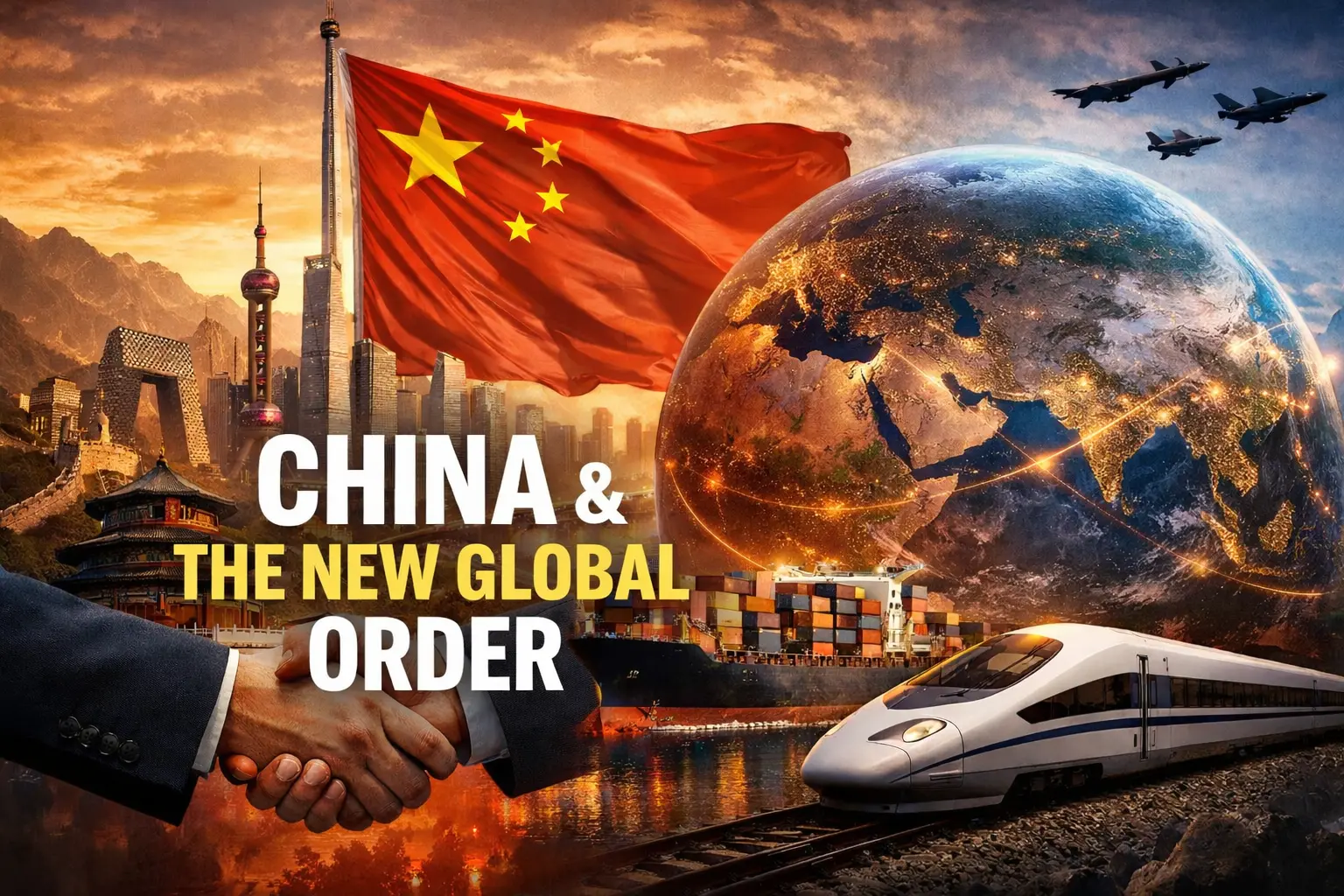

As the international system undergoes rapid transformation, China’s role in global geopolitics has become increasingly central. From economic diplomacy to strategic partnerships, Beijing is reshaping power dynamics without relying heavily on military confrontation. Instead, China is leveraging trade, infrastructure investment, and diplomatic engagement to influence a world moving steadily toward multipolarity.
China’s foreign policy is defined by a careful balance: expanding influence while avoiding direct conflict, particularly with the United States. This strategic restraint distinguishes China’s approach from traditional great-power competition and signals a long-term vision aimed at reshaping global governance rather than overturning it abruptly.
China–United States Rivalry and Global Power Shifts
At the core of today’s geopolitical transformation lies the China–US strategic rivalry. Officially, Beijing continues to promote the concept of a “peaceful rise,” emphasising respect for sovereignty, non-interference, and economic cooperation. However, rising tensions, trade disputes, and competing global narratives have made rivalry unavoidable.
China increasingly presents itself as a stabilising force in contrast to what it portrays as Western interventionism. By doing so, it appeals to states seeking alternatives to US-led political and security frameworks. This positioning has allowed China to expand diplomatic space while avoiding the costs of direct confrontation.
Europe, Strategic Autonomy, and Economic Influence
China’s engagement with Europe reflects a broader strategy of exploiting geopolitical fragmentation. Through trade agreements, investment, and market access, Beijing encourages European states to pursue strategic autonomy, subtly weakening transatlantic cohesion.
Rather than openly challenging NATO or US leadership, China benefits from a more independent Europe—one less inclined to align automatically with Washington on economic or security matters. This quiet diplomacy underscores China’s preference for influence through economic interdependence rather than coercion.
China’s Middle East Strategy: Stability Through Economics
In the Middle East, China prioritises energy security, infrastructure development, and trade connectivity. Its partnerships with countries like Iran are driven by long-term strategic needs, including secure supply chains and diversified transport corridors that reduce reliance on vulnerable maritime chokepoints.
Unlike Western powers, China avoids military entanglements in regional conflicts. Instead, it supports political settlements and post-conflict reconstruction. This approach allows Beijing to build influence while maintaining its image as a neutral economic partner rather than a military actor.
The Global South and China’s Development Model
China’s influence across Africa, Latin America, and Asia highlights its growing role in the Global South. Large-scale infrastructure projects, investment initiatives, and trade partnerships have positioned China as a key development partner for emerging economies.
Many states view China’s model as attractive because it avoids political conditionality tied to governance reforms. Critics warn that this may create long-term economic dependence, while supporters argue it offers an alternative development path in a world no longer dominated by Western institutions.
Economic Statecraft and Global Governance
Economic power remains China’s primary geopolitical tool. Through trade corridors, financial institutions, and connectivity initiatives, Beijing seeks to gradually reshape global economic governance. These efforts challenge the dominance of Western-led systems while stopping short of direct institutional confrontation.
However, China’s reach has limits. In strategically sensitive regions such as the Arctic, its presence remains cautious and constrained by geopolitical realities. This reflects Beijing’s broader strategy of incremental expansion rather than rapid escalation.
Conclusion: China and the Future of Global Order
China’s rise is redefining the nature of global power. Rather than pursuing dominance through military force, Beijing is advancing a calculated geopolitical strategy rooted in economic influence, diplomatic flexibility, and long-term planning. This approach aligns with a world increasingly characterised by multiple power centres rather than a single hegemon.
Whether China’s growing influence leads to a more balanced and cooperative international system—or intensifies competition among rival blocs—will depend on how global actors adapt to this shift. What is clear is that China is no longer a peripheral player. It is now a central architect of the evolving global order, shaping geopolitical transformations that will define international relations for decades to come.