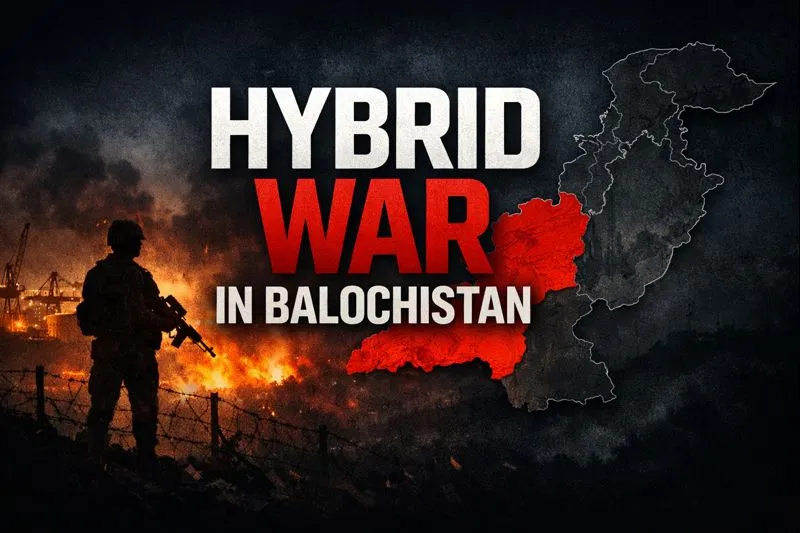

Balochistan today is not witnessing random law-and-order disturbances; it is enduring a sustained, low-intensity insurgency designed to bleed the Pakistani state politically, psychologically, and strategically. From Quetta and Mastung to Noshki, Dalbandin, Kalat, Pasni, Gwadar, Tump, and Balicha, militant activity has evolved into a pattern rather than isolated incidents. Despite periodic successes by law-enforcement agencies, the core insurgent infrastructure remains intact, adaptive, and emboldened.
At the center of this challenge stands the Balochistan Liberation Army (Balochistan Liberation Army) — not as a conventional fighting force, but as a proxy instrument in a wider regional hybrid war.
The Operational Reality on Ground
The geographic spread of militant activity reveals a calculated strategy. The western districts such as Noshki and Dalbandin offer proximity to porous borders; the central belt including Kalat and Mastung represents historic insurgent strongholds; and the southern coastal arc — Pasni and Gwadar — targets Pakistan’s economic future.
These areas form a strategic crescent, enabling insurgents to:
•Strike infrastructure and security forces
•Disrupt communication and logistics
•Intimidate local populations into silence
•Generate international headlines disproportionate to their actual strength
Security forces have neutralized several militants in intelligence-based operations. However, kinetic success does not translate into strategic victory. Small, compartmentalized cells regenerate rapidly, replacing eliminated operatives with new recruits drawn not from ideology alone, but from grievance, coercion, and external funding.
This is not a war of territory; it is a war of perception and persistence.
Understanding the Nature of the BLA Threat
The Balochistan Liberation Army is not attempting to militarily defeat Pakistan. It lacks the manpower, logistics, and popular support to do so. Instead, its objectives are narrower and more dangerous:
1.Sustain instability, not win control
2.Challenge the writ of the state symbolically
3.Internationalize the “Baloch issue”
4.Provoke heavy-handed responses to fuel alienation
In modern insurgency doctrine, survival itself is success. Each attack, no matter how limited, reinforces the narrative that the state is unable to govern its largest province.
India’s Role: Proxy War, Not Direct Conflict
The question of Indian involvement is often reduced to propaganda debates. In reality, India’s role is indirect, deniable, and strategically calculated.
The involvement of Research and Analysis Wing (Research and Analysis Wing) does not manifest through uniformed operatives or overt command structures. Instead, it operates through:
•Financial facilitation of insurgent networks
•Use of regional transit routes via Afghanistan and Iran (historically)
•Media amplification of separatist narratives
•Political lobbying to internationalize internal unrest
•Safe havens and logistical assistance to dissident elements abroad
India does not seek an independent Balochistan — that is neither realistic nor necessary. Its actual objectives are strategic:
•Disrupt the China-Pakistan Economic Corridor (China–Pakistan Economic Corridor)
•Undermine the viability of Gwadar as a regional trade hub
•Tie down Pakistani security forces internally
•Apply psychological pressure on Pakistan’s political system
This is classic cost-effective proxy warfare, allowing India to exert pressure without triggering conventional escalation.
Why the State Response Appears Ineffective
Public frustration stems from a visible disconnect between the scale of the problem and the seriousness of the response. The Pakistani state continues to treat Balochistan as a law-and-order issue, rather than a hybrid warfare theatre.
Several structural flaws persist:
Fragmented Strategy
There is no unified national framework integrating security, intelligence, governance, and diplomacy. Governments change, policies reset, but insurgents remain constant.
Episodic Security Operations
Operations are reactive rather than sustained. Area clearance is achieved temporarily, only to be vacated and re-infiltrated.
Development Without Security Sequencing
Economic packages are announced without first establishing long-term security dominance, rendering investments vulnerable and ineffective.
Weak Narrative and Diplomatic Response
Pakistan has failed to consistently expose India’s proxy war at international forums, allowing hostile narratives to dominate external discourse.
As a result, the state appears present — but not assertive; active — but not decisive.
Strategic Impact on Pakistan
The consequences of prolonged instability extend far beyond Balochistan.
Immediate Effects
•Investor hesitation and project delays
•Fatigue within security forces
•Suppression of local civilian voices
•Media self-censorship and information gaps
Long-Term Risks
•Alienation of politically neutral Baloch youth
•Normalization of separatist narratives abroad
•Strategic vulnerability of CPEC timelines
•Gradual internationalization of an internal security issue
Left unmanaged, this conflict risks transforming from a controllable insurgency into a permanent pressure point on Pakistan’s national cohesion.
What a Serious Policy Would Require
A credible state response would need to abandon cosmetic measures and adopt a multi-domain strategy.
Security First
•Persistent area dominance, not search-and-withdraw operations
•Intelligence-led targeting of facilitators and financiers
•Border intelligence coordination to disrupt cross-border logistics
Narrative Warfare
•Proactive exposure of Indian proxy involvement
•Digital counter-propaganda capabilities
•Protection of civilians from both militant coercion and excesses
Political and Governance Ownership
•Empowered local governance, not symbolic representation
•Tribal engagement based on inclusion, not transactional appeasement
•Fast, visible justice delivery to restore public confidence
Diplomatic Assertion
•Sustained raising of proxy warfare at international forums
•Linking regional instability to external interference
•Forcing adversaries into diplomatic defensiveness
Conclusion: A War That Cannot Be Ignored
Balochistan is not collapsing — but it is being kept deliberately unstable. The insurgency thrives not on strength, but on inconsistency in state response. Eliminating militants without dismantling networks, countering violence without countering narratives, and promising development without guaranteeing security will not resolve the crisis.
This is not merely a provincial issue; it is a test of Pakistan’s ability to recognize and respond to modern hybrid warfare.
Ignoring that reality will only prolong the conflict — and raise its eventual cost.