
The current confrontation between the United States, Israel, and Iran has rapidly evolved into one of the most dangerous geopolitical crises in recent years. While extensive air strikes and retaliatory attacks dominate headlines, the broader dynamics of the conflict suggest a far more complex strategic struggle unfolding beneath the surface.
At its core, this confrontation appears less like a traditional full-scale war and more like a prolonged strategic conflict in which each side is testing the other’s endurance, political will, and economic resilience.
From the beginning of the escalation, the United States and Israel relied heavily on air power, targeting Iranian military installations and strategic infrastructure. The expectation among some policymakers appeared to be that sustained pressure might weaken Iran’s leadership structure or trigger internal political instability.
However, Iran’s response suggests a very different strategic outlook. Instead of seeking a rapid decisive victory, Tehran appears to be pursuing a strategy designed to prolong the confrontation and increase the cost of the conflict over time.
This approach reflects a classic principle of asymmetric warfare: when facing a militarily superior adversary, victory does not necessarily require defeating that adversary on the battlefield. Instead, success may come from gradually exhausting the opponent’s political, economic, and strategic capacity to sustain the conflict.
Why Iran May Prefer a Prolonged Conflict
At first glance, the idea that Iran might deliberately avoid a quick resolution may seem counterintuitive. Yet when examined through a strategic lens, prolonging the conflict could serve several important objectives.
First, extending the duration of the conflict increases the economic burden on the United States and its allies. Sustained military operations, missile defense deployments, and naval patrols require enormous financial resources.
Second, prolonged instability in the Gulf places pressure on global energy markets. As oil prices fluctuate and shipping routes become uncertain, governments around the world begin to feel the economic consequences of the crisis.
Third, time can gradually strain coalition politics. While Washington may initially receive diplomatic support from allies, prolonged conflicts often expose divisions within alliances, particularly when national economic interests become affected.
In such an environment, Iran does not necessarily need to defeat the United States militarily. Instead, its objective may be to transform the conflict into a prolonged strategic burden for its opponents.
The Economics of Asymmetric Warfare
Another important factor shaping the conflict is the imbalance in the cost of military systems being used.
Iran has relied heavily on relatively inexpensive drones and missile systems, while the defensive systems used to intercept these threats are significantly more expensive.
A drone costing tens of thousands of dollars can force the launch of interceptor missiles costing millions. Over time, this imbalance creates a dynamic where the defender spends far more resources than the attacker.
Such tactics are increasingly common in modern conflicts and form a key component of Iran’s broader asymmetric strategy.
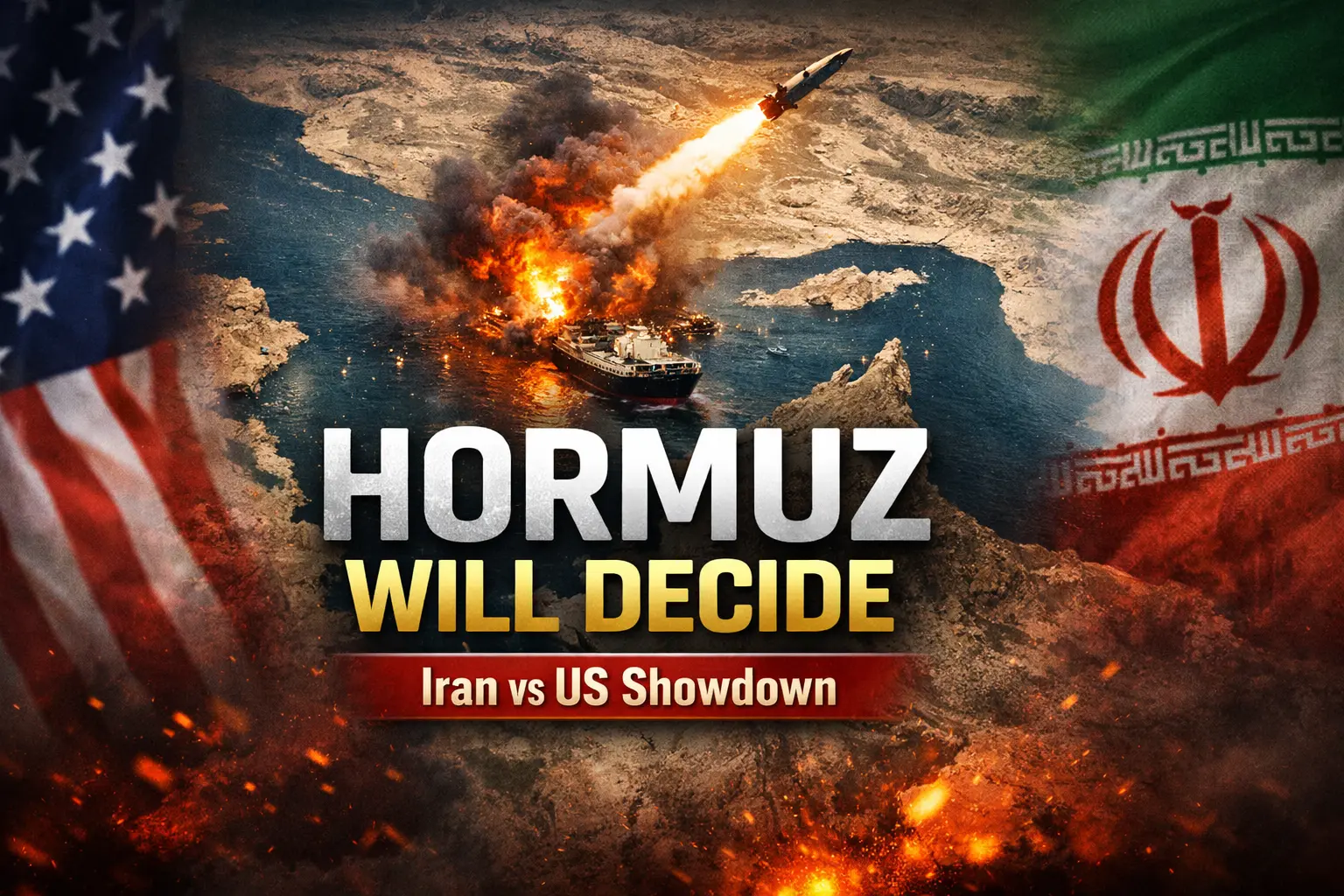
The Strait of Hormuz: The True Center of Gravity of the Conflict
In modern military theory, strategists often refer to the concept of a “center of gravity” — the point where pressure can produce the greatest strategic effect.
In the current Gulf confrontation, that center of gravity is not a city, a military base, or even a leadership structure. It is a narrow maritime corridor known as the Strait of Hormuz.
This waterway, located between Iran and Oman, carries roughly one-fifth of the world’s oil supply, making it one of the most strategically important energy chokepoints on the planet.
Every day, millions of barrels of crude oil and liquefied natural gas pass through this corridor to markets across Asia, Europe, and beyond. Any disruption to this flow has immediate consequences for global energy prices and economic stability.
For Iran, geography provides a natural strategic advantage. Its coastline runs along the northern edge of the strait, allowing Tehran to monitor and potentially threaten shipping traffic through a combination of coastal missile systems, drones, fast naval craft, and maritime surveillance assets.
This allows Iran to exert pressure without needing to directly challenge the overwhelming naval superiority of the United States Navy.
Instead, Tehran relies on asymmetric maritime tactics, using geography and lower-cost systems to create uncertainty and risk for global shipping.
Even limited disruption to tanker traffic can send shockwaves through energy markets, driving up oil prices and increasing economic pressure on governments around the world.
In this way, the Strait of Hormuz becomes far more than a shipping lane. It becomes the strategic lever capable of transforming a regional military confrontation into a global economic issue.
Alliance Hesitation and Strategic Uncertainty
Another notable feature of the conflict has been the cautious approach taken by many U.S. allies.
While several countries have expressed political support for maintaining stability in the Gulf, fewer have shown willingness to directly participate in military operations or naval missions in the region.
This hesitation reflects concerns about escalation, economic vulnerability to energy disruptions, and the long-term consequences of becoming directly involved in another Middle Eastern conflict.
Such caution does not necessarily indicate diplomatic isolation for Washington, but it does highlight the complexities of building a broad international coalition for prolonged military engagement.
Conclusion
The unfolding confrontation in the Gulf illustrates how modern conflicts are rarely decided by military power alone. Air strikes, missile exchanges, and naval deployments may dominate the immediate battlefield, but the true struggle often unfolds across a wider strategic landscape that includes economics, diplomacy, alliance cohesion, and global perception.
In this crisis, the United States and Israel possess overwhelming conventional military superiority. Yet Iran’s response suggests a deliberate strategy built on endurance, asymmetric pressure, and the exploitation of geopolitical vulnerabilities — particularly the global dependence on energy flows through the Gulf.
By leveraging geography, low-cost weapons systems, and the strategic importance of the Strait of Hormuz, Tehran appears to be attempting to shift the conflict away from a purely military contest and toward a prolonged geopolitical confrontation where time, economic pressure, and international political dynamics play a decisive role.
For Washington and its allies, the challenge is equally complex. Sustaining military pressure while maintaining international coalition support and stabilizing global energy markets requires careful strategic balance. Any prolonged disruption to Gulf energy supplies risks widening the conflict’s economic impact far beyond the region itself.
Ultimately, the trajectory of this crisis may not be determined solely by the number of strikes launched or defenses deployed, but by which side can better manage the broader strategic environment surrounding the conflict.
In that sense, the Gulf confrontation has become more than a regional security crisis. It is a test of endurance in which military action, economic stability, and geopolitical influence intersect — and where the narrow waters of the Strait of Hormuz may prove to be the pivot on which the entire conflict turns.