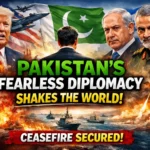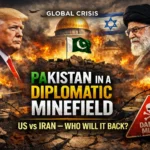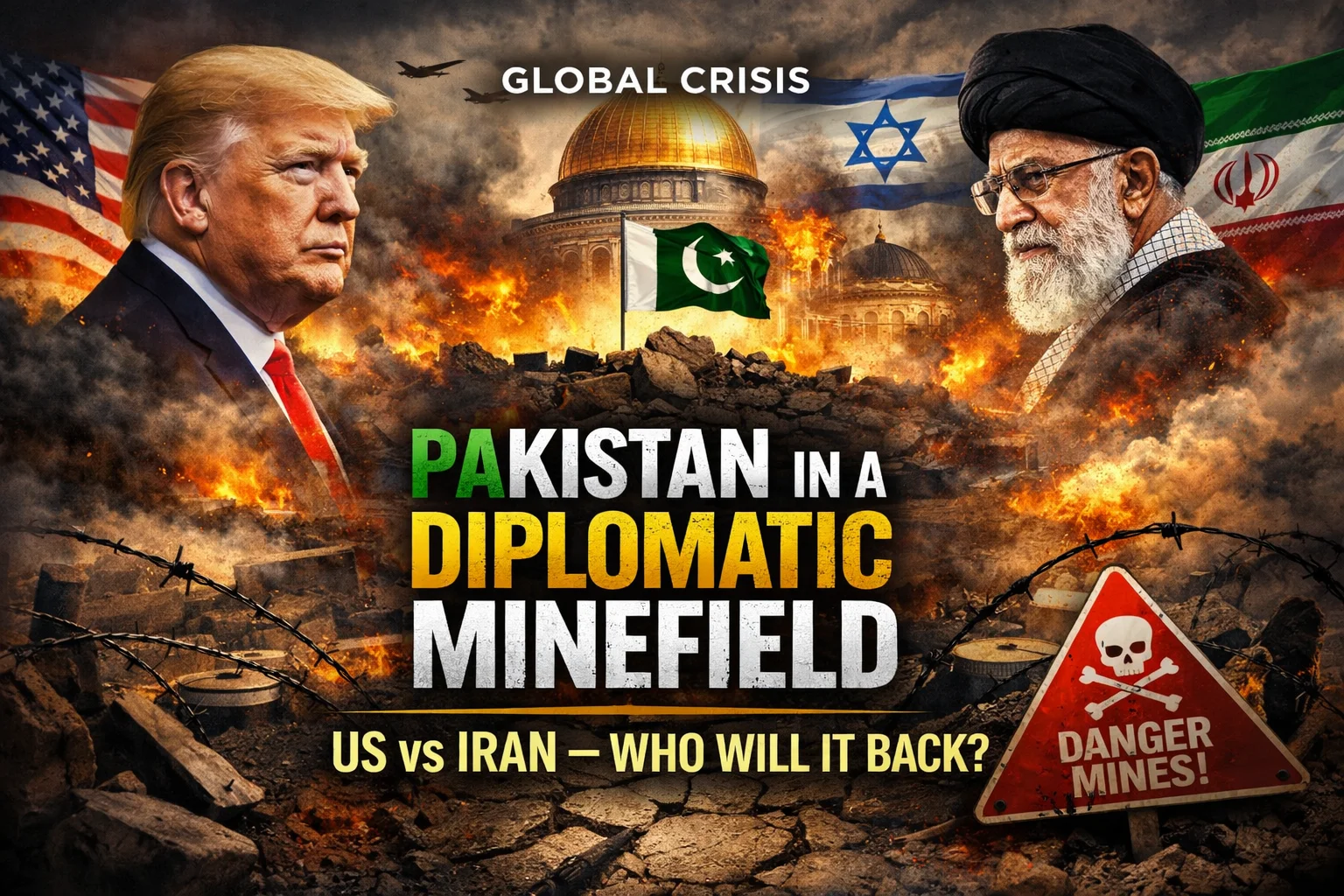

Pakistan is no longer a distant observer of the Middle East crisis. It is stepping into one of the most volatile geopolitical environments of the modern era a space where diplomacy is not conducted on stable ground, but across a field of competing interests, historical mistrust, and active military confrontation.
This is not conventional diplomacy. It is high-risk strategic maneuvering, where a single miscalculation can trigger consequences far beyond Pakistan’s immediate control.
In attempting to mediate between the United States, Iran, and Israel—alongside Turkey and Egypt—Pakistan is effectively operating in a diplomatic minefield, where neutrality is fragile and outcomes are uncertain.
Why Pakistan Stepped In
Pakistan’s involvement is not driven by ambition alone; it is rooted in strategic necessity.
First, the economic dimension is unavoidable. Any escalation in the Gulf directly threatens global energy flows. For a country like Pakistan—heavily dependent on imported oil—prolonged conflict translates into inflationary shocks, balance-of-payment stress, and internal economic instability. Diplomacy, in this sense, becomes an extension of economic security.
Second, the western border factor cannot be ignored. Iran is not a distant actor—it is a neighbor with shared security sensitivities. Instability within Iran, or a direct confrontation involving it, risks spillover effects into Pakistan’s border regions, complicating an already delicate internal security environment.
Third, Pakistan’s deep-rooted connections with Gulf states—particularly through labor exports and remittances—mean that any regional disruption carries direct socio-economic consequences. Millions of Pakistani families are indirectly tied to Gulf stability.
This is why Pakistan’s role is not optional diplomacy.
It is preventive statecraft aimed at safeguarding national stability.
Pakistan’s Unique Strategic Position — A Multi-Vector Diplomatic Actor
What makes Pakistan relevant in this crisis is not power projection, but connectivity across rival blocs.
Pakistan maintains functional relations with:
•The United States, despite periodic tensions
•Iran, based on geography and pragmatic engagement
•Gulf states, particularly Saudi Arabia and the UAE
•The broader Muslim world, where it retains symbolic credibility
This creates a rare strategic profile: a state capable of engaging mutually hostile actors without being immediately rejected by any one side.
This is best understood as:
Pakistan functioning as a Multi-Vector Diplomatic Actor—a state that navigates multiple power centers simultaneously without formal alignment.
However, this position is not inherently stable. It demands constant calibration, because engaging all sides also means risking suspicion from all sides.
The Turkey–Egypt–Pakistan Axis — Convergence Without Alignment
The emerging coordination between Turkey, Egypt, and Pakistan is not an alliance in the traditional sense. It is a situational convergence driven by overlapping interests.
•Turkey brings a hybrid identity: a NATO member with independent regional ambitions and open channels with Iran.
•Egypt contributes historical diplomatic weight and Arab-world legitimacy.
•Pakistan provides connective reach across Gulf monarchies, Iran, and Western stakeholders.
Together, they form a flexible diplomatic platform rather than a rigid bloc.
Yet, beneath this cooperation lie differing priorities:
•Turkey seeks regional leadership and strategic autonomy
•Egypt prioritizes stability and regime security
•Pakistan aims for balance and international relevance
This means coordination is possible—but strategic cohesion is limited.
⚠️ Operating in a Diplomatic Minefield
This is the core reality Pakistan faces.
A. Conflicting Strategic Objectives
The fundamental problem is structural:
•The United States seeks to contain Iran’s regional influence
•Israel aims to neutralize perceived existential threats from Iran
•Iran seeks regime survival and strategic depth across the region
These are not negotiable preferences—they are core security doctrines.
This makes the conflict resistant to traditional mediation, because there is no fully overlapping zone of agreement.
B. The Trust Deficit Crisis
Diplomacy relies on trust. This conflict is defined by its absence.
•Previous agreements have collapsed or been abandoned
•Proxy conflicts have deepened suspicion
•Strategic signaling is often interpreted as deception
In such an environment, even genuine diplomatic efforts are viewed through a lens of skepticism.
Pakistan, therefore, is not just bridging interests—it is attempting to operate in a trust vacuum, where credibility is constantly questioned.
C. The Risk of Strategic Backlash
Balancing multiple adversaries creates exposure.
•A perceived tilt toward the United States risks alienating Iran
•Engagement with Iran may trigger unease in Washington or Gulf capitals
•Neutral positioning may be interpreted as indecision or weakness
In this environment:
Neutrality itself becomes a liability.
Pakistan must continuously signal balance without appearing ambiguous—a task that is strategically exhausting and politically sensitive.
Can Pakistan Create a Win-Win Outcome?
The idea of a “win-win” solution, while appealing, is structurally unrealistic in this conflict.
The objectives of the primary actors are not fully compatible. Any resolution will involve compromise, not victory.
This shifts the role of mediation from conflict resolution to:
Managed De-escalation Strategy
In practical terms, this means:
•Reducing immediate hostilities
•Creating communication channels
•Preventing escalation into full-scale war
Pakistan’s role is not to solve the conflict—it is to prevent it from spiraling beyond control.
Strategic Outcomes — Three Possible Scenarios
1. Controlled De-escalation
If diplomatic efforts succeed:
•Tensions reduce
•Communication channels stabilize
•Pakistan gains recognition as a credible mediator
This would elevate Pakistan’s status as a functional middle power in global diplomacy.
2. Prolonged Strategic Stalemate
More likely is a drawn-out situation:
•No decisive resolution
•Periodic escalation and de-escalation
•Continuous diplomatic engagement
In this scenario, Pakistan remains relevant but under constant pressure to maintain balance.
3. Escalation and Polarization
Worst-case scenario:
•Conflict expands
•Regional blocs harden
•Pakistan is forced to take a clearer side
This would undermine its multi-vector diplomacy and expose it to strategic costs on multiple fronts.
Final Strategic Assessment
Pakistan’s current diplomatic posture reflects a shift from reactive policy to proactive strategic engagement.
However, this engagement comes with inherent risk.
Pakistan is not attempting to win this conflict—it lacks both the leverage and the mandate to do so. Instead, it is trying to prevent a wider regional collapse that would directly impact its own stability.
In a region shaped by rivalry, mistrust, and competing power ambitions, diplomacy is no longer about ideal outcomes.
It is about managing risks, delaying escalation, and navigating uncertainty.
And in that context:
Pakistan is not walking a path of peace it is navigating a diplomatic minefield, where survival depends not on bold moves, but on precise and calculated steps.