
Every few years, Pakistan announces the same reform: government officers will now declare their assets publicly. This time, the move is tied to conditions set by the International Monetary Fund (IMF), and once again it is being presented as a major step toward transparency.
But honesty requires clarity. Asset declaration, by itself, does not stop corruption. It never has.
Pakistan does not suffer from a shortage of forms or declarations. It suffers from a lack of enforcement.
We Already Declare Assets — Corruption Still Thrives
Politicians, civil servants, and judges in Pakistan already submit asset details. These records exist. Yet corruption continues openly because the system rarely asks the most basic follow-up question: Where did the money come from?
When an officer earning a fixed government salary owns luxury houses, high-end vehicles, or foreign properties, the issue is not disclosure — it is explanation. And explanations are seldom demanded, let alone tested.
Officers Fear Law, Not Paperwork
If asset declarations were actually verified and enforced, they would create real pressure. Officers would think twice before accepting bribes, knowing their lifestyle could expose them.
But without consequences, the system will adapt in predictable ways. Assets will move to spouses, children, or trusted proxies. Property values will be understated. Bank trails will be obscured. Corruption will not disappear — it will simply become more careful.
Pakistan has seen this pattern before. When rules are weak, corruption learns how to survive within them.
Disclosure Without Punishment Changes Nothing
No country has reduced corruption through disclosure alone. It works only when directly linked to punishment.
If an officer cannot justify assets beyond known income through proper documentation, the law must respond. That means suspension, dismissal, confiscation of illegal wealth, and prison where warranted. Without real consequences, disclosure becomes a formality — something to file, not something to fear.
Corruption is controlled not by intention, but by certainty of punishment.
Declarations Must Be Based on Proof, Not Trust
Allowing officers to simply “declare” assets without supporting documents defeats the purpose of transparency. Anyone can write figures on a form.
A credible system requires evidence: property deeds, bank records, tax returns, and documented inheritance where claimed. Assets without proof should not be accepted. Transparency without verification is guesswork, not governance.
Verification Is the Real Reform
The heart of any serious anti-corruption effort is independent verification. Without it, disclosure is theatre.
An effective system must cross-check declared assets with bank records, land registries, vehicle data, and tax filings. Sudden jumps in wealth should trigger automatic scrutiny. If verification is selective or politically influenced, the reform collapses instantly.
Benami Assets Will Kill This Reform If Ignored
In Pakistan, corrupt wealth rarely sits in the officer’s own name. It sits in the names of spouses, children, or close associates. Any system that ignores this reality is pretending to fight corruption while protecting it.
If an officer controls or benefits from an asset registered in a relative’s name — and that relative lacks independent income — the law must presume benami ownership and act accordingly. Without this, asset declaration becomes a loophole, not a safeguard.
IMF Pressure Is Not the Same as Political Will
The IMF seeks fiscal transparency to protect its loans, not to reform Pakistan’s governance culture. Once financial targets are met and tranches released, history suggests enforcement weakens and urgency fades.
Real reform requires internal resolve. It requires applying the same rules to senior civil servants, judges, generals, and politicians — not just to those without influence. Selective accountability destroys public trust faster than corruption itself.
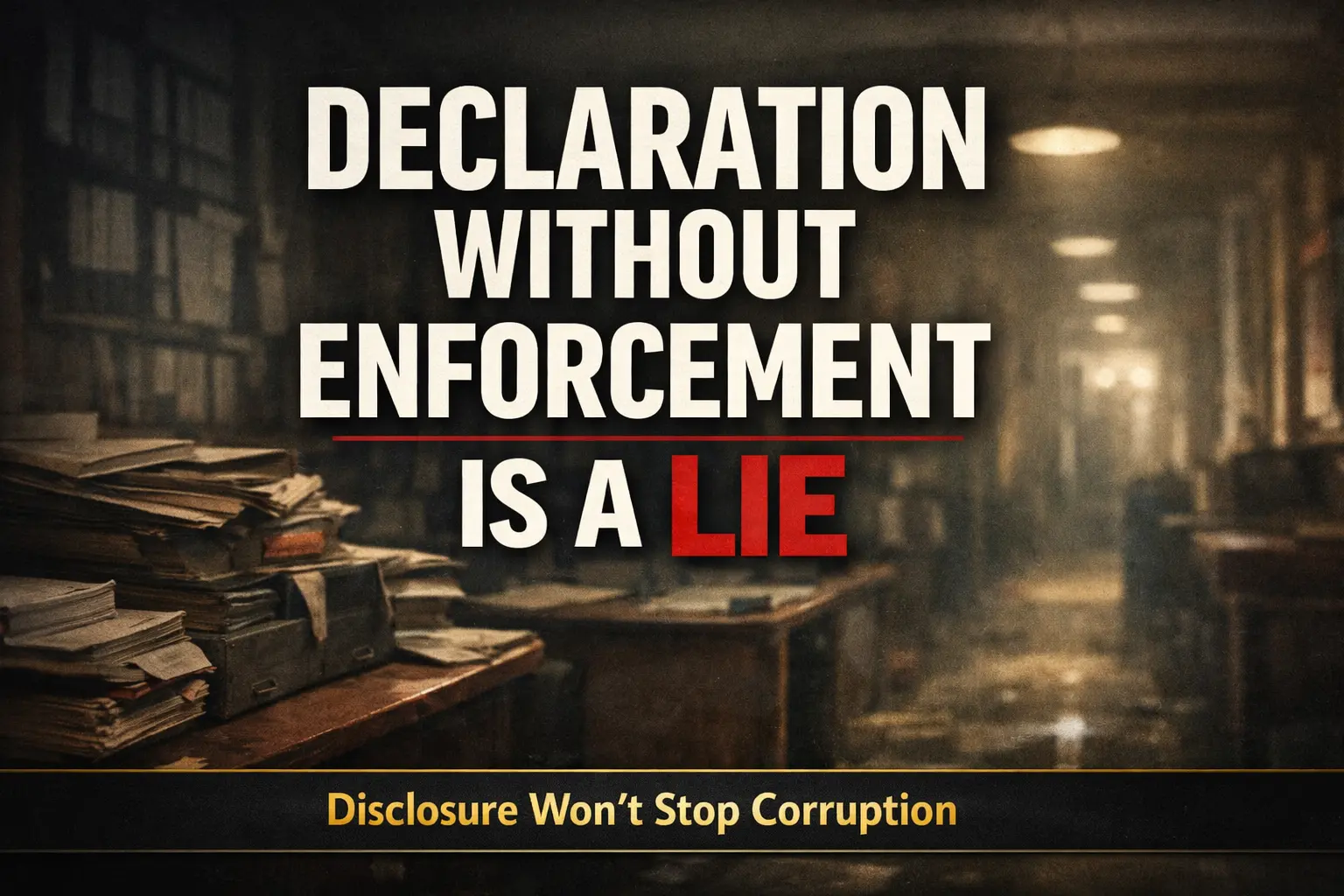
Declaration Without Enforcement Is a Lie We Keep Telling Ourselves
Pakistan’s corruption problem does not exist because assets are undeclared. It exists because illegal wealth is rarely questioned and almost never punished. Asset declaration without verification and consequences is not reform — it is performance.
The corrupt are not afraid of forms. They are afraid of prison, confiscation, and permanent loss of power. Until those outcomes become certain, disclosure will change nothing.
If unexplained wealth remains protected by influence, proxies, and silence, asset declaration will only make corruption smarter. Transparency without enforcement does not deter crime; it legitimizes it.
Real reform begins the day illegal wealth becomes unsafe to hold and impossible to hide. Until then, asset declaration will remain what it has always been in Pakistan — a comforting lie dressed up as accountability.