
I. Introduction — A Quiet Economic Earthquake
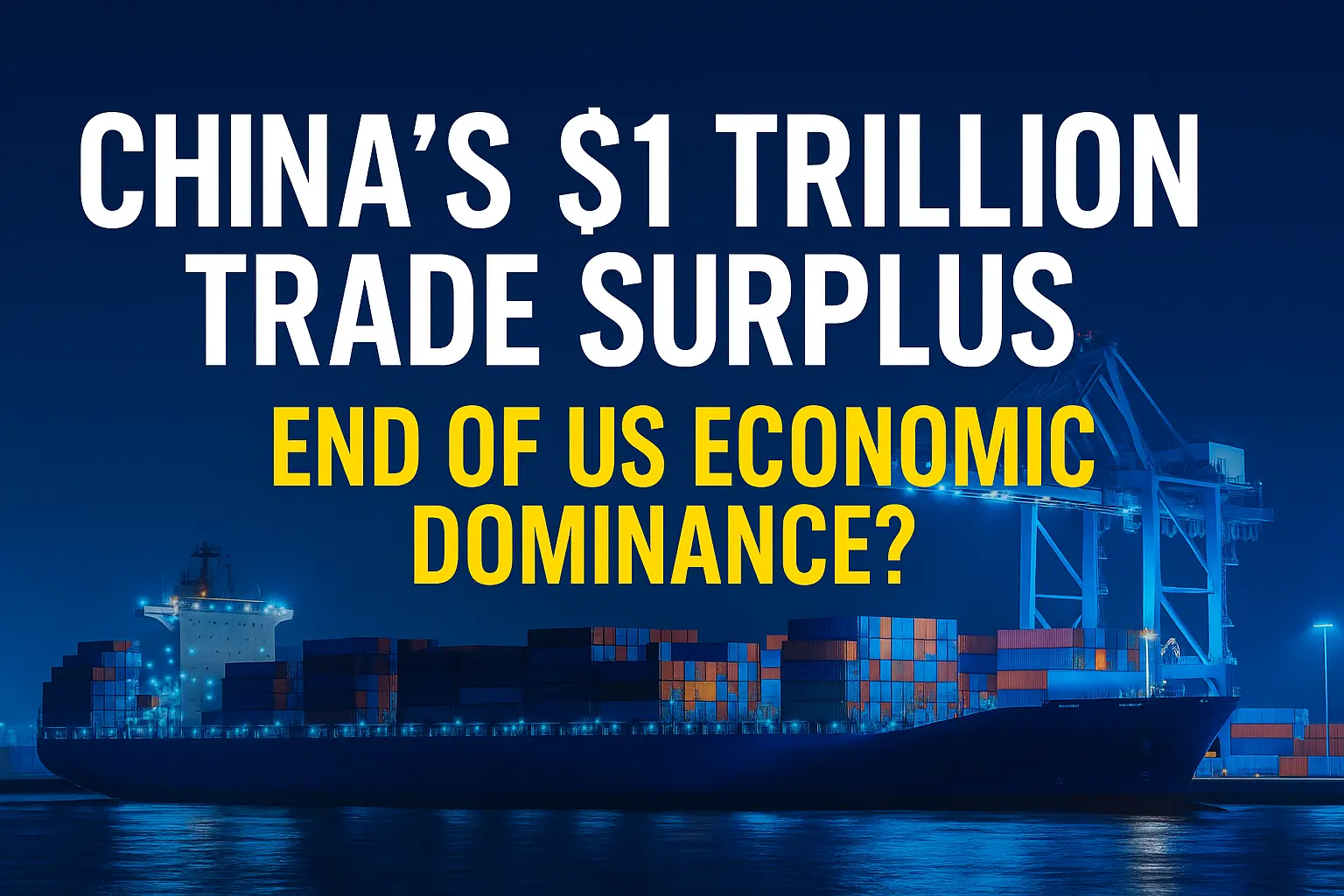
China crossing a $1 trillion trade surplus mark is more than a headline-grabbing economic statistic. It represents a deeper transformation underway in China’s global trade position and, by extension, the structure of the international economy. What makes this development particularly significant is that this surge is no longer driven primarily by the United States (US). Instead, non-US markets are now the main engine of China’s export growth.
For decades, the US consumer market anchored China’s export-led rise, giving Washington confidence that trade pressure could restrain Beijing’s economic ambitions. That assumption is now under strain. China’s trade surplus growth reflects a deliberate shift away from US-centric trade, pointing toward a broader realignment in global economic power.
II. Understanding the Trade Surplus Shift
A trade surplus occurs when a country exports more than it imports. While China has long maintained a surplus, its current scale and structure are unprecedented. Historically, US–China trade relations formed the backbone of China’s export economy. Today, that dependency has weakened.
China’s exports to ASEAN, the Middle East, Africa, Latin America, and Europe have expanded rapidly, while the US share of China’s total exports continues to decline. This change is not accidental. It reflects a strategic redirection of China’s global supply chains, trade diplomacy, and industrial planning toward markets less exposed to US political pressure.
III. Drivers Behind Non-US Growth
1. Strategic Export Diversification
At the core of this transformation lies China’s export diversification strategy. Beijing systematically expanded trade ties with the Global South, offering competitive pricing, long-term financing, and infrastructure-backed partnerships. As a result, China Global South trade has become one of the strongest pillars of its external economic engagement.
In regions such as Africa, ASEAN, and the Middle East, Chinese goods are not merely imports — they are integral to development plans, energy projects, and industrial expansion.
2. Manufacturing Scale and Cost Dominance
China’s manufacturing dominance remains unmatched. Its ability to control entire production chains — from raw materials to finished products — allows Chinese exporters to maintain cost advantages even amid rising wages.
This structural strength enables China to outperform competitors in price-sensitive global markets, reinforcing its role as the central node of global manufacturing and trade.
3. Technology-Heavy Exports
China’s surplus growth is increasingly driven by advanced sectors:
•China electric vehicle exports
•China battery manufacturing
•China solar panel exports
•China industrial machinery exports
These sectors sit at the heart of global energy transition and infrastructure modernization. As demand for affordable green technology grows worldwide, China’s green technology exports have become a decisive factor in its expanding trade surplus.
IV. The Failure of US-Led Economic Containment
US efforts at economic containment of China, including tariffs and sanctions, were designed to constrain Beijing’s export capacity. Instead, they accelerated China’s trade realignment.
Trade restrictions forced Chinese firms to diversify markets, localize supply chains, and invest in technological self-reliance. Rather than isolating China, these measures reduced US leverage while strengthening China’s non-US export markets.
In practice, China economic decoupling occurred selectively — not through isolation, but through strategic expansion elsewhere.
V. Europe’s Emerging Dilemma
Europe now finds itself absorbing a growing share of China’s export surplus. While consumers benefit from lower prices, China–Europe trade imbalance has placed European industries under severe strain.
Sectors linked to electric vehicles, renewable energy, and heavy industry face intense competition. In response, European governments are exploring:
•Anti-dumping investigations
•Green-technology tariffs
•Regulatory barriers framed as strategic or environmental safeguards
Yet Europe lacks the economic insulation to fully disengage from China global trade without risking inflation and industrial disruption.
VI. Exporting Deflation: A Global Shockwave
China’s massive export volumes are effectively exporting deflation — pushing down prices worldwide. For consumers, this offers relief. For producers, it presents existential challenges.
In developed economies, domestic manufacturing competitiveness erodes. In developing countries, cheaper imports support affordability but weaken local industry. This dynamic is reshaping industrial policy debates across the globe and reinforcing China’s central role in global supply chains.
VII. The Rise of a Parallel Trade Order
Beyond trade volumes, China is constructing a parallel global trade system. Initiatives such as the Belt and Road Initiative (BRI) and the Regional Comprehensive Economic Partnership (RCEP) reduce dependence on Western-dominated trade and financial mechanisms.
The expansion of yuan-based settlements and regional trade frameworks signals a gradual shift toward a multipolar global economy, where no single power monopolizes economic influence.
VIII. Implications for Pakistan and Similar Economies
Opportunities
For countries like Pakistan, deeper integration into China Pakistan trade relations offers:
•Access to affordable capital goods
•Energy and infrastructure development
•Industrial inputs critical for growth
Projects under the China–Pakistan Economic Corridor (CPEC) benefit directly from China’s export capacity.
Risks
However, persistent trade imbalances and industrial dependence remain serious risks. Without targeted industrial policy and skills development, local manufacturing can be crowded out by Chinese imports. The challenge lies in converting trade access into sustainable domestic growth.
IX. Strategic Consequences for Global Power Balance
Economic power underpins geopolitical influence. A China less dependent on US markets is more resistant to coercion and more confident in shaping international norms.
As China economic power expands, the global system continues its shift away from a US-dominated framework toward a multipolar trade and power structure. For Washington, policy options narrow. For the rest of the world, strategic hedging becomes the norm.
X. Conclusion — Beyond a Trillion Dollars
China’s $1 trillion trade surplus is not a temporary spike or statistical anomaly. It reflects long-term structural changes in China’s trade strategy, manufacturing capacity, and global engagement.
The broader message is unmistakable:
Global trade is no longer organized primarily around the United States.
As economic gravity shifts, geopolitical influence follows. In that evolving order, China has positioned itself not just as the world’s factory, but as a central pillar of the emerging global trade system.