
Introduction: Why the H-20 Matters—Even Before It Appears
Much has been written about China’s missiles, its navy, and its rapidly expanding fighter force. Far less attention has been paid to what may ultimately prove more consequential: China’s effort to field a true strategic stealth bomber. The H-20, still unseen and officially unrevealed, is often discussed as a future platform something to be evaluated once photographs, specifications, and flight data emerge. That approach misses the point.
The significance of the H-20 lies less in what is publicly known about it and more in why China is building it at all. Strategic bombers are not vanity projects. They are expensive, complex, and operationally demanding. States pursue them only when they intend to change how they think about deterrence, reach, and escalation. In that sense, the H-20 is best understood not as an aircraft program, but as a marker of China’s evolving strategic self-image.
Comparisons with the U.S. B-21 Raider are inevitable, but they are secondary. The more important question is what the H-20 reveals about how Beijing now views the regional balance of power—and its own role within it.

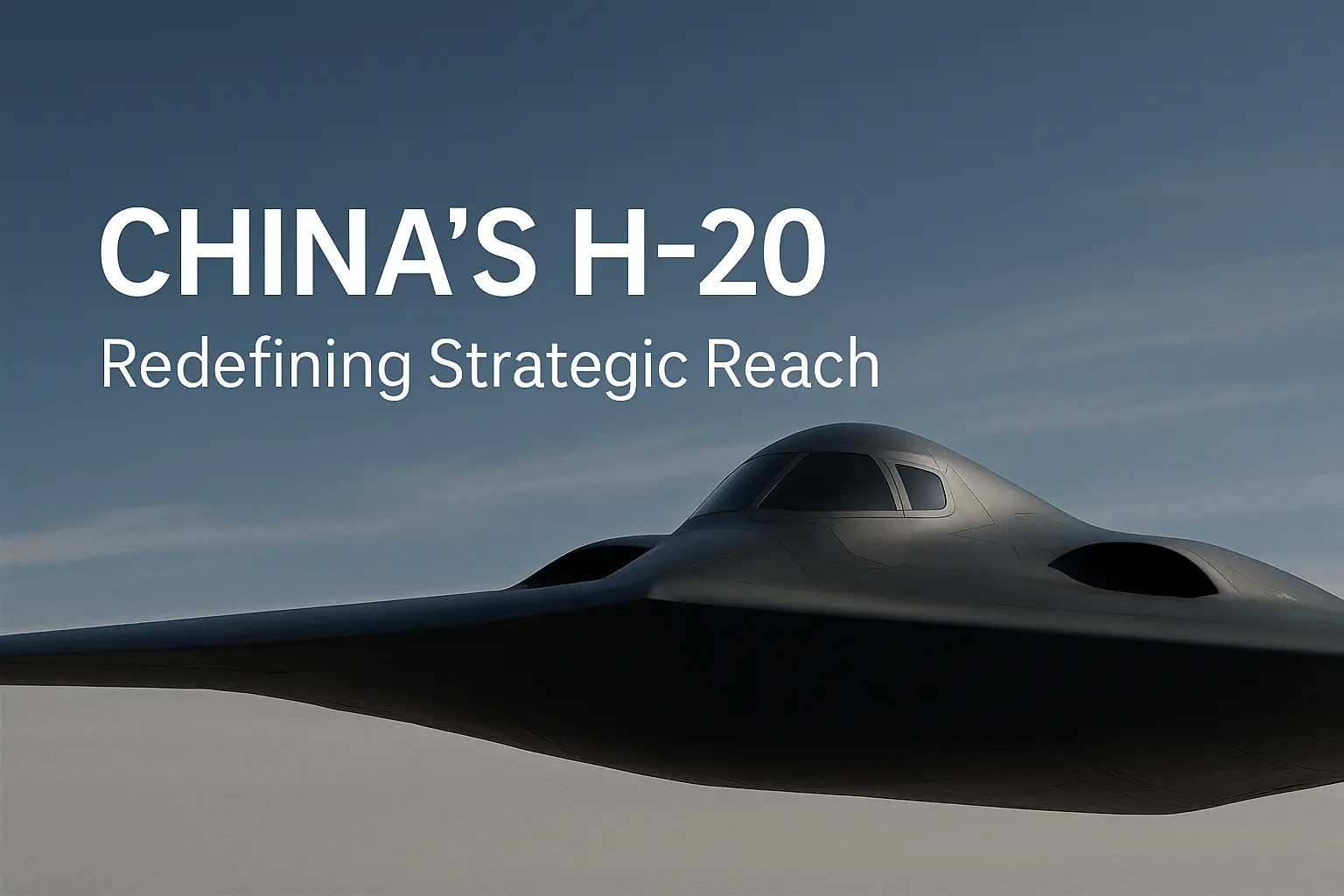
Place after the introduction to visually establish secrecy and strategic intent.
China’s Bomber Gap and the Strategic Logic Behind the H-20
For decades, China’s long-range airpower rested on a narrow foundation. The H-6 bomber fleet, itself derived from a 1950s Soviet design, has been continuously upgraded and adapted, but it was never meant to serve as a true strategic bomber in the modern sense. Its survivability depends heavily on standoff weapons, its penetration capability is limited, and its operational flexibility is constrained by range and signature.
China compensated for this gap through other means. Ballistic and cruise missiles became the backbone of its deterrence and strike posture. The navy took on a growing role in power projection. Fighters extended their reach through aerial refueling and basing strategies. Yet one element remained conspicuously underdeveloped: a survivable, recallable, long-range bomber capable of operating deep into contested airspace.
That gap matters because missiles and bombers serve different strategic purposes. Missiles are decisive but inflexible. Once launched, they cannot be recalled or signaled. Bombers, by contrast, are tools of control as much as destruction. They can loiter, demonstrate intent, adjust targets, and be withdrawn. For a rising power seeking greater influence over escalation dynamics, this flexibility is not optional—it is essential.
The H-20 is China’s attempt to acquire that missing tool.
Building Quietly: Development, Secrecy, and Strategic Intent
China publicly acknowledged the H-20 program in 2016, and since then has released almost nothing of substance. No official photographs. No confirmed flight tests. No technical specifications. This silence is often interpreted as evidence that the program is delayed or struggling. That may be partly true—but it is not the whole explanation.
Secrecy itself serves a strategic purpose. By withholding details, China denies foreign planners the ability to make confident assessments. Uncertainty forces worst-case assumptions, complicates defense planning, and amplifies the psychological impact of the platform long before it becomes operational. In effect, the H-20 already performs a strategic function without ever leaving the ground.
This approach reflects institutional learning. China has closely observed how the United States managed the B-2 Spirit and now the B-21 Raider—how limited disclosure preserves deterrent value. The H-20’s opacity suggests that Beijing is not merely copying an aircraft configuration, but adopting a strategic culture around high-end deterrence assets.

Place here to reinforce mystery while transitioning into capability discussion.
Expected Capabilities: Strategic Utility Over Performance Metrics
Because China has released no official data, discussion of the H-20’s capabilities inevitably relies on informed estimation rather than hard numbers. That uncertainty often leads to exaggerated claims at both ends of the spectrum—either portraying the aircraft as a near peer to the most advanced U.S. bombers, or dismissing it as an overambitious project likely to underperform.
The reality lies somewhere in between.
Most assessments converge on a flying-wing, subsonic design optimized for low observability rather than speed. That choice alone reveals its intended role. China is not building a bomber to dash in and out of contested airspace. It is building a platform meant to avoid detection, operate at long range, and deliver weapons from positions of relative sanctuary—or penetrate defenses selectively when required.
The aircraft is expected to rely on internal weapons bays, preserving its radar signature while carrying a mix of payloads. These likely include long-range cruise missiles, potentially hypersonic systems, and nuclear gravity weapons. In other words, the H-20 appears designed as a multi-role strategic asset, not a niche platform tied to a single mission.
What matters is not whether the H-20 matches Western stealth bombers feature for feature, but whether it can reliably hold high-value targets at risk across extended distances. If it can do that, even in limited numbers, it reshapes strategic calculations.
Completing the Nuclear Triad: Why the Air Leg Matters to Beijing
China’s nuclear deterrent has traditionally emphasized land-based missiles, with a growing sea-based component in recent years. The air leg, by contrast, remained underdeveloped. For much of its history, China prioritized assured retaliation over flexible deterrence.
The introduction of a true strategic bomber changes that equation.
Bombers are visible, controllable, and adaptable. Unlike missiles, they can be deployed as signals rather than weapons—launched, diverted, recalled, or repositioned as crises evolve. For a leadership increasingly concerned with managing escalation rather than merely surviving it, this flexibility is invaluable.
The H-20 provides China with precisely that option. It allows Beijing to demonstrate resolve without immediately crossing irreversible thresholds, adding nuance and depth to its deterrence posture.
Regional Impact: The Western Pacific as the Primary Arena
The most immediate implications of the H-20 are regional rather than global. Its development should be viewed primarily through the lens of the Western Pacific, where China’s strategic concerns are most acute and where U.S. military presence is most concentrated.
If the H-20 achieves the range and survivability widely attributed to it, it expands China’s ability to hold targets beyond the First Island Chain at risk. Forward airbases, logistics hubs, and command infrastructure that underpin U.S. and allied operations become more vulnerable—not necessarily to destruction, but to sustained pressure.
In a Taiwan contingency, the H-20’s value would lie less in direct battlefield effects and more in shaping the broader operational environment. It could threaten rear-area bases, complicate reinforcement flows, and serve as a tool of strategic intimidation rather than mass attack.
Maritime operations add another dimension. A stealth bomber capable of carrying long-range anti-ship weapons deepens China’s already dense anti-access architecture. It does not replace missiles or naval forces, but complements them—forcing adversaries to account for mobile, unpredictable threats that are difficult to track.

Place here to visually support discussion of regional reach and flexibility.
Implications for the United States—and a Limited Comparison with the B-21
From a U.S. perspective, the H-20 does not overturn the balance of power overnight. What it does is erode long-standing assumptions about sanctuary. It reinforces the need for dispersed basing, hardened infrastructure, and resilient logistics across the Indo-Pacific.
The comparison with the B-21 Raider is unavoidable but should be kept in proportion. The B-21 is already flying and embedded within a mature ecosystem of tankers, intelligence assets, and command-and-control networks. The H-20, by contrast, represents China’s first attempt at this class of capability.
That distinction matters. The challenge posed by the H-20 is not one of immediate parity, but of trajectory. It signals where China intends to go—and how patient it is willing to be in getting there.

Place once, here only, to avoid shifting focus away from the H-20.
Constraints, Unknowns, and Strategic Patience
Significant uncertainties remain. Engines, stealth materials, mission systems, crew training, and sustainment all pose challenges that cannot be solved quickly. Bombers are only effective as part of a broader system, and building that system takes time.
China appears willing to accept that timeline. The H-20 aligns with long-term modernization goals rather than short-term signaling. Its true impact will likely be felt gradually, as it moves from concept to capability and eventually to operational integration.
Conclusion: The H-20 as a Strategic Signal, Not Just a Bomber
The H-20 should not be judged by what it can do today, but by what it represents. It marks China’s entry into the realm of strategic stealth bombers—a club long dominated by the United States. More importantly, it reflects a shift in how Beijing thinks about deterrence, escalation, and long-range power projection.
For the United States and its allies, the challenge is not the aircraft itself, but the broader ecosystem China is building around it. The H-20 is less a single platform than a signal: China intends to shape the strategic environment far beyond its immediate periphery—and to do so with patience, ambiguity, and purpose.
Image Attribution & Disclaimer
All images depicting China’s H-20 bomber used in this article are AI-generated conceptual illustrations created for analytical and educational purposes. China has not released official photographs or technical specifications of the H-20 aircraft.
FAQs
Has China officially revealed the H-20?
No. China has acknowledged the program but has released no verified images or specifications.
Is the H-20 equal to the U.S. B-21?
There is no evidence of parity. The comparison is useful only as a strategic benchmark.
Does the H-20 change the balance of power immediately?
No. Its impact is gradual, shaping planning assumptions rather than outcomes.
Why is secrecy itself important?
Because uncertainty forces adversaries to plan conservatively, amplifying deterrence before the system is operational.