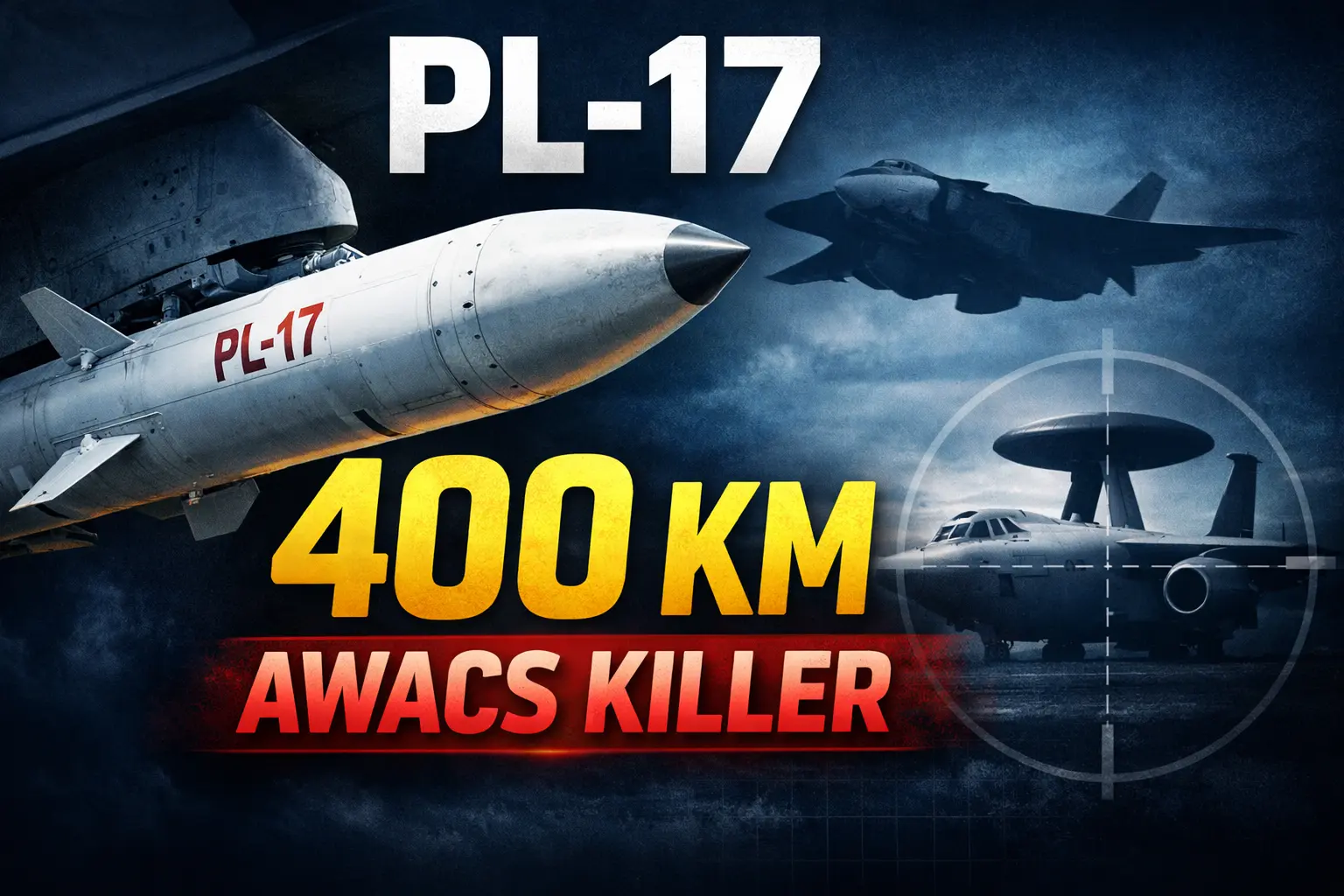

The appearance of the first clear image of China’s PL-17 ultra-long-range air-to-air missile has sent a strong signal through global defense circles. For years, the missile existed largely in speculation and scattered intelligence reports. Now, with visual confirmation in the public domain, the PL-17 is no longer just a rumored capability — it is a real and emerging element of China’s air warfare doctrine.
Believed to have a range exceeding 400 kilometers, the PL-17 represents a new class of beyond-visual-range (BVR) missile designed not for dogfights, but for dismantling the backbone of modern air power. Its emergence reflects China’s growing focus on air denial, targeting the enablers that allow advanced air forces to dominate the battlespace.
What the Newly Surfaced Image Reveals
The newly surfaced image, first shared through Chinese defense-focused social media and later picked up by international military analysts, offers the most detailed look yet at the PL-17’s design. The missile is visibly large and elongated, with estimates placing its length at around six meters, making it far bigger than conventional BVR missiles currently in widespread service.
This sheer size is not accidental. It strongly suggests a missile optimized for long-range, high-altitude engagements, where sustained energy and flight endurance matter more than compact internal carriage. Analysts believe the PL-17 likely uses a dual-pulse rocket motor, allowing it to conserve energy during midcourse flight and retain speed during the terminal phase.
The image effectively confirms what many suspected: the PL-17 is purpose-built for extreme-range aerial combat, pushing the boundaries of how air-to-air missiles are employed.
Estimated Capabilities and Guidance
Although China has not released official specifications, open-source intelligence and defense analysis point to the PL-17 being a 400-kilometer-class air-to-air missile, potentially rivaling or exceeding any operational counterpart globally.
The missile is assessed to feature a layered guidance system, likely combining:
•Inertial navigation during initial flight
•Midcourse updates via secure datalink
•Possible satellite navigation support
•An active radar seeker for terminal homing
This guidance architecture allows the missile to engage targets far beyond the radar range of the launching aircraft. In practice, this means a fighter carrying the PL-17 may never need to detect the target itself. Instead, targeting data can be supplied through networked sensors, including airborne early warning aircraft, ground-based radars, or even space-based assets.
Such capabilities align closely with China’s emphasis on network-centric warfare, where information dominance is as critical as firepower.
Intended Targets: Killing the Eyes and Lifeline of Air Power
The PL-17 is not designed to replace standard fighter-to-fighter missiles. Its true purpose lies elsewhere.
Modern air operations depend heavily on a small number of high-value airborne assets, including:
•Airborne Warning and Control Systems (AWACS)
•Aerial refueling tankers
•Intelligence, surveillance, and reconnaissance (ISR) platforms
These aircraft are essential for maintaining situational awareness, extending combat range, and coordinating air operations. Traditionally, they operate well behind the front lines, beyond the reach of enemy fighters.
The PL-17 directly challenges this long-standing assumption. With its extreme range, it enables Chinese aircraft to threaten AWACS and tankers from unprecedented distances, forcing them to operate farther from contested airspace. Even without achieving frequent kills, the missile’s presence alone can disrupt air operations, reduce radar coverage, and limit mission endurance.
In this sense, the PL-17 is as much a strategic weapon as it is a tactical one.
Which Aircraft Will Carry the PL-17?
J-20 Mighty Dragon
The J-20 stealth fighter is widely regarded as the primary platform for the PL-17. However, there is an important constraint. Due to the missile’s size, it is unlikely to fit inside the J-20’s internal weapons bay.
As a result, the PL-17 is expected to be carried externally, mounted on underwing or semi-conformal pylons. While this compromises the aircraft’s stealth profile, Chinese operational thinking appears willing to accept this trade-off for missions focused on long-range interception of high-value targets.
In such scenarios, stealth is less critical than reach, speed, and first-shot capability.
J-35 (FC-31 Derivative)
China’s upcoming J-35 fifth-generation fighter, intended for both land-based and carrier operations, is also expected to integrate the PL-17. Similar to the J-20, internal carriage remains unlikely, making external mounting the most probable configuration.
The J-35’s role as a flexible, multirole stealth platform makes it a logical candidate for PL-17 integration, particularly in air superiority or fleet defense missions.
Other Platforms
Earlier sightings and reports suggest that heavy fighters such as the J-16 may have been used for testing or evaluation. While these aircraft lack stealth, they could serve effectively as long-range missile carriers, operating under the protection of China’s integrated air defense network.
Operational Concept: How the PL-17 Would Be Used
In a combat scenario, PL-17-equipped aircraft would likely operate at high altitude and long stand-off ranges. Targeting data could be supplied by:
•KJ-series Chinese AWACS
•Ground-based long-range radars
•Space-based surveillance systems
Once launched, the missile’s extended flight profile and data-linked guidance allow it to pursue large, slow, and non-maneuverable targets such as AWACS and tankers. These aircraft lack the speed or agility to evade a missile traveling at high supersonic velocities.
Even a limited success rate could have outsized operational effects, forcing adversaries to withdraw or reposition critical airborne assets.
Strategic and Regional Implications
The PL-17 has serious implications for the future of air superiority, particularly in the Indo-Pacific region. Air forces that rely heavily on AWACS and aerial refueling now face a growing challenge: protecting assets that were once considered relatively safe.
For regional powers, including India and U.S. allies, the missile highlights a shift in air combat dynamics. Control of the air is no longer determined solely by fighter performance, but by the survivability of the entire airborne support ecosystem.
From a psychological warfare standpoint, the PL-17 also serves as a powerful signaling tool, reinforcing China’s message that it can contest air dominance through asymmetric, high-impact capabilities.
What Remains Unknown
Despite the new imagery, many questions remain unanswered:
•The missile’s exact range and speed
•The sophistication of its seeker and electronic counter-countermeasures
•Warhead size and kill probability
•Its current level of operational deployment
Future air shows, military parades, or clearer flight imagery may provide further clarity.
Conclusion
The PL-17 is more than just a new missile — it reflects a shift in how China intends to fight future air wars. By threatening the critical airborne assets that enable modern air operations, it challenges long-held assumptions about rear-area safety and air dominance.
Whether fully operational or still evolving, the message is clear: the era of uncontested air support platforms is coming to an end, and future conflicts will be shaped as much by who can protect their airborne lifelines as by who fields the most advanced fighters.