
1. The Church of England History
Early Christian Roots
Christianity reached Britain during the Roman Empire. By the third and fourth centuries, British bishops were already attending church councils.
In 597 AD, Augustine of Canterbury arrived in England on a mission sent by Pope Gregory the Great. This marked the formal beginning of what later became the Church of England.
For nearly 1,000 years, the English Church was fully Roman Catholic and accepted the authority of the Pope.
The English Reformation
The major turning point came in the sixteenth century.
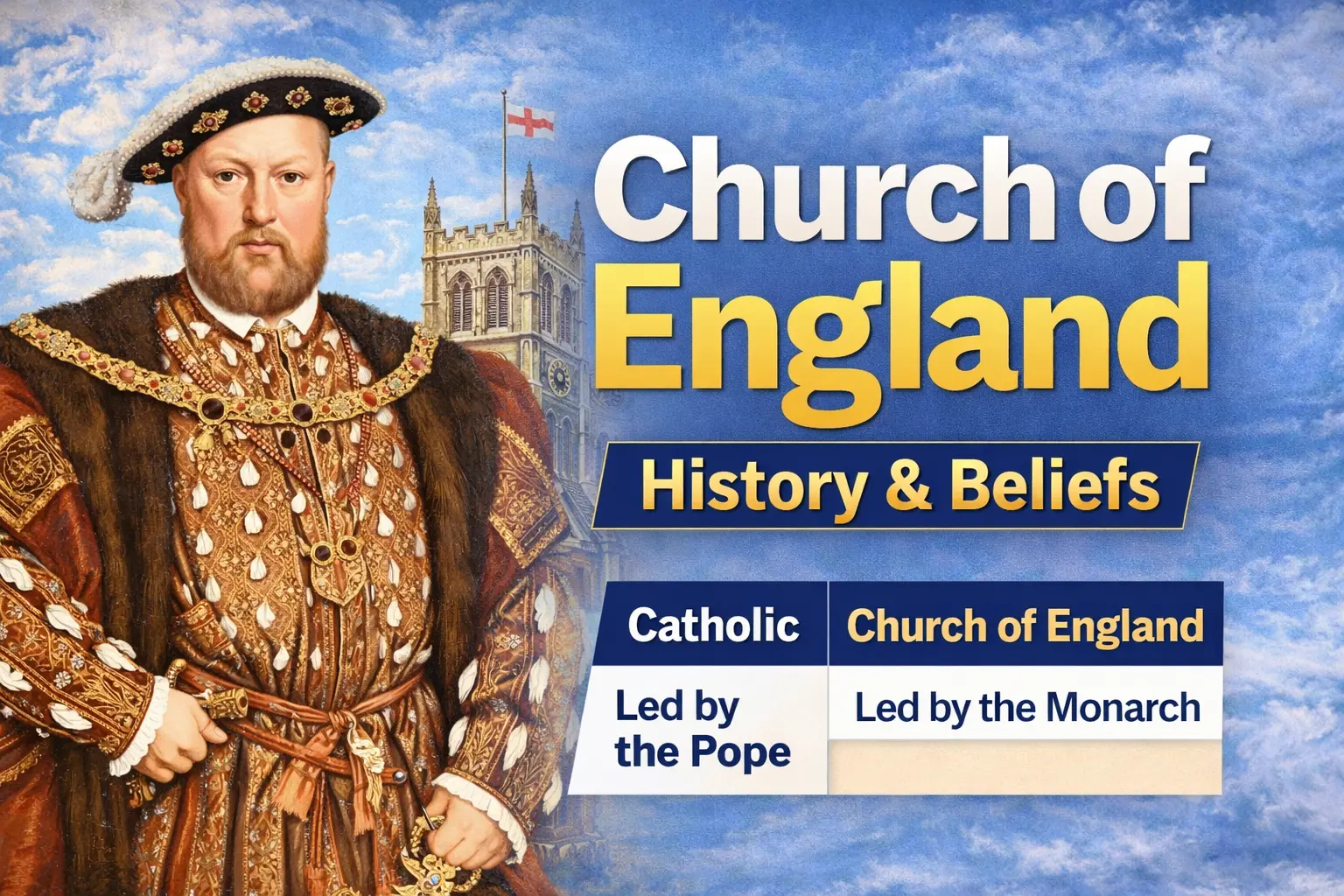
King Henry VIII wanted his marriage annulled, but the Pope refused. In 1534, Parliament passed the Act of Supremacy, declaring the King as Supreme Head of the Church of England.
This officially separated the English Church from Rome.
Under Edward VI, Protestant reforms reshaped worship and theology. The Book of Common Prayer was introduced in English. The Thirty Nine Articles defined church teaching.
Under Queen Elizabeth I, a religious settlement created a middle path. The Church of England became Protestant in doctrine but kept many Catholic traditions in structure and worship.
This balance became known as the via media, meaning middle way.
2. What Is Church of England Religion
The Church of England is Christian.
It belongs to the Anglican tradition. In fact, it is the original Anglican Church. The global family of Anglican churches around the world is called the Anglican Communion.
So yes, the Church of England is Anglican.
It is also episcopal in structure, meaning it is led by bishops. In the United States, a similar church is called the Episcopal Church.
3. Is the Church of England Protestant or Catholic
This is one of the most searched questions.
The simple answer is Protestant.
It broke away from the Roman Catholic Church during the Reformation. It does not accept the authority of the Pope.
However, it kept bishops, ancient creeds, and many traditional forms of worship. Because of this, it describes itself as both Catholic and Reformed.
It is Protestant in doctrine but Catholic in heritage and structure.
4. What Are the Main Beliefs of the Church of England
The Church of England shares core Christian beliefs with other churches.
Belief in the Trinity
God is Father, Son, and Holy Spirit.
Authority of the Bible
Scripture contains all things necessary for salvation.
The Historic Creeds
The Apostles Creed and Nicene Creed summarize the Christian faith.
The Sacraments
Baptism and Holy Communion are central acts of worship.
Threefold Ministry
Bishops, priests, and deacons serve the church.
Salvation by Grace
People are saved by God’s grace through faith.
5. What Is the Difference Between Christianity and the Church of England
Christianity is the global religion based on the life and teachings of Jesus Christ.
The Church of England is one branch of Christianity.
It is not the whole of Christianity. It is one denomination within the wider Christian world.
6. What Is the Difference Between the Catholic Church and the Church of England
Here is a clear comparison:
| Topic | Catholic Church | Church of England |
|---|---|---|
| Leader | Pope in Rome | British Monarch as Supreme Governor |
| Authority | Scripture and Church tradition under Papal authority | Scripture as final authority with tradition and reason |
| Structure | Global centralized leadership | National church with synod governance |
| Language of Worship | Latin historically, now local languages | English from the Reformation onward |
| Marriage of Clergy | Priests normally celibate | Priests may marry |
Both churches share belief in the Trinity, the sacraments, and the historic creeds. The key difference is authority and governance.
7. Worship and Church Life
The Book of Common Prayer, first written in the sixteenth century, shaped Anglican worship. Today many churches also use modern liturgy called Common Worship.
Services often include Scripture readings, prayers, hymns, and Holy Communion.
Churches range from very traditional to very contemporary. Some follow high church traditions with formal liturgy. Others are evangelical and simple in style.
This diversity is part of the Church’s identity.
8. The Church of England Today
The Church of England is the established church in England. The monarch is its Supreme Governor. The Archbishop of Canterbury is its spiritual leader and a symbol of unity for Anglicans worldwide.
It serves every parish in England and operates thousands of schools and community ministries.
In recent decades, the Church has faced challenges including declining attendance and debates over social and theological issues. Despite this, it remains historically important and globally influential.
Conclusion
The Church of England began as part of the Roman Catholic Church, separated during the English Reformation, and developed into a unique tradition that is both Protestant and Catholic in character.
It is Anglican, episcopal in structure, rooted in Scripture, guided by historic creeds, and shaped by centuries of English history.
Understanding the Church of England helps us understand not only Christianity in Britain but also the wider Anglican Communion around the world.