
When a consumer drone costing less than a smartphone can force a navy to fire an interceptor worth hundreds of thousands of dollars, the economics of war tilt dangerously. That imbalance defines today’s conflicts, where everything from hobby FPV drones to upgraded UAV drones has become a battlefield threat. Whether it’s a cheap DJI drone modified for reconnaissance or an improvised racing drone turned into a kamikaze weapon, militaries worldwide are struggling to keep pace.
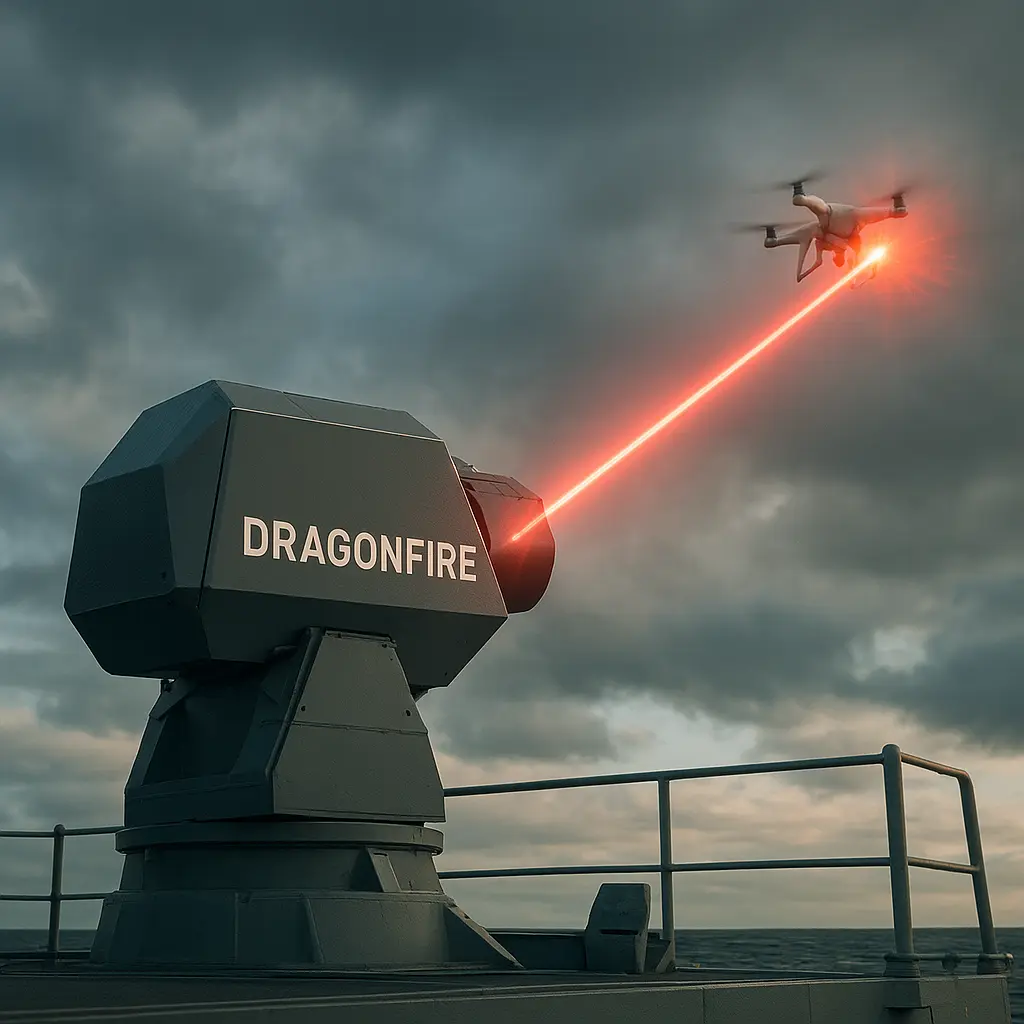
So when the United Kingdom announced that its DragonFire laser weapon had successfully taken down high-speed drones during live firing trials, the defence world paid attention. After years of development, Britain’s directed-energy programme had finally demonstrated what modern air defence may look like in the next decade.
And crucially, it offers something traditional missile systems cannot:
near-zero cost per shot.
A New Era of Defence: Why DragonFire Matters
Drones have evolved from simple drones with cameras to lethal tools capable of dropping explosives, scouting enemy positions, or performing coordinated swarm attacks. They can be purchased online just as easily as consumers buy drones for photography or recreational flying. This accessibility—combined with rapid modification techniques—has turned small UAVs into one of the most disruptive weapons of the modern age.
DragonFire is designed to answer that threat with pure physics:
a silent beam of concentrated light that destroys airborne targets by burning through vital components.
Compared to traditional interceptors—expensive, limited, and wasteful when used against cheap drones—the laser system offers militaries a new kind of defensive advantage: affordability at scale.
Inside DragonFire: How the Laser Weapon Works
Developed by MBDA UK, QinetiQ, Leonardo UK, and the UK Ministry of Defence, DragonFire combines several fibre lasers into one powerful beam. This “beam-combining” method produces remarkable stability and accuracy, even on a moving naval platform.
What Makes DragonFire Unique
-
Exceptional tracking against fast-moving drones
-
Can hit a coin-sized target at 1 km
-
Operates silently and invisibly
-
Costs roughly £10 per engagement
-
Can fire repeatedly as long as electrical power is available
Unlike kinetic systems, DragonFire doesn’t rely on ammunition stores—just electricity. This transforms a warship into a platform with a nearly bottomless defensive magazine.
The 2025 Breakthrough Test
In late 2025, during exercises in the Hebrides Range, DragonFire intercepted multiple high-speed drones travelling at more than 650 km/h. These weren’t hobby aircraft—they were purpose-built targets meant to mimic hostile UAVs in real combat scenarios.
The trial also demonstrated:
-
Above-horizon tracking, using networked sensors
-
Stability under harsh maritime conditions
-
Instant damage delivery once the beam is locked
For the first time, the UK publicly validated a laser weapon capable of neutralising real airborne threats—not just in controlled labs, but in the open environment where drones actually operate.
Deployment: The Royal Navy Takes the Lead
The UK has committed over £300 million to accelerate DragonFire toward front-line service. The Royal Navy’s Type 45 destroyers will be the first to receive the system.
These ships already serve in areas facing rising drone threats, including the Middle East, where everything from improvised FPV drones to long-range UAVs has appeared around shipping lanes.
With DragonFire onboard, these vessels gain a powerful inner defensive layer—silent, precise, and cost-effective.
How DragonFire Compares Globally
Several nations are pursuing advanced counter-drone systems, but each with unique strengths.
1. Israel’s Iron Beam
A 100–150 kW laser intended to replace missile interceptors for rockets and drones.
Comparison:
-
Israel focuses on land-based interception
-
UK leads in naval deployment precision
2. U.S. DE M-SHORAD and IFPC-HEL
Mounted on Stryker vehicles and fixed-site platforms, these protect U.S. forces against UAVs and rockets.
Comparison:
-
U.S. systems emphasise mobility
-
DragonFire excels in stabilised optics and maritime integration
3. U.S. Navy HELIOS
Closest naval competitor to DragonFire, used aboard Aegis destroyers.
Comparison:
-
HELIOS has greater power access
-
DragonFire achieves exceptional accuracy with a compact footprint
Limitations of Laser Systems
Even advanced lasers face operational challenges:
-
Reduced efficiency in fog, rain, and smoke
-
Require direct line-of-sight
-
High electrical power consumption
-
Need for cooling under continuous fire
Yet their overall strengths—precision, low cost, immediate effect—give them a unique role in future air defence.
Why DragonFire Signals a Major Shift in Warfare
The battlefield of tomorrow will be crowded with:
-
Micro-drones
-
Swarm drones
-
Long-range UAV drones
-
Easy-to-modify DJI drones
-
Commercial drone services turned hostile
-
Fast racing drones capable of deadly manoeuvres
Traditional air defence systems cannot keep up economically. Lasers like DragonFire create balance by making interception as cheap as the threat itself.
A £10 laser shot against a £300 drone is the first fair fight militaries have seen in years.
Conclusion: A Light Beam That Changes Everything
DragonFire represents a turning point in military history. For the first time, a major Western power has demonstrated a laser weapon capable of destroying real, fast-moving airborne threats. It’s a sign that the future battlefield will not be shaped by missiles alone—but by directed-energy weapons that operate quietly, precisely, and at the speed of light.
Whether countering hostile UAVs, improvised FPV drones, or the next generation of autonomous swarms, the UK’s DragonFire system is positioned to become one of the most significant defensive technologies of the decade.