
A Crisis Measured in Days, Not Just Dollars
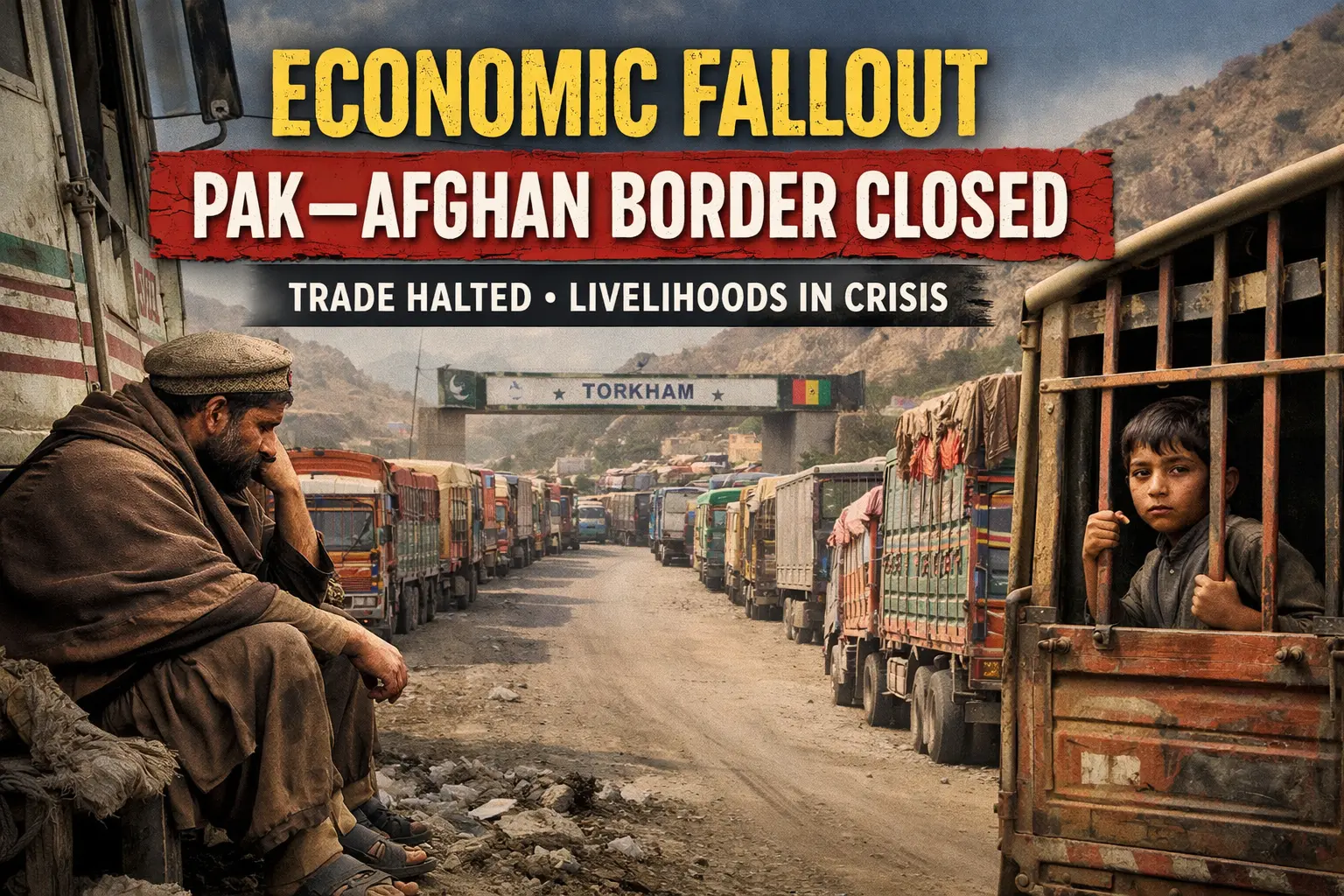
Along the Pak–Afghan border, long lines of cargo trucks sit motionless under the open sky. For the drivers inside them, the crisis is no longer abstract or political—it is painfully personal. Each passing day means spoiled goods, rising debt, and families back home waiting for money that is no longer coming. What was once a vital commercial artery connecting farms, factories, and markets has turned into a holding ground for uncertainty.
The prolonged closure of key crossings between Pakistan and Afghanistan has transformed a security standoff into a deep economic and human emergency, with consequences stretching far beyond the border itself.
Life on the Border: The Human Cost
Nearly 8,000 cargo trucks are currently stranded on both sides of the Pak–Afghan border. Many drivers have been parked for weeks, some for months, living inside their vehicles to protect their cargo from theft. Food is rationed, fuel is conserved, and access to medical care is minimal.
Most drivers are paid per trip, not per day. When the wheels stop turning, income drops to zero. Some have borrowed money to finance their journeys and now face mounting debt. Others fear that spoiled goods will leave them liable for losses they cannot afford to repay.
Border towns that once thrived on the movement of goods—mechanics, tea stalls, loaders, and warehouse workers—are also feeling the squeeze. With trucks immobilized, entire local economies are grinding down in silence.
From Busy Corridor to Bottleneck
Before the shutdown, an estimated 1,500 to 2,000 trucks crossed the Pak–Afghan border daily, carrying everything from fresh fruit and vegetables to construction materials, textiles, and consumer goods. That flow has now dropped to almost zero.
Perishable cargo is suffering the most. Containers loaded with fruit, vegetables, and food items are either rotting in place or being sold at heavy losses. Pharmaceutical shipments and industrial inputs are also delayed, disrupting downstream supply chains in both countries.
The border has effectively shifted from being a facilitator of trade to a choke point—one that is absorbing costs without generating any economic value.
Economic Damage Spreading Outward
Traders and Transporters
For traders, the financial pressure is relentless:
•Demurrage and detention charges continue to accumulate on delayed cargo.
•Export contracts are being canceled or renegotiated at lower prices.
•Small and medium-sized transport companies are struggling to service loans, pay drivers, and cover fuel and maintenance costs.
Many fear that even if the border reopens, the damage done may be irreversible for smaller operators.
Markets and Consumers
The disruption is also being felt far from the border:
•Reduced inflows of Afghan agricultural produce have contributed to price pressures in Pakistani markets.
•Afghan exporters face shrinking access to buyers and reduced competitiveness due to delays.
•Informal trade networks—often the backbone of livelihoods in border regions—are being quietly dismantled by prolonged inactivity.
Why the Border Closed
The trade freeze is rooted in escalating security tensions. Pakistan has repeatedly accused Afghan authorities of failing to prevent militant activity emanating from Afghan territory. Afghanistan has rejected these allegations, viewing Pakistan’s border restrictions as punitive and politically motivated.
As tensions escalated, both sides responded with tighter controls, eventually leading to near-total trade paralysis. In the absence of sustained diplomatic engagement, economic activity became collateral damage in a broader security dispute.
Strategic and Policy Analysis: More Than a Trade Dispute
1. Trade as Strategic Leverage
The current standoff highlights how border trade is increasingly treated as a pressure instrument rather than a protected economic channel. While this may signal political resolve, it shifts the burden onto civilians, businesses, and transport workers—groups with little influence over security decisions.
2. Long-Term Damage to Transit Credibility
Repeated closures erode confidence in Pakistan as a reliable transit corridor. Afghanistan, already under economic strain, is accelerating efforts to diversify trade routes through Iran and Central Asia. Over time, these adjustments could permanently alter regional trade patterns, reducing Pakistan’s strategic relevance as a gateway.
3. Domestic Stability Risks
Economic stagnation in border regions carries security implications of its own. Job losses, rising frustration, and the collapse of informal trade can fuel smuggling, criminal networks, and social unrest—creating new challenges for authorities on both sides.
4. Absence of Trade Firewalls
One of the most striking aspects of the crisis is the lack of institutional safeguards to keep commerce moving during political disputes. In many regions, essential trade corridors remain partially open even during crises. Here, the absence of such mechanisms has amplified economic losses.
What a Human-Centered De-Escalation Could Look Like
A sustainable response would require separating economic continuity from political confrontation:
•Phased reopening for essential and perishable goods under enhanced monitoring.
•Parallel dialogue tracks, allowing security talks to continue without fully halting trade.
•Joint coordination mechanisms at major crossings to reduce misunderstandings and escalation.
•Temporary relief measures for stranded drivers and small transporters to prevent sector-wide collapse.
Such steps would not resolve deeper political disputes, but they could prevent further humanitarian and economic damage.
Conclusion
The prolonged closure of the Pak–Afghan border has turned trucks into symbols of a wider failure—one where political mistrust outweighs economic reality. For drivers waiting in their cabins, traders watching contracts unravel, and consumers paying higher prices, the costs are immediate and deeply human.
If trade continues to be treated as expendable, the long-term consequences will extend well beyond this standoff, reshaping regional connectivity and undermining livelihoods that depend on stability rather than stalemate.