Urgent, unified national action is essential to confront this growing health crisis.
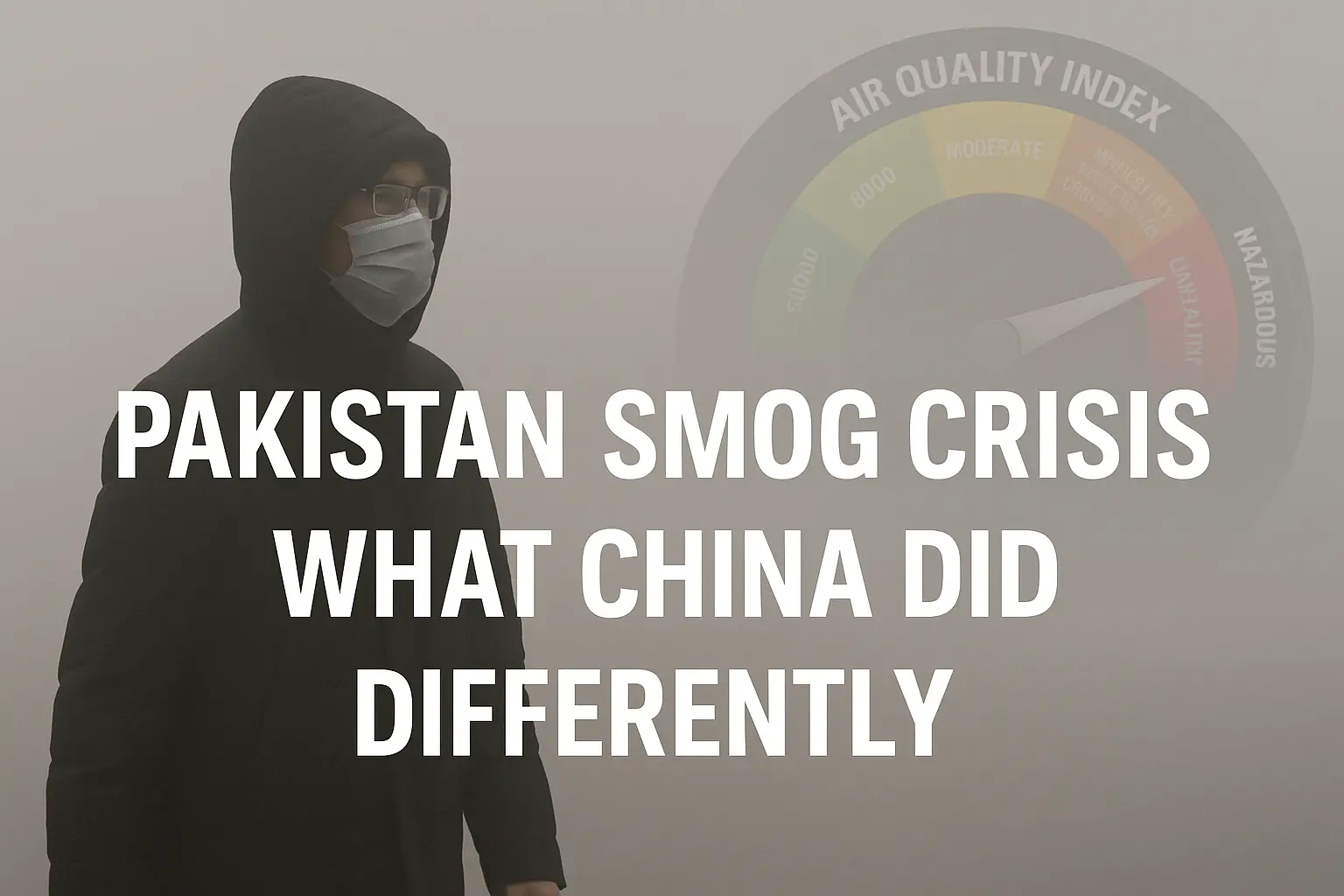
Every winter, Lahore wakes up to a suffocating blanket of toxic smog. Schools close, flights are cancelled, and emergency rooms quietly fill with patients struggling to breathe. Lahore’s air now ranks among the most polluted in the world not because solutions don’t exist, but because we have not applied them with seriousness.
China once faced a similar crisis. Cities like Beijing, Tianjin and Hebei were global symbols of hazardous air, recording some of the worst Particulate Matter 2.5 (PM2.5) levels on the planet. Yet within a single decade, China achieved one of the sharpest air-quality improvements in modern history, cutting Beijing’s PM2.5 by nearly two-thirds between 2013 and 2022.
So what did China do and why is Pakistan still struggling?
1. China’s Clean-Air Revolution: A Practical Blueprint
China’s success was not built on temporary bans or symbolic actions. It emerged from policy-backed decisions, strict enforcement, and an uncompromising shift toward cleaner development.
Below is a concise breakdown of what actually worked.
1.1 A Real “War on Pollution”
In 2013, China launched the Air Pollution Prevention and Control Action Plan (APPCAP) — the toughest anti-smog campaign in its history.
Key elements included:
- Clear PM2.5 reduction targets
- A national air-quality monitoring network across 300+ cities
- Local officials held personally accountable
- Promotions linked to environmental performance
China didn’t simply announce reforms — it enforced them.
1.2 Reducing Coal Use at the Source
Coal was China’s biggest pollution driver, and the country confronted it boldly:
- All coal-fired power plants in Beijing were shut down
- Residential coal burning was banned in northern cities
- Millions of households shifted to cleaner heating systems
- Power plants were required to adopt Ultra-Low Emission (ULE) technology
These measures dramatically reduced PM2.5, sulphur dioxide and Nitrogen Oxides (NOx) emissions.
1.3 Modernising Heavy Industry
China compelled major industries to clean up or close down.
This included:
- Mandatory Continuous Emissions Monitoring Systems (CEMS)
- Strict emission caps for steel, cement, chemical and fertilizer sectors
- Shutdowns of outdated, high-pollution factories
- Relocation of industries away from dense urban areas
Polluting industries had only two options: upgrade or exit.
1.4 Transforming Transport
China’s transport reforms were structural, not cosmetic:
- Euro-equivalent China V and VI standards
- Scrapping of high-emission vehicles
- Mass rollout of electric buses, taxis and logistics fleets
- Expansion of metro systems
- Shifting freight from trucks to rail and waterways
These steps significantly lowered transport-related emissions.
1.5 Tackling Urban Sources
China cracked down on multiple smaller sources that Pakistan often overlooks:
- Strict construction dust regulations
- Enforced bans on waste burning
- Controls on emissions from restaurants and small businesses
- Phasing out small coal boilers
- Providing real alternatives to crop-residue burning
No polluting source was considered “too small” to regulate.
1.6 Monitoring and Enforcement
China established:
- Real-time air-quality dashboards
- Independent inspection teams
- Environmental courts
- Surprise industrial raids
- Criminal penalties for violators
Air quality was not left to estimation — it was measured and enforced.
1.7 Regional Airshed Management
China treated Beijing, Tianjin and Hebei as one shared airshed.
Policies were coordinated across:
- Industry
- Energy
- Agriculture
- Transport
- Enforcement
This regional coordination was essential for lasting improvement. Pakistan must adopt the same thinking.
Visual Snapshot: Beijing vs Lahore (Illustrative PM2.5 Comparison)
Note: This chart is illustrative, designed to show the direction of change — Beijing’s PM2.5 levels falling sharply over a decade, while Lahore’s remain extremely high or even worsen.

2. Pakistan’s Air Pollution Is a Public Health Emergency
If Pakistan continues on its current path, consequences will be severe.
Health impacts of PM2.5 include:
- Heart attacks and strokes
- Lung cancer
- Chronic asthma and bronchitis
- Pregnancy complications
- Reduced lung development in children
- Shortened life expectancy (2–5 years)
Economic impacts include:
- Billions lost in productivity
- Higher healthcare costs
- Flight disruptions
- Lower agricultural yields
- Reduced tourism and investment
This is no longer an environmental issue — it is a national health and economic crisis.
3. Pakistan’s Current Response: Cosmetic Measures Are Failing
Punjab has deployed:
- Water-sprinkling guns
- Road washing vehicles
- “Anti-smog” spray machines
These may improve visibility temporarily but do nothing to reduce PM2.5 or clean the air. They are cosmetic interventions, not solutions.
Pakistan needs structural, policy-driven action, not optics.
4. What Pakistan Must Do — Real Solutions Inspired by China
Pakistan can clean its air if it follows a similar policy path.
4.1 Declare a National Clean Air Emergency
Pakistan must:
- Establish a National Air Quality Commission
- Set annual PM2.5 reduction targets
- Link bureaucratic promotions to performance
China succeeded because local bureaucracy was held fully accountable. Mayors, provincial heads and district officers received clear PM2.5 targets. Their promotions depended on achieving them. Those who failed were removed from promotion tracks, while high performers advanced.
Cleaning the air became a career-defining responsibility, not a ceremonial task. Pakistan must adopt the same accountability model to ensure meaningful action.
4.2 Fix the Energy & Fuel Problem
- Ban the dirtiest industrial fuels
- Convert all brick kilns to zig-zag technology
- Offer financing for cleaner industrial boilers
- Enforce sulphur limits in diesel and furnace oil
4.3 Modernise Heavy Industry
- Mandate CEMS across factories
- Adopt ULE-equivalent standards
- Shut down chronic violators
- Incentivise clean technology adoption
4.4 Clean Up Transport
- Enforce Euro-VI fuel and vehicle standards
- Modernise the Inspection & Maintenance (I/M) System
- Deploy electric buses through Public–Private Partnerships (PPP)
- Shift freight to rail
4.5 Control Urban & Agricultural Sources
- Enforce construction dust rules
- Ban waste burning
- Provide machinery to farmers for residue management
- Regulate small commercial emissions
4.6 Build Real-Time Monitoring & Enforcement
- Install a nationwide monitoring system
- Publish real-time air-quality data
- Establish environmental courts
- Conduct surprise inspections
4.7 Create a Punjab Airshed anagement Authority
Lahore cannot clean its air if surrounding districts — Kasur, Sheikhupura, Gujranwala, Faisalabad, Narowal, Sialkot — continue polluting.
Smog is regional. The solution must also be regional.
Conclusion: China Has Shown the Way. Pakistan Must Choose to Follow It.
China proved that even the world’s worst air can be cleaned with political will, strict enforcement and coordinated action. Pakistan now faces a choice:
Continue relying on cosmetic measures or commit to real reforms that protect public health.
If China can do it at its scale and complexity, Pakistan can do it too but only if it chooses action over optics.