
China’s latest Long March 8A mission, conducted from Hainan on December 6, 2025, marks more than another milestone in the China space program. By deploying the 14th batch of low orbit internet satellites into operational orbit, China has reinforced its ambition to build a sovereign, large-scale communications architecture under the expanding Guowang satellite constellation.
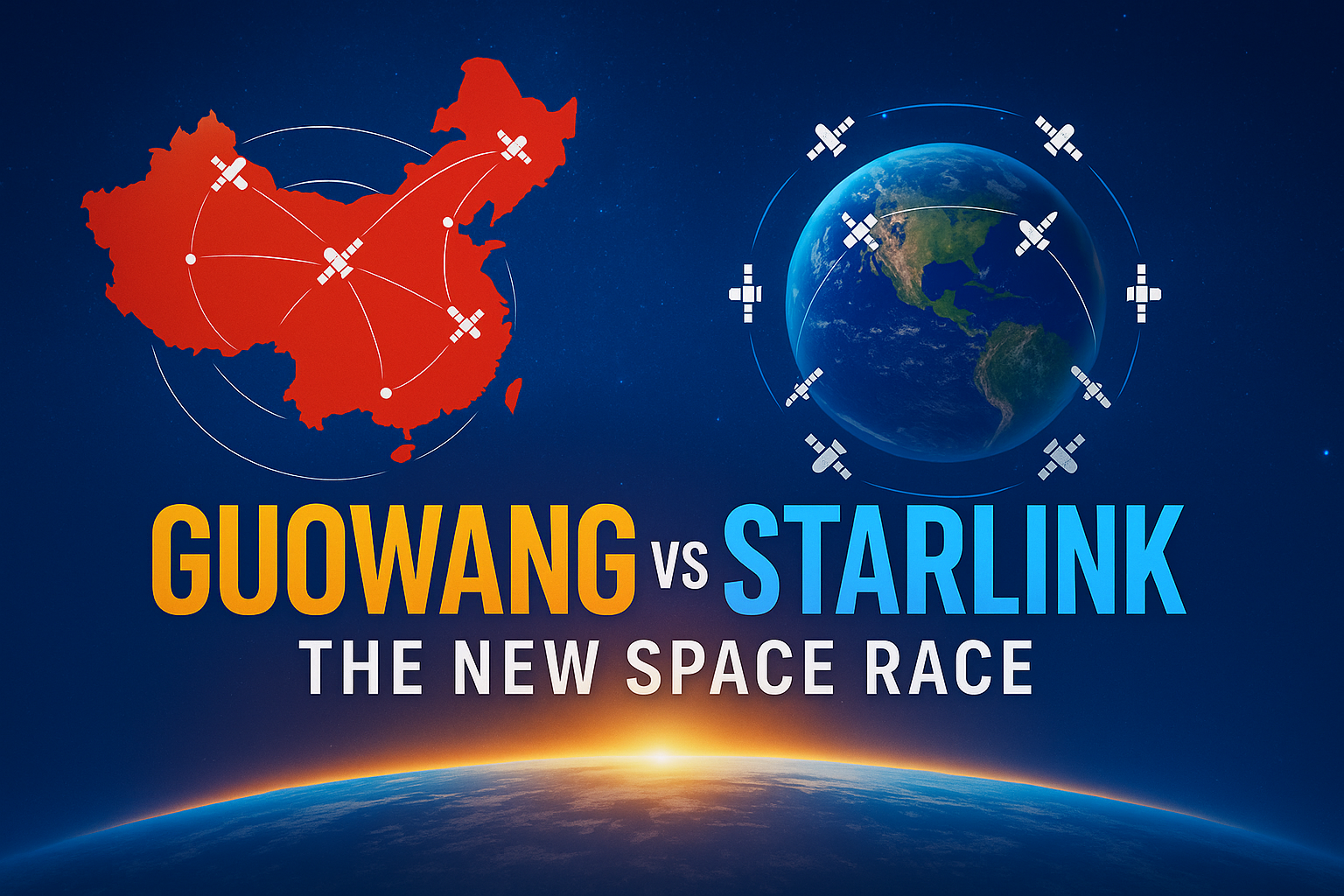
As China launches internet satellites at an accelerating pace, a new dynamic is emerging: China vs Starlink satellite internet competition is no longer abstract. With the Long March 8A launch, Beijing has sent a clear signal that Guowang is evolving into a strategic rival—not a commercial imitation—of Starlink’s global system.
The Rocket Behind the Strategy — Why Long March 8A Matters More Than Ever
The Long March 8A launch Hainan showcased China’s effort to modernize launch infrastructure and reduce reliance on imported fuels. Its use of coal-based rocket kerosene—a first for any operational mission—demonstrates a drive toward cost-stable, domestically sourced propellants suitable for high-frequency launches.
This coal-based rocket fuel China innovation directly supports the long-term lifecycle of Guowang. Mega-constellations cannot be sustained without predictable launch cadence and cost control. China’s approach differs from SpaceX’s reusability model, but the objective is similar: reduce cost-per-launch while increasing deployment tempo.
As Beijing works toward China global connectivity via satellites, this fuel advancement gives it logistical resilience and industrial independence, two assets critical for strategic systems competing at scale.
A Constellation With Consequences — The Strategic Rise of Guowang
The Guowang 14th batch satellites strengthen a constellation intended to exceed 13,000 units—making it one of the world’s largest China mega constellation satellites projects. Unlike purely commercial LEO ventures, Guowang is built as a multi-layered national asset combining civil, commercial, and security functions within a unified architecture.
The benefits of China’s Guowang satellites include:
•Redundant emergency communications
•Maritime and aviation data links
•Full-spectrum coverage across remote or underdeveloped regions
•Secure, state-controlled information channels
•A robust foundation for unmanned and autonomous systems
Through Guowang, Beijing is developing a communications backbone that aligns with national priorities and geopolitical goals rather than market demand alone.
Competing With — Not Copying — Starlink: China’s Very Different LEO Strategy
Much of the global conversation frames the race as Guowang vs Starlink, but this comparison overlooks their fundamentally different design philosophies. Starlink is commercially optimized for rapid global expansion. Guowang is strategically oriented and tightly integrated into state-led digital governance.
The impact of China’s satellite internet network lies in its alignment with national strategy. For countries cautious about overreliance on U.S.-based infrastructure, China’s model may appear more politically neutral—or more compatible with their development needs. The competition between the two systems reflects broader geopolitical alignments, making LEO broadband not just a technological field, but a structural element of international influence.
Understanding how Guowang competes with Starlink requires viewing the system not as a commercial service, but as a strategic communications architecture that extends China’s digital presence across continents.
LEO Broadband China: More Than Connectivity, It’s National Strategy
The drive to expand LEO broadband China stems from China’s geographic realities. Remote mountain regions, deserts, and maritime zones cannot be economically served by fiber networks. Here, rural China internet via LEO satellites becomes not only viable but essential.
LEO networks will empower:
•Digital public services in underserved regions
•Precision agriculture and remote industrial operations
•Maritime safety and aviation networks
•Border-region integration and surveillance
•Data-rich smart logistics corridors
Beyond connectivity, this expansion strengthens domestic industries by scaling satellite manufacturing and component production, which reduces cost and improves resilience—key advantages in the long-term competition between China satellite internet and Starlink.
Coal-Based Kerosene: Fuel Innovation That Changes the Economics of Space
China’s decision to adopt Long March 8A coal-based kerosene reflects an industrial strategy based on local resource abundance and scalability. This fuel type enables stable pricing, predictable supply chains, and efficient launch cycles—all essential to deploying and maintaining a mega-constellation.
The innovation is not an isolated experiment but part of a plan to secure economic sustainability for Guowang’s expansion. By lowering launch costs and reducing external dependencies, China is shaping a launch ecosystem engineered for decades of high-frequency orbital deployment.
Why Guowang and Starlink Are on a Collision Course for Global Connectivity
As nations across Africa, Asia, and Latin America seek satellite broadband solutions, the decision between Starlink and China satellite internet has strategic implications. For some, performance and availability matter most. For others, political alignments, data governance, and economic partnerships will shape their choices.
China’s pursuit of China global connectivity via satellites is part of a larger digital diplomatic framework that complements Belt and Road infrastructure and offers an alternative to Western-led digital corridors. The competition between Guowang and Starlink thus represents a deeper contest over who will shape the next phase of global digital infrastructure.
The Military Edge No One Talks About — Why LEO Networks Matter in Conflict
LEO networks like Guowang provide advantages far beyond civil broadband. Their distributed architecture enhances survivability and enables secure, real-time communications across land, sea, air, and space. They support:
•Anti-jamming communication nodes
•Precision data for unmanned platforms
•Real-time intelligence sharing
•Integrated maritime and aerial coordination
For a military increasingly reliant on precision networking, LEO constellations offer structural advantages that traditional GEO systems cannot match.
Conclusion — A New Strategic Rivalry in Low Earth Orbit
The December China rocket launch 2025 featuring the newest low orbit internet satellites is more than a technical success. It marks China’s clear intent to build a sovereign, resilient, and globally competitive communications ecosystem centered on Guowang.
By merging fuel innovation, industrial scale, and strategic planning, China is positioning Guowang as a state-directed counterweight to Starlink. The emerging competition is not simply technological—it is geopolitical, economic, and structural.
As the world enters an era defined by dual satellite-internet super-networks, the question is no longer whether Guowang can keep pace with Starlink, but how this rivalry will reshape global connectivity and the balance of digital power for decades to come.