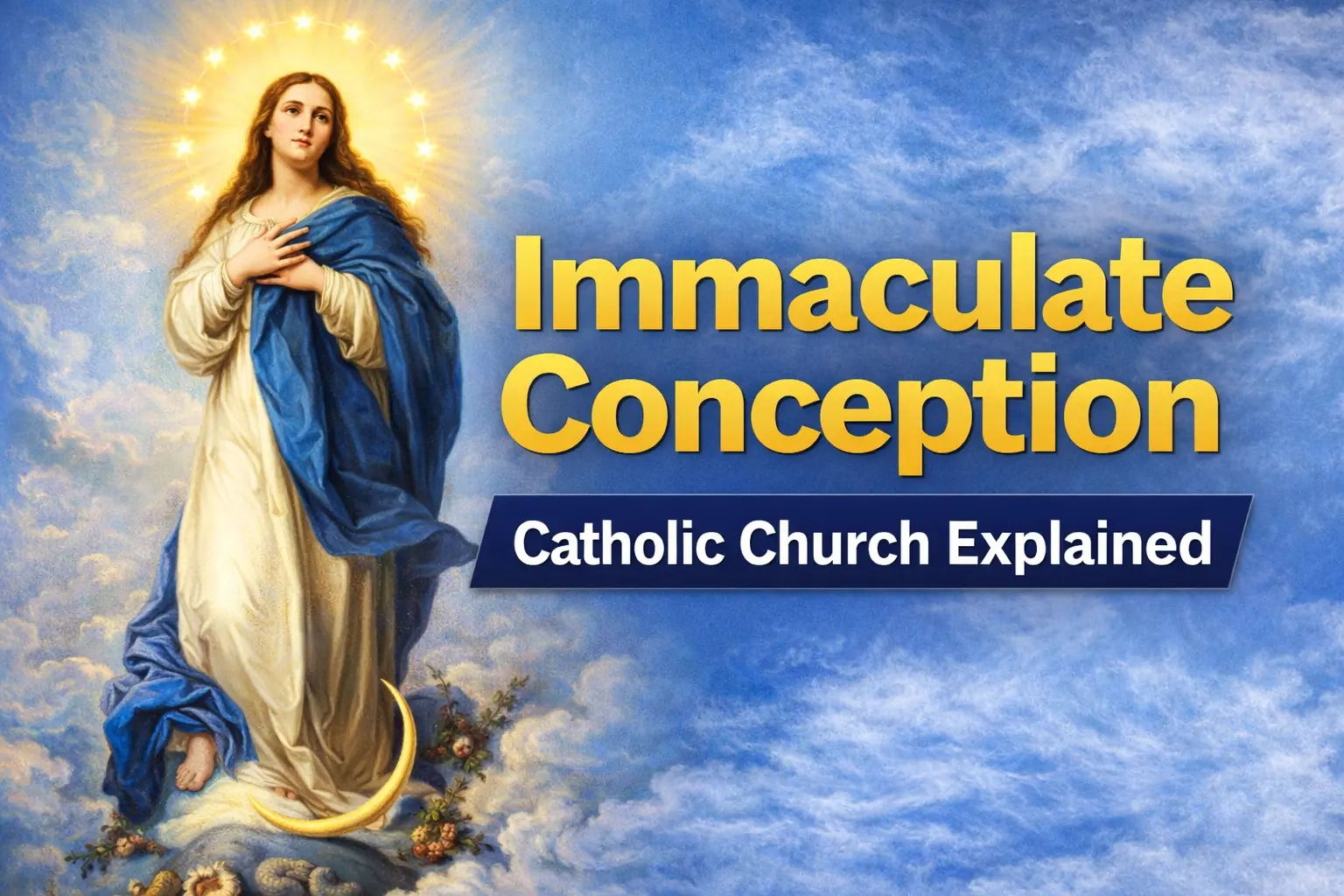

Many people hear the phrase Immaculate Conception and immediately think about the birth of Jesus. That is one of the biggest misunderstandings in Christian theology. The Immaculate Conception is not about the pregnancy of Mary with Jesus. It is about the conception of Mary herself.
In simple words, the Immaculate Conception of Mary means that Mary was conceived without original sin. From the first moment of her existence in her mother’s womb, she was preserved by God’s grace from the stain of original sin.
This teaching is one of the most important Marian doctrines in the Catholic Church. In this guide, we will clearly explain the meaning, story, history, biblical foundations, and why the Immaculate Conception is important in Catholic belief.
Table of Contents
ToggleWhat Is the Meaning of Immaculate Conception
The word immaculate means without stain. In Catholic theology, the stain refers to original sin, the fallen condition inherited from Adam and Eve.
The Immaculate Conception meaning is simple. It teaches that Mary was preserved free from original sin from the first instant of her conception. She was conceived in the normal biological way by her parents, traditionally named Joachim and Anne, but by a special grace of God she was protected from original sin.
It does not mean Mary was conceived without sexual relations. It does not mean she had no need of salvation. Instead, Catholics believe she was saved in a unique way by the future merits of Jesus Christ.
Immaculate Conception of Mary Explained Clearly
To understand the Immaculate Conception of Mary, we must understand original sin. In Catholic teaching, original sin is not a personal sin we commit. It is a fallen human condition inherited from the first disobedience of Adam and Eve.
Every human person is born into this fallen condition. Catholics believe Mary was the exception, not by her own power, but because God applied the grace of Christ to her at the moment of her conception.
The Catechism of the Catholic Church explains that Mary was redeemed in a more exalted way. Instead of being cleansed after sin, she was preserved from it in advance.
A simple analogy helps. If someone falls into a muddy pit and is pulled out, that person is saved. But if someone is about to fall and is stopped before touching the mud, that person is also saved, and in an even more protective way. Catholics say Mary was saved in that second way.
Immaculate Conception of Jesus and Common Confusion
One of the most searched questions online is about the Immaculate Conception of Jesus. But this phrase is technically incorrect.
The conception of Jesus refers to the Virgin Birth. Catholics believe Jesus was conceived by the power of the Holy Spirit in Mary’s womb without a human father.
The Immaculate Conception refers to Mary’s conception, not Jesus’. The two teachings are different.
The Immaculate Conception pregnancy question usually comes from this confusion. Mary’s pregnancy with Jesus was miraculous, but the Immaculate Conception happened decades earlier, when Mary herself was conceived.
What Is the Story of the Immaculate Conception
The story begins with Mary’s parents, traditionally called Joachim and Anne. According to early Christian tradition, they were unable to have children for many years. After prayer, God blessed them with a daughter, Mary.
The Catholic Church teaches that at the moment Mary began to exist in her mother’s womb, God gave her sanctifying grace and preserved her from original sin. This grace was given because she was chosen to be the Mother of Jesus Christ.
The formal definition of this doctrine came much later. In 1854, Pope Pius IX officially declared the Immaculate Conception a dogma of the Catholic Church. This means it must be believed by Catholics as a revealed truth.
How Do Catholics Explain the Immaculate Conception
Catholics explain the Immaculate Conception through several key ideas.
First, Mary still needed a Savior. In the Gospel of Luke, Mary says her spirit rejoices in God her Savior. Catholics say she was saved by Christ in advance. The grace of Jesus’ future sacrifice was applied to her at her conception.
Second, Catholics point to the angel Gabriel’s greeting in Luke 1:28, where Mary is called full of grace. The Greek word used there suggests a lasting and complete state of grace.
Third, Catholics believe that it was fitting for the Mother of God to be pure from the beginning. This idea was strongly defended by medieval theologians like John Duns Scotus, who argued that God could preserve Mary from sin and that it was fitting for Him to do so.
Why Is the Immaculate Conception Important
Many people ask why the Immaculate Conception is important.
It matters for several reasons.
It highlights the power of God’s grace. Mary’s holiness was not self-made. It was a gift from God.
It protects the truth about Jesus. If Jesus is truly divine and sinless, it is fitting that the woman chosen to carry Him would be prepared by special grace.
It shows the beauty of redemption. Mary is seen as the first fruit of Christ’s saving work.
It also gives hope. Catholics see in Mary a picture of what humanity is meant to become through grace.
What Does the Immaculate Conception Celebrate in the Catholic Church
The Catholic Church celebrates the Solemnity of the Immaculate Conception on December 8 each year. It is a holy day of obligation in many countries.
The feast celebrates Mary being conceived without original sin. It is not a celebration of Jesus’ birth or Mary’s pregnancy.
The date is placed exactly nine months before September 8, the feast of Mary’s Nativity.
10 Facts About the Immaculate Conception
Here are ten helpful facts that summarize the doctrine.
One. It refers to Mary’s conception, not Jesus’.
Two. It teaches that Mary was free from original sin from the first moment of her life.
Three. It was officially declared a dogma in 1854.
Four. It is one of four Marian dogmas in the Catholic Church.
Five. The feast day is December 8.
Six. It does not mean Mary had no need of a Savior.
Seven. Catholics believe she was redeemed by Christ in advance.
Eight. Many Protestants reject this doctrine as not clearly stated in Scripture.
Nine. The doctrine was widely debated in the Middle Ages.
Ten. It remains a central part of Catholic Mariology today.
Original Image of Immaculate Conception in Art
The original image of Immaculate Conception in Christian art developed slowly. Early medieval art showed the meeting of Joachim and Anne at the Golden Gate of Jerusalem, symbolizing Mary’s conception.
Later, especially in Spain, artists began depicting Mary as a young woman standing on a crescent moon, surrounded by stars, clothed in white and blue, with a serpent under her feet. This imagery comes from Revelation chapter 12 and Genesis chapter 3, where God promises victory over the serpent.
One of the most famous artistic representations was painted by Bartolome Murillo in the seventeenth century. These paintings helped shape popular devotion.
Protestant and Orthodox Objections
Many Protestant churches reject the Immaculate Conception, arguing that Scripture says all have sinned. Catholics respond that exceptions exist, such as Jesus, and that Paul’s statement refers to humanity generally, not absolutely without exception.
Eastern Orthodox Christians also reject the dogma as defined in 1854, although they strongly honor Mary as all holy.
The difference often comes down to authority. Catholics believe the Church has the authority to define doctrines that are rooted in Scripture and tradition, even if not explicitly written in one verse.
Summary of the Immaculate Conception
In summary, the Immaculate Conception is the Catholic belief that Mary was preserved from original sin from the first moment of her existence. It does not refer to Jesus’ conception. It was officially defined in 1854 but developed over many centuries.
The doctrine emphasizes grace, redemption, and Mary’s unique role in salvation history.
Final Reflection
When I first studied the Immaculate Conception, I assumed it was only about Marian devotion. But after reading deeper, I realized it is more about Christ than Mary.
The teaching focuses on what God can do through grace. It presents Mary as someone fully dependent on divine mercy.
Whether one accepts the doctrine or questions it, understanding it properly removes confusion. The Immaculate Conception is not about myth or exaggeration. It is about how the Catholic Church understands God’s plan of salvation unfolding from the very beginning of Mary’s life.
For anyone studying Catholic theology, this doctrine remains one of the most important keys to understanding Marian belief and the broader framework of Catholic teaching.