
Cricket is not just a game in South Asia.
It is memory. Emotion. Identity.
For decades, it connected people across borders even when politics failed. Today, that bridge is cracking — not because of rivalry, but because of politicisation.
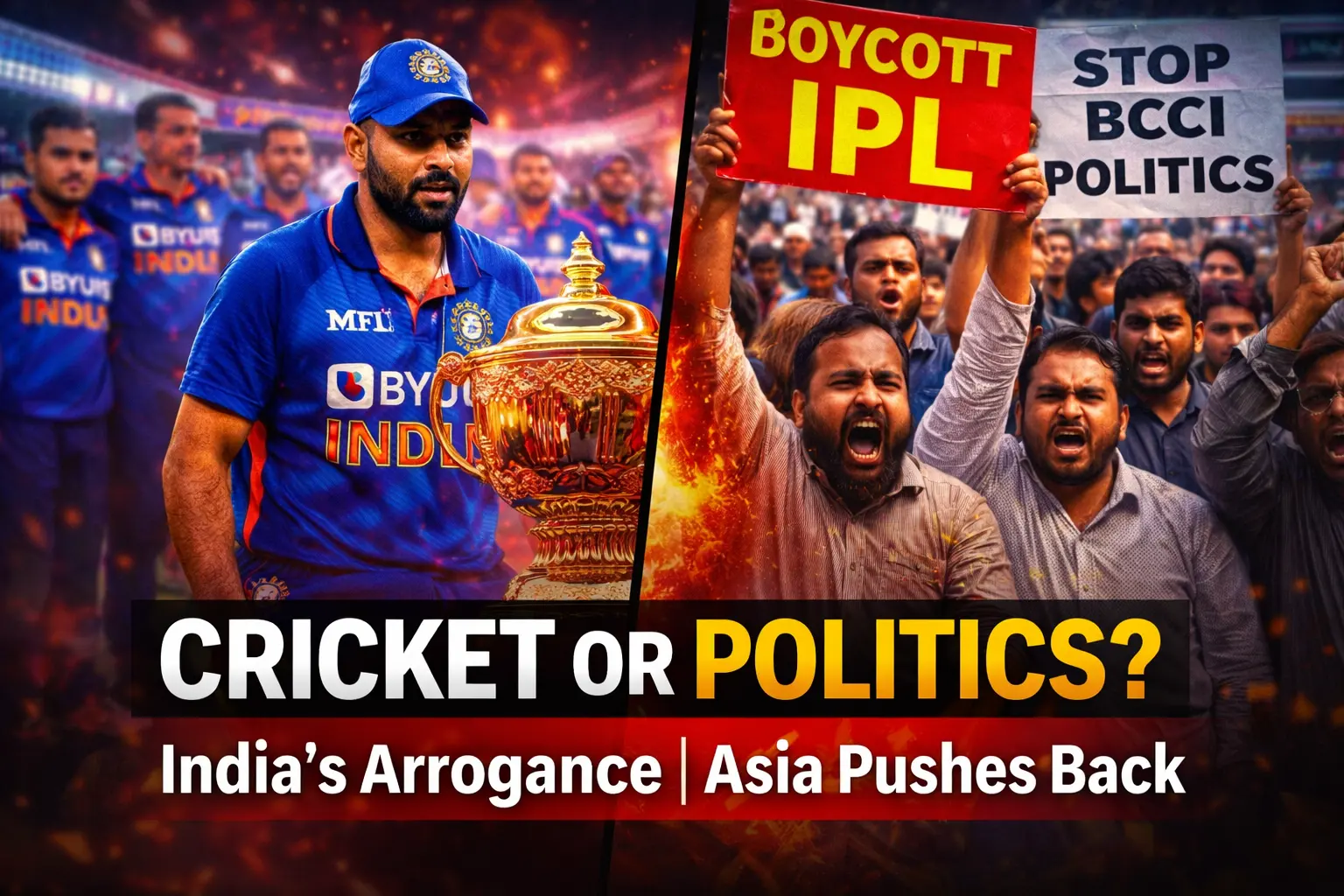
At the center of this shift stands the Board of Control for Cricket in India (BCCI), an institution that increasingly behaves as if money alone gives it the right to set rules for the entire cricketing world. It does not.
Power without restraint always invites resistance.
Refusing to Play in Pakistan: When Politics Overrides Sport
India has not played bilateral cricket in Pakistan for more than a decade. The official excuse remains “security concerns.” Yet the facts tell a different story.
Pakistan has hosted Australia, England, New Zealand, South Africa, and major international tournaments under the supervision of the International Cricket Council (ICC). Stadiums were full. Tours were completed. No major incidents occurred.
India’s refusal, therefore, is not about safety.
It is about political posture.
Cricket has been turned into a bargaining chip — sacrificed for domestic optics and nationalist messaging.
From Competition to Contempt in Asian Tournaments
This attitude did not stop at bilateral cricket. It spilled into Asian events that were meant to unite the region.
Refusing to shake hands with the Pakistan captain.
Declining to accept a trophy from the Pakistan Cricket Board (PCB) chairman.
These were not misunderstandings. They were intentional acts, performed under global cameras. For fans across Asia, the message was clear: India was no longer just competing — it was confronting.
Sport lost. Politics won.
IPL: A League Losing Its Soul
The Indian Premier League (IPL) was once cricket’s most exciting idea. Talent from everywhere. Fans from everywhere. Opportunity without borders.
That vision is fading.
Pakistani players were excluded long ago. Afghan players have faced quiet pressure. Recently, a Bangladeshi player was reportedly refused participation and sent back — not for cricketing reasons, but political ones.
When a sporting league begins deciding careers based on geopolitics, it stops being global. It becomes ideological.
Bangladesh Draws a Line
This time, the response was different.
Instead of quiet acceptance, Bangladesh halted the telecast of the IPL indefinitely. It was a calm move, but a firm one. No press theatrics. No shouting. Just action.
The message was simple:
Respect is not optional.
This was not anti-cricket. It was anti-arrogance.
A Pattern Too Clear to Ignore
These are not isolated incidents. They form a pattern many analysts — including your platform — have highlighted before:
•Financial pressure shaping ICC decisions
•Neutral venues forced to bypass Pakistan
•Asian Cricket Council unity weakened
•Cricket victories packaged as nationalist spectacle
•Smaller boards expected to comply or stay silent
This is not leadership.
It is dominance — and dominance breeds backlash.
The Cost of Turning Cricket Into a Weapon
India still controls revenue. That is true.
But soft power does not disappear overnight — it erodes slowly.
Fans notice. Boards notice. Governments notice.
Across South Asia, frustration is growing. Not with Indian players or Indian fans — but with an institutional mindset that treats cricket as a tool of state behavior rather than a shared heritage.
History shows that sporting empires do not fall because they lose matches.
They fall because they lose trust.
Cricket Is Not a Ministry
Cricket cannot be run like a political campaign.
The ICC is not a corporate branch office.
And Asia is not any one country’s backyard.
If India continues to politicise cricket — refusing tours, humiliating hosts, and weaponising leagues — it will not dominate the region. It will isolate itself.
Bangladesh’s decision was not an ending.
It was a warning.