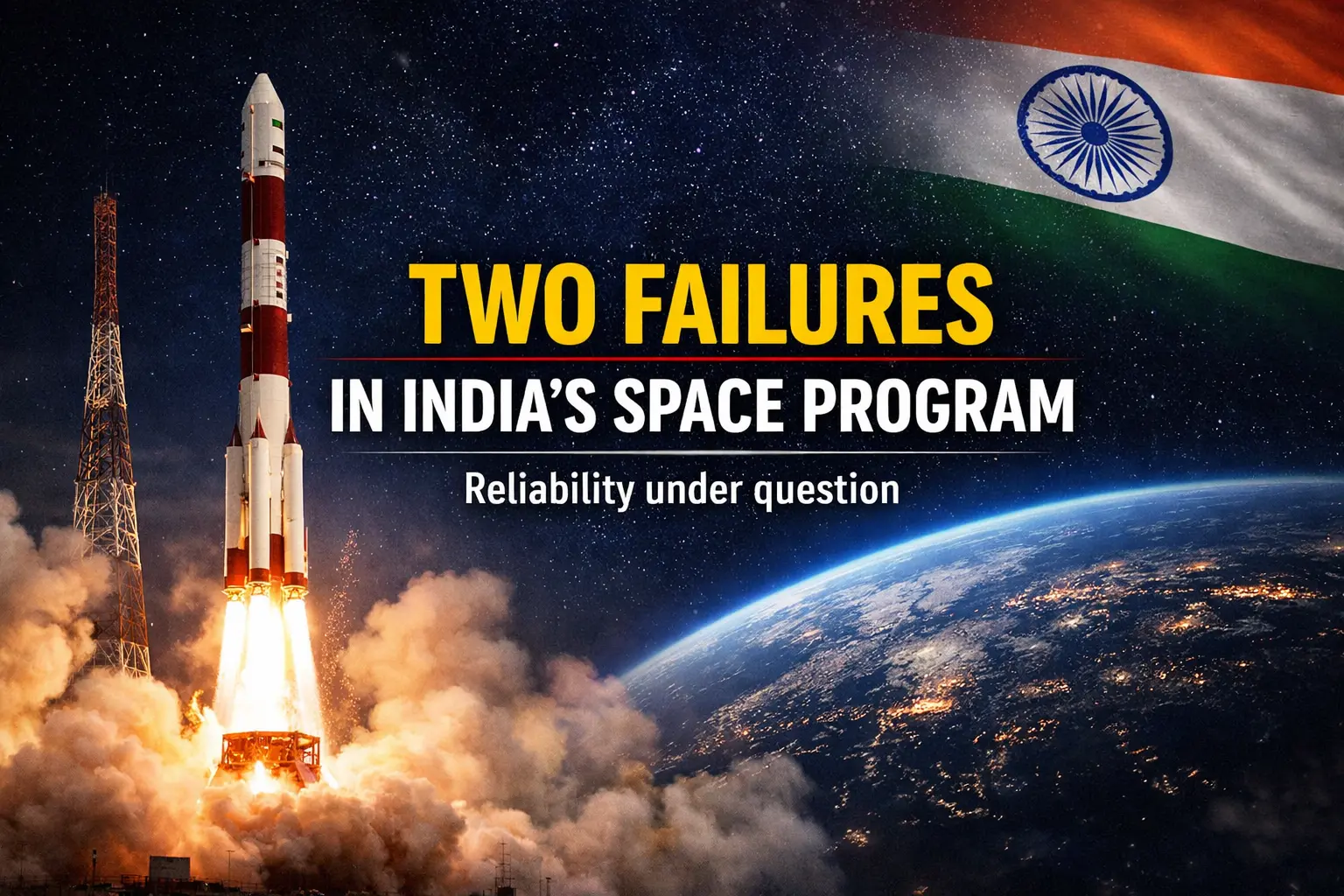

India’s space program has long projected confidence built on consistency, particularly through the Polar Satellite Launch Vehicle (PSLV), regarded as ISRO’s most dependable launch platform. However, two mission failures within a short span have introduced an unusual pause in that narrative, prompting renewed scrutiny over reliability rather than ambition.
The most recent setback occurred with the PSLV-C62 mission, which lost control during flight and failed to place its payloads into the intended orbit. The rocket was carrying multiple satellites, including Earth-observation and commercial payloads linked to startups and research institutions. Initial stages of the launch proceeded as planned, but an anomaly during the third stage led to deviation from the intended trajectory, resulting in mission failure.
What makes this incident more consequential is its proximity to an earlier failure. Just months before, the PSLV-C61 mission also failed after a third-stage malfunction, leading to the loss of an Earth-observation satellite. Two failures occurring so close together, and involving the same flight segment, make it difficult to view these events as isolated technical glitches.
In spaceflight, setbacks are not unusual. However, repetition within a compressed timeframe often signals deeper issues that merit attention. These may range from manufacturing consistency and quality assurance to the pressures created by an increasingly ambitious launch schedule. For a vehicle that built its reputation on reliability, such patterns naturally attract closer examination.
Beyond the technical domain, the consequences extend to commercial and strategic spheres. Reliability remains the single most important factor for satellite operators and insurers when choosing launch providers. Even limited failures can influence future contracts, insurance costs, and international confidence. For India’s growing private space ecosystem, especially startups dependent on single demonstration launches, such setbacks can be particularly disruptive.
ISRO has initiated technical reviews to identify the root causes and outline corrective measures. How transparently and decisively these issues are addressed will play a key role in restoring confidence. India’s space program has recovered from setbacks before, but maintaining credibility in a competitive global environment demands not only innovation, but sustained engineering discipline.
Whether these failures represent a temporary dip or an early warning will depend on what follows. For now, they serve as a reminder that rapid expansion must be matched with uncompromising attention to reliability.
Frequently Asked Questions (FAQs)
1. Are launch failures common in space programs?
Yes. Space launches involve complex systems operating at extreme conditions, and failures occur even in mature programs. What draws attention here is the short interval between two similar failures.
2. Why is the third-stage issue significant?
The third stage is critical for precise orbital insertion. Repeated anomalies in the same stage suggest potential systemic issues rather than random faults.
3. Does this weaken India’s position as a space launch provider?
Not permanently. However, reliability strongly influences customer confidence. Swift corrective action and successful future launches will be essential to maintain credibility.