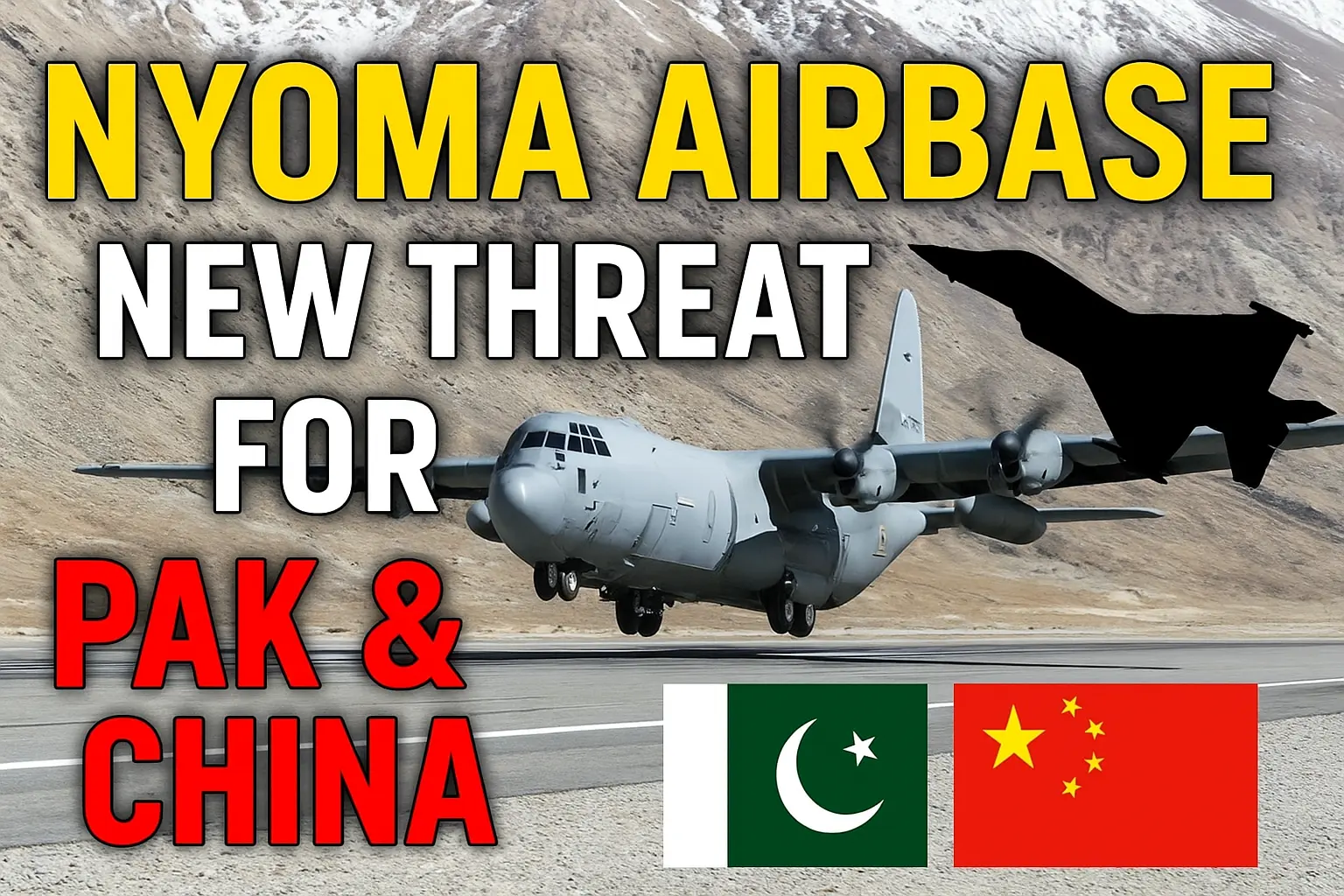

India’s inauguration of the Mudh-Nyoma Air Force Station in Ladakh marks one of the most significant military developments in the Himalayan region in recent years. Although the base sits only 30 kilometres from the Line of Actual Control, its implications extend beyond China and directly affect Pakistan’s strategic environment.
The Indian Air Force Chief, Air Chief Marshal A. P. Singh, personally landed a C-130J Super Hercules at the base, demonstrating that the high-altitude facility is not symbolic but operationally ready. Located at roughly 4,000 metres above sea level, the Nyoma base is designed for fighter jet operations, heavy airlift missions, surveillance flights, and rapid troop deployment.
A retired Indian Air Marshal openly stated that the new airfield creates challenges for both adversaries, confirming that Pakistan remains part of India’s strategic calculus.
1. A High Altitude Military Advantage Extending Beyond China
Establishing a major air base at 13,000 feet is both an engineering and operational achievement. India invested heavily to overcome reduced aircraft performance at such altitudes.
Why this matters for China
The base allows faster deployment, enhanced surveillance, and forward positioning of combat aircraft near the LAC.
Why this matters for Pakistan
Strengthening Ladakh means India no longer needs to divert forces from the Pakistan front during tension with China. This frees India to maintain full readiness against Pakistan, even in a northern crisis.
2. Strengthening India’s Two Front War Preparedness
For decades India feared simultaneous conflict with China and Pakistan. Nyoma reduces that vulnerability.
With Nyoma operational
• India maintains a steady air presence in Ladakh
• China focused units no longer draw resources from the Pakistan front
• Quick response capability improves on both fronts
Impact on Pakistan
India is no longer forced to choose between the northern and western sectors. This shifts long term strategic balance.
3. C 130J Landing Proves Long Term Operational Intent
The landing was not ceremonial. It proved that Nyoma can support
• heavy transport aircraft
• special forces deployment
• fast reinforcement of forward posts
• logistical supply for high altitude bases
• movement of equipment using roll on and roll off systems
Impact on Pakistan
India’s improved mobility in Ladakh frees resources elsewhere, including the Pakistan sector. This affects escalation calculations in future crises.
4. Fighter Jet Operations from Nyoma: A New Layer of Complexity
The runway is designed to support fighter jets such as
• Sukhoi 30MKI
• Mirage 2000
• Rafale
• Tejas Mk 1A
• future aircraft like AMCA
Even without permanent deployment, India can quickly move fighters to Nyoma during any escalation.
Impact on Pakistan
• faster repositioning of fighters between fronts
• improved intelligence and surveillance
• enhanced strike flexibility
• credible multi front pressure
5. Pressure on Gilgit Baltistan and CPEC Corridors
Nyoma’s location gives India improved vantage points over the northern arc.
Potential outcomes
• enhanced surveillance over Gilgit Baltistan
• monitoring capability across CPEC routes
• pressure on Pakistan China infrastructure
• higher strategic visibility over high altitude supply lines
Why this matters for Pakistan
Air defence, early warning systems, and response posture in the GB region must now be strengthened.
6. Psychological Warfare and Strategic Signalling
India also uses Nyoma for messaging. Senior Indian officers have openly referred to Pakistan and China as dual adversaries.
Effects of this signalling
• influence on Pakistani domestic debate
• strengthened Indian image internationally
• more leverage during crises
• psychological pressure on Pakistan
If Pakistan does not counter this narrative, India’s infrastructure gains can translate into political and psychological advantage.
7. The United States and India Dimension
The C 130J is an American aircraft, and its operation at Nyoma highlights growing U.S.–India defence ties.
Key implications
• India is integrating Western systems into high altitude zones
• Washington views India as a key partner against China
• India’s diplomatic leverage increases
• Pakistan faces a widening capability gap unless it adapts
Nyoma is therefore both a military and geopolitical signal.
8. Overall Impact on Pakistan
Even though Nyoma is positioned near the China border, Pakistan is directly affected because
• India’s two front war capability improves
• northern forces no longer drain resources from the Pakistan sector
• GB and CPEC face long term strategic pressure
• Indian mobility increases
• air power becomes more flexible and unpredictable
• India strengthens its diplomatic and psychological posture
Pakistan must now include Nyoma in all future policy, defence planning, and crisis simulations.
Frequently Asked Questions
1. Where is India’s new Nyoma air base located
It is in Ladakh, around 30 km from the Line of Actual Control at an altitude of about 4,000 metres.
2. Why is the Nyoma air base important for India
It enhances rapid deployment, fighter operations, and surveillance capabilities along the China border.
3. How does the Nyoma air base affect Pakistan
It strengthens India’s two front readiness, improves mobility, and increases monitoring ability over Gilgit Baltistan.
4. Can fighter jets operate from Nyoma
Yes. The runway is built for aircraft like the Sukhoi 30MKI, Mirage 2000, Rafale, and others.
5. Does the base threaten CPEC
Not directly at present, but it adds long term pressure on CPEC routes through surveillance and strategic positioning.