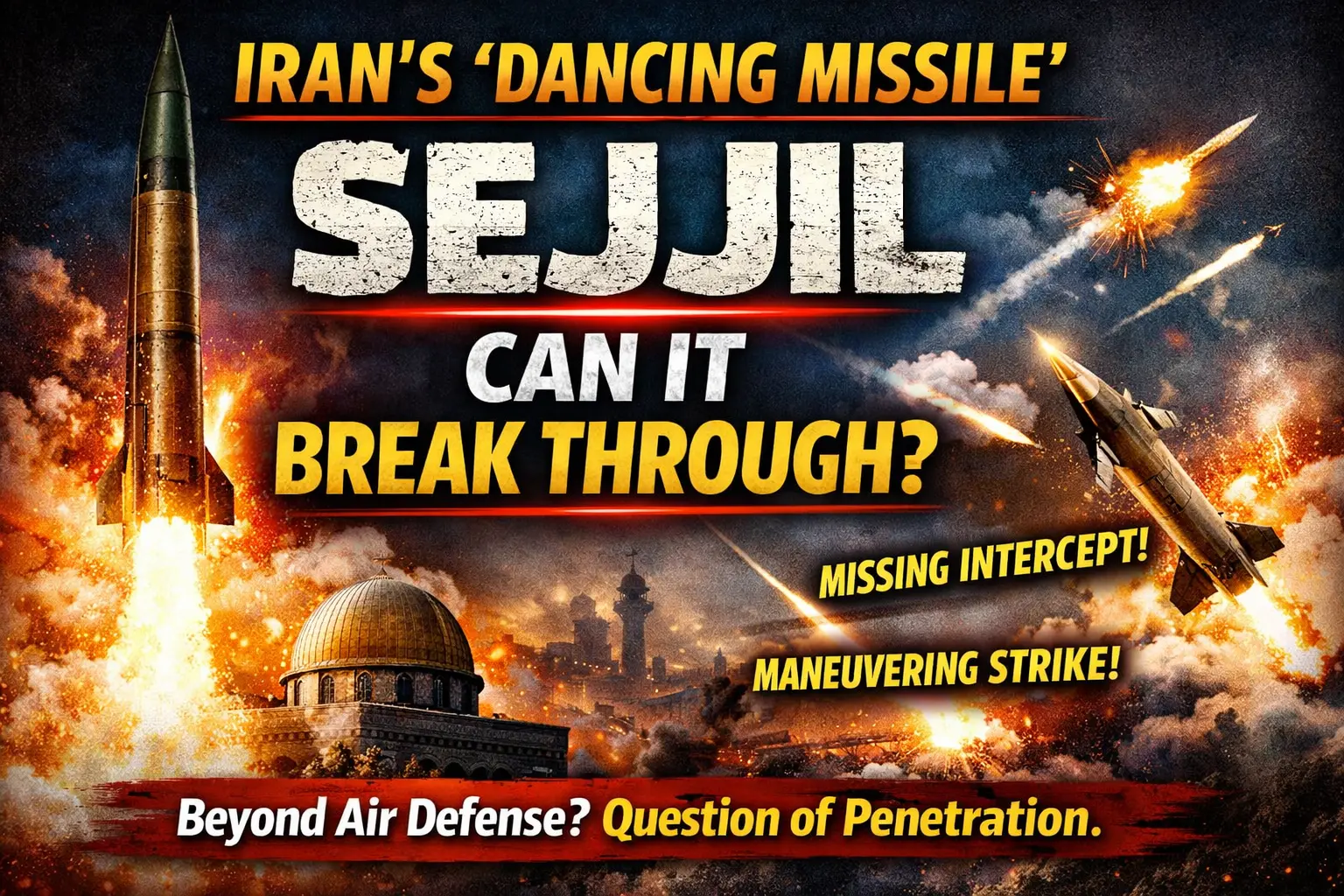

Iran’s Sejjil “dancing missile” is redefining modern warfare with maneuverable trajectories and high-speed penetration. Explore its capabilities, battlefield role, and strategic impact in the ongoing conflict.
🔥 Introduction: A Shift in the Missile Battlefield
In the ongoing 2026 Iran conflict, Iran has introduced a weapon that is not necessarily unstoppable—but strategically disruptive.
The Sejjil missile, often called the “dancing missile,” represents a critical evolution in modern warfare:
👉 Not just about range or payload
👉 But about penetration probability
At a time when layered air defense systems dominate the battlefield, Sejjil is designed to challenge interception dominance and introduce uncertainty.
🚀 Sejjil: Capabilities That Change the Equation
🔹 Core Specifications
•Range: 2,000–2,500 km
•Payload: ~1,000 kg
•Type: Two-stage solid-fuel ballistic missile
•Launch Platform: Road-mobile (high survivability)
🔹 The “Dancing” Factor (Game Changer)
Unlike traditional ballistic missiles that follow predictable arcs, Sejjil introduces:
•Terminal-phase maneuverability (MaRV concept)
•Unpredictable flight path adjustments
•Reduced tracking accuracy for interceptors
👉 This is the core shift:
It is not invisible—but less predictable
⚔️ Battlefield Role: From Quantity to Quality
In the early phase of the conflict, Iran relied on mass missile and drone barrages.
However, recent patterns suggest a transition:
🔄 From:
•Saturation attacks (volume-based warfare)
🔄 To:
•Selective deployment of advanced missiles like Sejjil
This indicates a doctrinal evolution toward:
👉 Precision + penetration over sheer quantity
🎯 Strategic Advantage for Iran
1. Higher Penetration Probability
Even with high interception rates (80–90%), maneuverable missiles increase leakage probability.
👉 A small percentage getting through can still cause strategic damage
2. Cost Imposition Strategy
•Interceptors (Patriot, Arrow): $2–5 million per shot
•Offensive missiles: comparatively cheaper
👉 Forces adversaries into economic attrition warfare
3. Psychological Warfare (Psy-War)
Sejjil’s impact extends beyond physics:
•Undermines public confidence in air defense
•Creates uncertainty in protected zones
•Amplifies media and psychological pressure
4. Survivability Under Pressure
Despite counter-strikes:
•Mobile launchers increase survivability
•Solid fuel enables rapid launch cycles
👉 Ensures continuity of deterrence capability
🎯 Likely Targets in Coming Days (Strategic Assessment)
⚠️ This section is analytical, not predictive, based on observed patterns and doctrine.
🔴 1. Military Infrastructure
•Airbases
•Missile defense nodes
•Command and control centers
👉 Objective: degrade defensive capability
🔴 2. Forward-Deployed US Assets
•Regional bases
•Logistics hubs
•Naval support facilities
👉 Objective: increase cost and widen conflict pressure
🔴 3. Energy Infrastructure (High-Impact Targets)
Oil terminals
•Refineries
•Export ports
👉 Global impact potential: oil prices, supply chains, economic shock
🔴 4. Symbolic / High-Visibility Targets
•Urban infrastructure
•High-profile facilities
👉 Objective:
•Media amplification
•Strategic signaling
⚖️ Limitations: Reality Check
Despite its advantages:
•Not a true hypersonic glide vehicle
•Still interceptable by advanced systems
•Dependent on launch survivability
👉 Sejjil is a force multiplier—not a standalone game changer
🧠 Final Strategic Insight
Sejjil reflects a deeper transformation in warfare:
From interception dominance → to penetration uncertainty
Modern missile warfare is no longer about absolute defense—but about probability management.
🧾 Conclusion
The Sejjil missile is not just a weapon—it is a strategic message:
•Air defense systems are no longer foolproof
•Even advanced shields can be stressed and penetrated
•Warfare is shifting toward cost, probability, and psychological effect
👉 The defining question of modern conflict is no longer:
“Can it be intercepted?”
👉 But rather:
“How many will get through?”