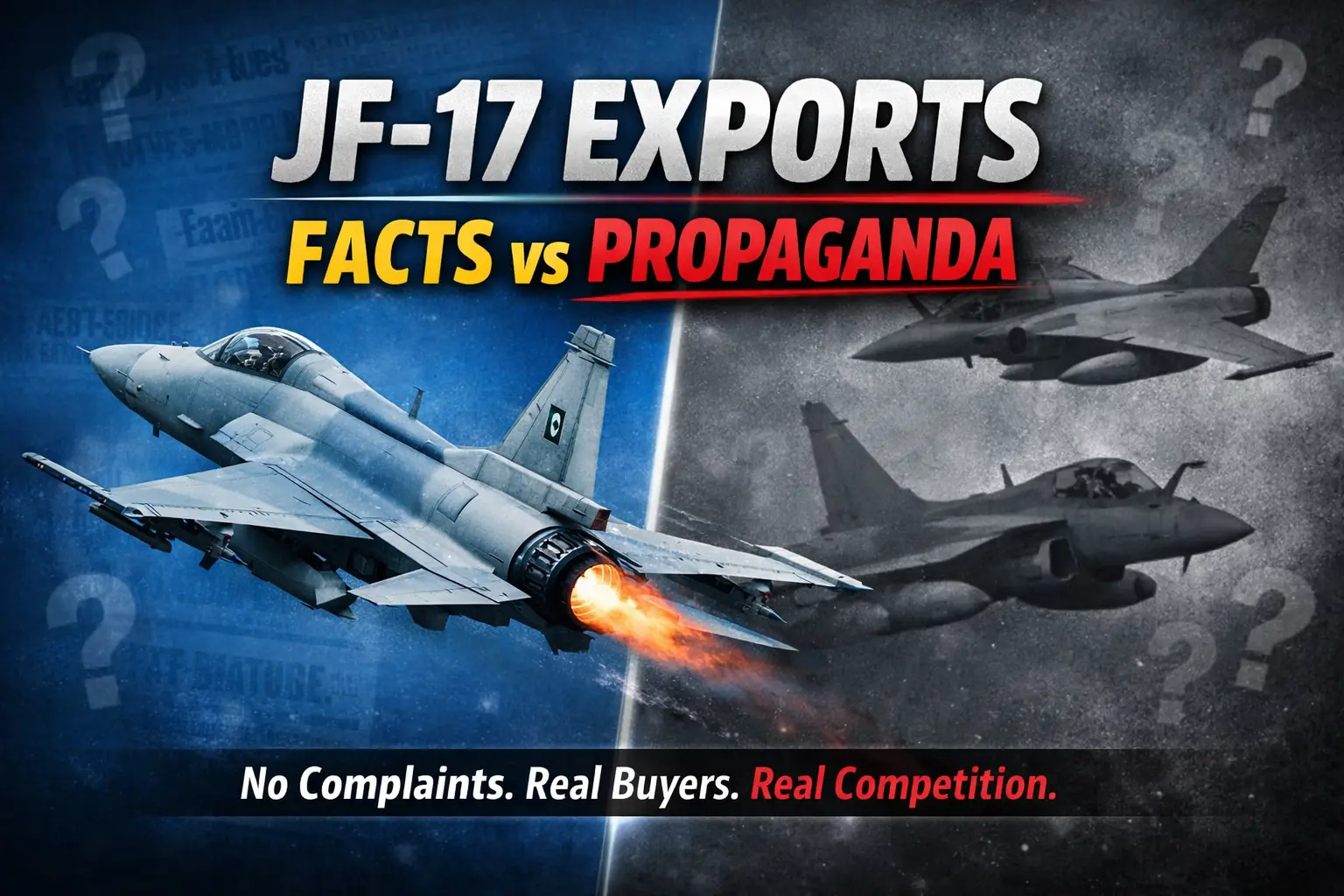

In recent months, a familiar narrative has resurfaced across sections of international media and rival defence commentary: that Pakistan has “exaggerated” the export success of the JF-17 Thunder.
The allegation suggests inflated claims, overstated interest, and a supposedly misleading portrayal of market demand.
Yet when this narrative is stripped of rhetoric and examined through facts, buyer behaviour, and defence-industry realities, a different picture emerges — one that points less toward overclaiming by Pakistan and more toward competitive propaganda by rival aerospace manufacturers seeking to undermine confidence in a cost-effective challenger.
The Competitive Reality of the Global Fighter Jet Market
The international combat aircraft market is not merely commercial — it is strategic, political, and intensely competitive.
Every potential sale impacts:
•Industrial supply chains
•Regional military balances
•Long-term sustainment contracts
•Strategic alliances
In this environment, information warfare is standard practice.
Western and regional aerospace giants such as:
•Lockheed Martin
•Dassault Aviation
•Saab
do not merely compete on performance — they compete on narrative control.
The JF-17’s rise as an affordable, multirole, politically flexible fighter directly threatens legacy suppliers whose platforms often cost three to four times more, both to acquire and to operate.
No User Complaints: The Most Ignored Fact
One striking omission in nearly all critical commentaries is this:
No existing JF-17 operator has filed formal complaints regarding misrepresentation or overclaiming.
Countries currently operating the aircraft have:
•Continued fleet induction
•Requested upgrades
•Entered follow-on negotiations
•Integrated the platform into frontline squadrons
In the defence world, dissatisfaction is rarely subtle. Aircraft that fail expectations are:
•Grounded
•Returned
•Publicly criticised
•Quietly replaced
None of these indicators exist in the JF-17’s operational history.
Buyers Are Not Naïve — They Are Sovereign Decision-Makers
A persistent undertone in criticism is the implicit assumption that new buyers are being “misled.”
This assumption borders on institutional arrogance.
Air forces do not purchase fighter jets based on brochures or press conferences.
They conduct:
•Multi-year technical evaluations
•Live flight assessments
•Radar and weapon trials
•Cost-benefit simulations
•Political risk analysis
To suggest that professional air staffs, defence ministries, and national security councils can be “fooled” by Pakistan’s claims is to undermine their competence, not Pakistan’s credibility.
The “Interest vs Contract” Argument: A Manufactured Talking Point
Critics frequently weaponise the distinction between “expressions of interest” and “signed contracts.”
While technically accurate, the argument is deliberately misleading.
In the aerospace industry:
•Interest → evaluation → negotiation → financing → training → contract
is a normal pipeline, often spanning 5–8 years.
Ironically, the same media outlets celebrating Western fighter deals often announce them years before contracts are finalised — yet apply a double standard when Pakistan does the same.
Why the JF-17 Is Disruptive — And That’s the Real Issue
The JF-17 does not threaten competitors by outperforming them in every metric.
It threatens them by redefining value.
Key strengths include:
•Low acquisition cost
•Low lifecycle and maintenance cost
•No political usage restrictions
•Flexible weapons integration
•Indigenous upgrade pathways via Pakistan Aeronautical Complex
For developing and mid-tier air forces, the choice is often not between the JF-17 and a Rafale or F-16 — but between having a modern air force or not having one at all.
That reality unsettles traditional suppliers.
Media Narratives as Strategic Tools
Negative reporting on defence platforms is rarely accidental.
Such narratives serve to:
•Raise buyer doubts
•Delay procurement decisions
•Pressure financing institutions
•Signal diplomatic displeasure
This technique has been used historically against:
•Chinese UAV exports
•Turkish defence systems
•South Korean fighter programs
The JF-17 is now experiencing the same treatment — a sign not of weakness, but of market relevance.
Pakistan’s Messaging: Confidence, Not Deception
Pakistan’s public communication on the JF-17 reflects strategic confidence, not deception.
Highlighting:
•Ongoing talks
•Expressions of interest
•Evaluation visits
is standard practice in defence diplomacy.
What Pakistan does not do is fabricate operational data, falsify performance, or misstate delivered capabilities — actions that would immediately trigger international backlash.
The absence of such backlash from users speaks louder than anonymous critiques.
The Psychological Objective Behind the Criticism
At its core, the criticism seeks to:
1.Create doubt among undecided buyers
2.Frame Pakistan as unreliable
3.Protect competitor market share
4.Maintain technological hierarchies
This is psychological warfare within the defence export domain, not an objective audit of aircraft performance.
Conclusion: Judge Aircraft by Operators, Not Commentators
The JF-17 Thunder should be evaluated the same way all combat aircraft are evaluated:
•By operational users
•By sustained service
•By repeat engagement
•By real-world integration
On all four counts, the aircraft continues to perform credibly.
Until a single operator publicly claims deception or failure, the allegation of “exaggeration” remains what it truly is:
a competitor-driven narrative designed to slow momentum, not expose truth.
In the modern aerospace market, success is not denied by critics —
it is confirmed by the effort spent trying to undermine it.