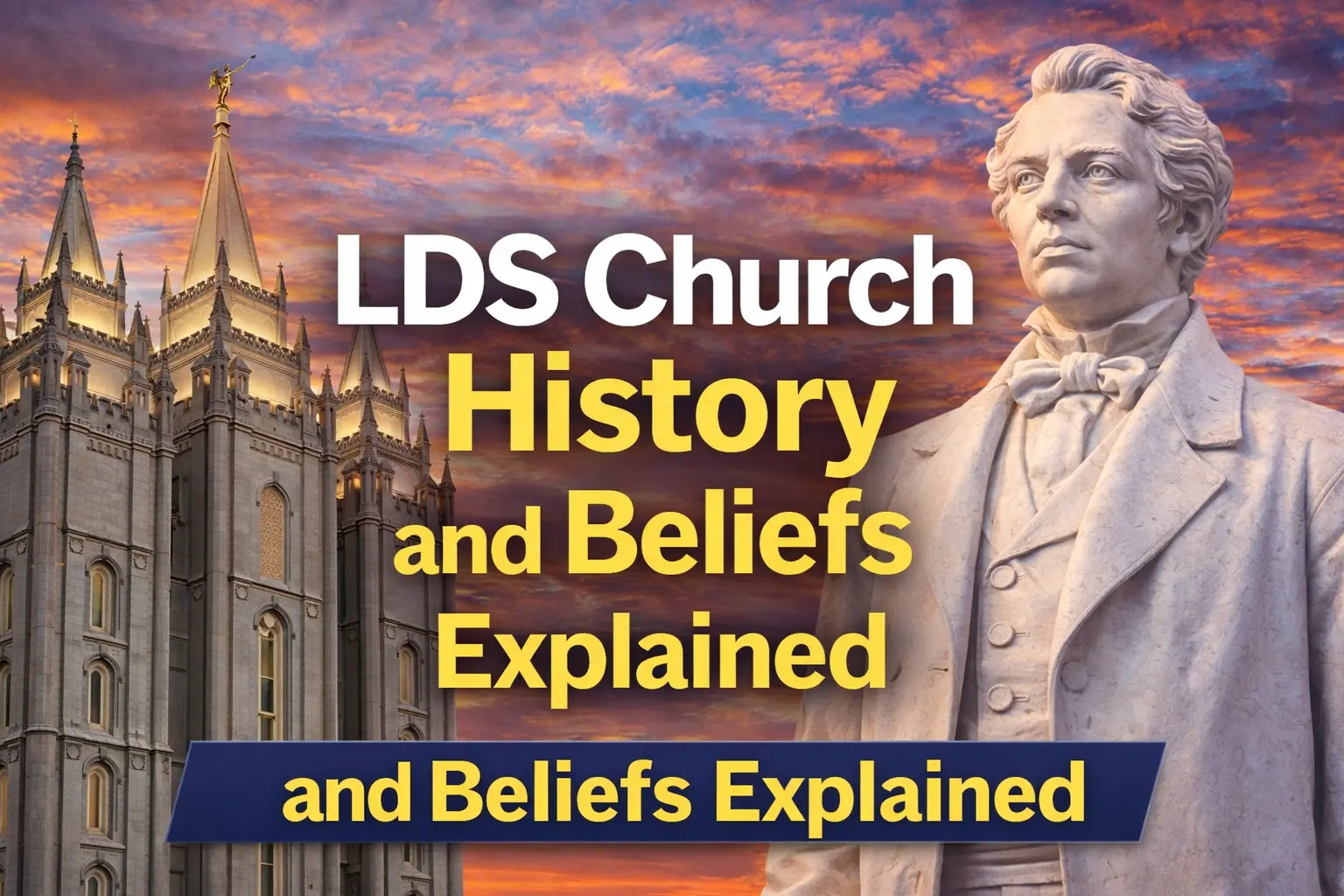

The LDS Church, officially called the Church of Jesus Christ of Latter-day Saints, is one of the most discussed religious movements to emerge from 19th-century America. Some call it the Mormon Church, while members prefer the full name because it centers on Jesus Christ.
When I first began researching the LDS Church, I noticed something interesting. People often describe it with strong emotions — admiration, curiosity, suspicion, or criticism. But very few take the time to calmly explain both its history and beliefs in a clear, structured way. That is what this article aims to do.
This is not an attack or a defense. It is an explanation.
The Historical Beginning: Joseph Smith and Restoration
The LDS Church was founded on April 6, 1830, by Joseph Smith in New York during a period known as the Second Great Awakening a time of intense religious revival in America.
According to Joseph Smith, as a teenager he prayed to ask which church was true. He later reported a vision in which God the Father and Jesus Christ appeared to him and told him that existing churches had lost original authority. This idea became the foundation of LDS theology: restoration, not reformation.
A few years later, Smith claimed that an angel named Moroni directed him to golden plates buried near his home. These plates, he said, contained a record of ancient prophets in the Americas. Smith translated them into what became the Book of Mormon, published in 1830.
From a historical perspective, this claim remains debated. Believers see it as divine revelation. Critics question the historical and archaeological support. What cannot be denied, however, is the impact. Within a few years, a structured religious movement had formed.
After Joseph Smith was killed in 1844, leadership passed to Brigham Young, who led followers west to Utah. That migration shaped Mormon identity deeply — a people who survived persecution and built a religious society in the desert.
Today, the Church headquarters remains in Salt Lake City, Utah.
What Do Latter-day Saints Believe?
The LDS Church identifies as Christian, but its theology differs from traditional Catholic and Protestant Christianity in important ways.
1. Scripture Beyond the Bible
Latter-day Saints accept four main scriptures:
-
The Bible
-
The Book of Mormon
-
Doctrine and Covenants
-
Pearl of Great Price
This open canon is one of the biggest theological differences from mainstream Christianity.
Personally, when I compared passages from the Book of Mormon with the New Testament, I noticed strong emphasis on Jesus Christ, repentance, baptism, and covenant relationships. The tone is devotional and mission-focused.
2. The Nature of God
The LDS Church is nontrinitarian. Members believe:
-
God the Father, Jesus Christ, and the Holy Spirit are separate beings
-
God has a glorified physical body
-
Humans can progress spiritually toward exaltation
This idea of eternal progression is unique and often misunderstood.
Traditional Christianity teaches that God is eternally God and humans remain created beings. LDS theology presents a different vision one centered on growth, family, and eternal potential.
3. Salvation and the Plan of Salvation
Salvation in LDS belief includes:
-
Faith in Jesus Christ
-
Repentance
-
Baptism
-
Obedience to commandments
-
Temple ordinances
Members follow what is called the Plan of Salvation, which includes pre-mortal life, earthly life, and eternal kingdoms after death.
Unlike some Protestant traditions that emphasize “faith alone,” LDS belief combines faith with covenant obedience and ritual participation.
Temple Worship and Covenants
One area competitors often oversimplify is temple life.
LDS temples are not regular Sunday churches. They are sacred spaces for special ordinances such as:
-
Endowment ceremonies
-
Eternal marriage (sealing)
-
Baptism for the dead
When I spoke with LDS members about temple worship, they described it as deeply personal and spiritual rather than secretive. Outsiders often focus on mystery, but members focus on covenant.
Understanding this distinction helps explain why temple building is central to LDS expansion worldwide.
The Polygamy Question
No serious discussion of LDS history can ignore polygamy.
Joseph Smith introduced plural marriage in the 1840s. The practice became public under Brigham Young. It created massive political and social tension in the United States.
In 1890, church leadership officially ended new plural marriages. In 1904, strict enforcement followed. Today, the LDS Church does not practice polygamy, although small breakaway groups still do.
The historical controversy still shapes public perception, even though modern LDS families practice monogamy.
Leadership Structure and Modern Organization
The LDS Church operates with a clear hierarchy:
-
President (Prophet)
-
Quorum of the Twelve Apostles
-
Area authorities
-
Stakes and wards
Local bishops are typically unpaid volunteers. This surprised me during my research. Many serve while maintaining full-time jobs.
The Church also emphasizes missionary work. Young men and women commonly serve missions for 18–24 months. As of recent reports, the Church has millions of members worldwide and tens of thousands of missionaries.
Missionary culture plays a major role in growth. Sociological studies suggest conversion often happens through friendships rather than cold introductions.
Women in the LDS Church
Women do not hold priesthood offices, which is often criticized. However, women lead large auxiliary organizations, teach, serve missions, and influence community structure strongly.
From conversations I’ve had, LDS women often describe their role as spiritually equal but functionally distinct. Whether one agrees with this framework or not, it is central to LDS identity.
Growth and Global Influence
From a few dozen followers in 1830, the LDS Church has grown into a global religious organization with congregations across continents.
Its strength lies in:
-
Strong family structure
-
Clear moral code (Word of Wisdom health law)
-
Structured community life
-
Strong internal loyalty
Unlike casual religious affiliation seen in some Western societies, LDS membership tends to involve active participation.
Is the LDS Church Christian?
This question generates debate.
Latter-day Saints affirm belief in Jesus Christ as Savior. However, differences in the Trinity doctrine, additional scripture, and theology of exaltation lead many Catholics, Orthodox Christians, and Evangelicals to consider it outside traditional Christianity.
From a historical perspective, religious identity boundaries often shift over time. What begins as a movement may later be seen as a branch — or as a distinct religion entirely.
Rather than labeling, it is more helpful to understand the theological differences clearly.
My Personal Reflection
While researching LDS Church history and beliefs, I realized something important.
Religions are not just systems of doctrine. They are communities shaped by conviction, sacrifice, structure, and identity.
Whether one agrees with LDS theology or not, the movement represents one of the most organized and resilient religious expansions in modern history.
The real story is not just about golden plates or doctrinal debates. It is about how belief shapes community — and how community shapes endurance.