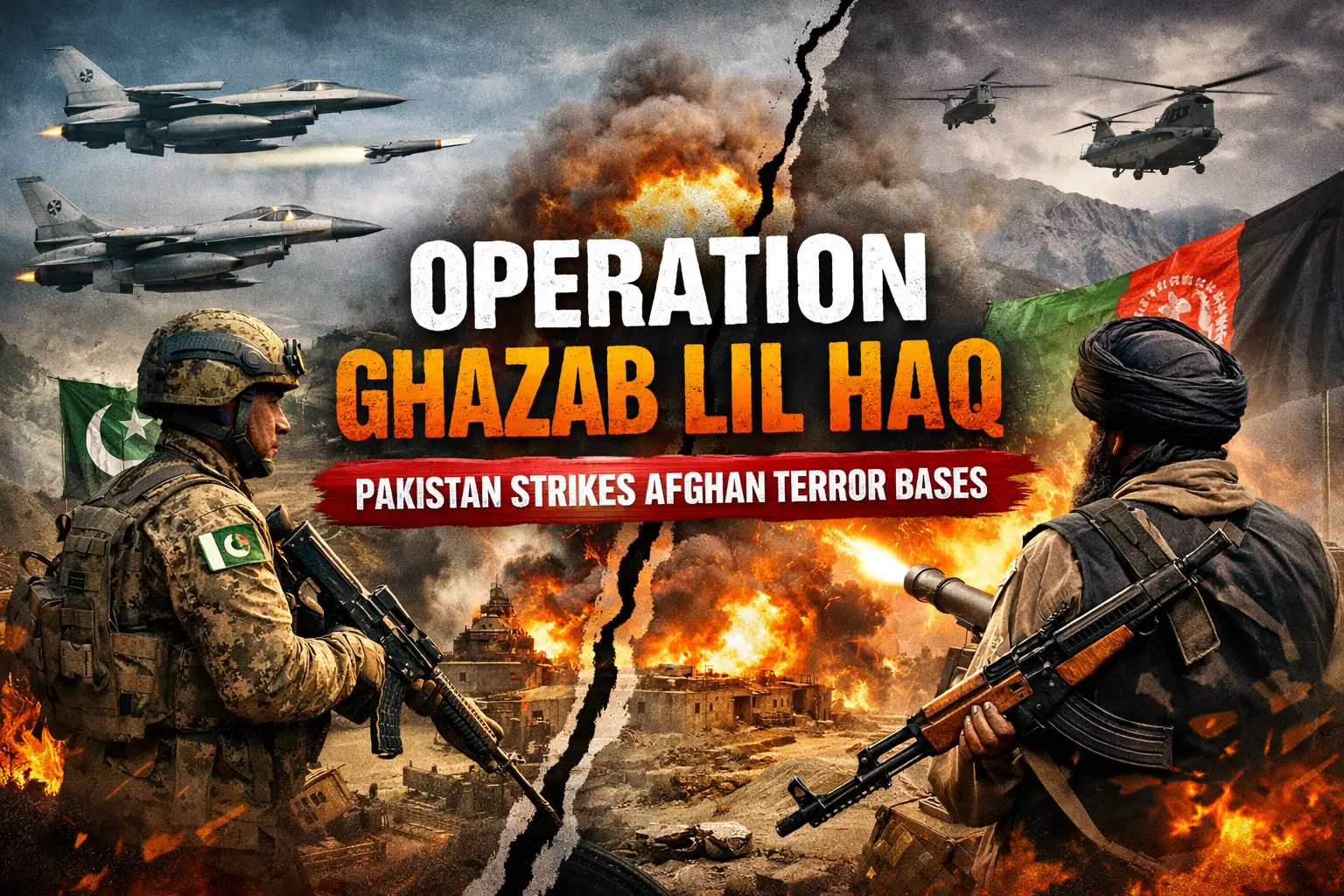

Pakistan’s launch of Operation Ghazab Lil Haq marks more than a retaliatory strike — it signals the beginning of a hardened security doctrine along the western frontier. After years of restraint, warnings, and diplomatic engagement, Islamabad appears to have concluded that tolerance has only emboldened hostile actors operating from Afghanistan.
This is no longer a border skirmish. It is a test of sovereignty, deterrence credibility, and regional alignment.
The Core Issue: Sanctuary and State Responsibility
At the center of the crisis lies one fundamental question: Who controls Afghan territory?
Pakistan’s security establishment maintains that Tehreek-e-Taliban Pakistan (TTP) continues to operate from Afghan soil, launching cross-border attacks that kill Pakistani soldiers and civilians. Despite repeated diplomatic engagements, intelligence sharing, and high-level talks, the infrastructure of militancy has not been dismantled.
Islamabad’s calculation appears clear:
If Kabul cannot control these elements — or refuses to — then Pakistan will neutralize the threat directly.
This represents a strategic shift from reactive defense to proactive denial.
The India Variable: Strategic Depth Reversed
Within Pakistan’s security discourse, there is a growing perception that hostile intelligence networks are exploiting Afghan territory to stretch Pakistan on two fronts. Whether through direct support, facilitation, or permissive neglect, the belief in Islamabad is that instability in the west complements pressure from the east.
Pakistan has historically feared encirclement. What we are witnessing now is an attempt to break that perception through kinetic signaling.
Operation Ghazab Lil Haq sends a message:
Pakistan will not allow its western frontier to become a secondary pressure point while it manages eastern deterrence dynamics.
From Restraint to Retaliatory Dominance
For several years following the Taliban’s return to power, Pakistan exercised caution. There was an expectation that ideological proximity and past cooperation would translate into border stability.
Instead, attacks intensified.
The doctrine now appears recalibrated around three pillars:
1.No safe havens across the Durand Line
2.Immediate retaliation for cross-border aggression
3.Cost imposition as deterrence
Military actions reportedly include precision airstrikes, heavy artillery engagement, drone surveillance, and reinforcement of forward posts. The objective is not territorial expansion. It is punitive disruption.
Deterrence only works when consequences are visible and sustained.
The Risk of Miscalculation
However, escalation carries its own dangers. Afghanistan does not formally recognize the Durand Line as a settled border. Nationalist sentiment within Kabul can transform tactical exchanges into symbolic resistance.
If Afghan authorities respond militarily instead of dismantling militant infrastructure, the conflict risks morphing from counter-terrorism into state-to-state confrontation.
Pakistan must therefore walk a calibrated line:
•Be forceful enough to restore deterrence
•Avoid full-scale conventional entanglement
•Maintain diplomatic channels open
Strategic punishment is effective only if it remains controlled.
A Message to Kabul — Not the Afghan People
It is critical to separate the Afghan population from the decisions of power centers. Prolonged instability harms ordinary Afghans as much as it harms Pakistanis. Economic corridors, trade routes, and humanitarian flows are already fragile.
But sovereignty carries responsibility.
If armed groups use Afghan territory to attack Pakistan and those groups are not restrained, then Islamabad will treat the territory as a launch platform for hostility.
That is the hard logic of national security.
The Broader Regional Implication
The operation also reshapes regional calculations:
•It signals to militant networks that sanctuary is no longer guaranteed.
•It signals to regional rivals that Pakistan retains escalation dominance in the western theater.
•It tests whether Kabul prioritizes ideological alignment or state stability.
If Afghanistan continues to permit cross-border militancy, it risks strategic isolation and sustained military pressure. If it acts decisively against the TTP, de-escalation becomes possible.
The choice lies in Kabul.
The Strategic Endgame
Pakistan’s objective is unlikely to be occupation or long-term deployment. The objective is compliance through deterrence.
The endgame scenario Islamabad seeks likely includes:
•Verifiable dismantling of TTP infrastructure
•Formal border management mechanisms
•Clear red lines backed by force
Without those elements, cycles of violence will continue.
Conclusion: A Doctrine Under Testing
Operation Ghazab Lil Haq is not just a military maneuver — it is a doctrinal declaration. Pakistan appears to be saying that cross-border terrorism will now trigger cross-border consequences.
The coming days will determine whether this becomes a short punitive episode or the beginning of a prolonged coercive strategy.
One reality is clear:
Deterrence that is not enforced eventually collapses. Pakistan has chosen enforcement.
Whether Kabul chooses confrontation or correction will decide the future of the western frontier.