
On the cold morning of 22 February 2026, families living near the mountainous belt of eastern Afghanistan woke not to the sound of birds or morning prayers — but to the roar of fighter jets.
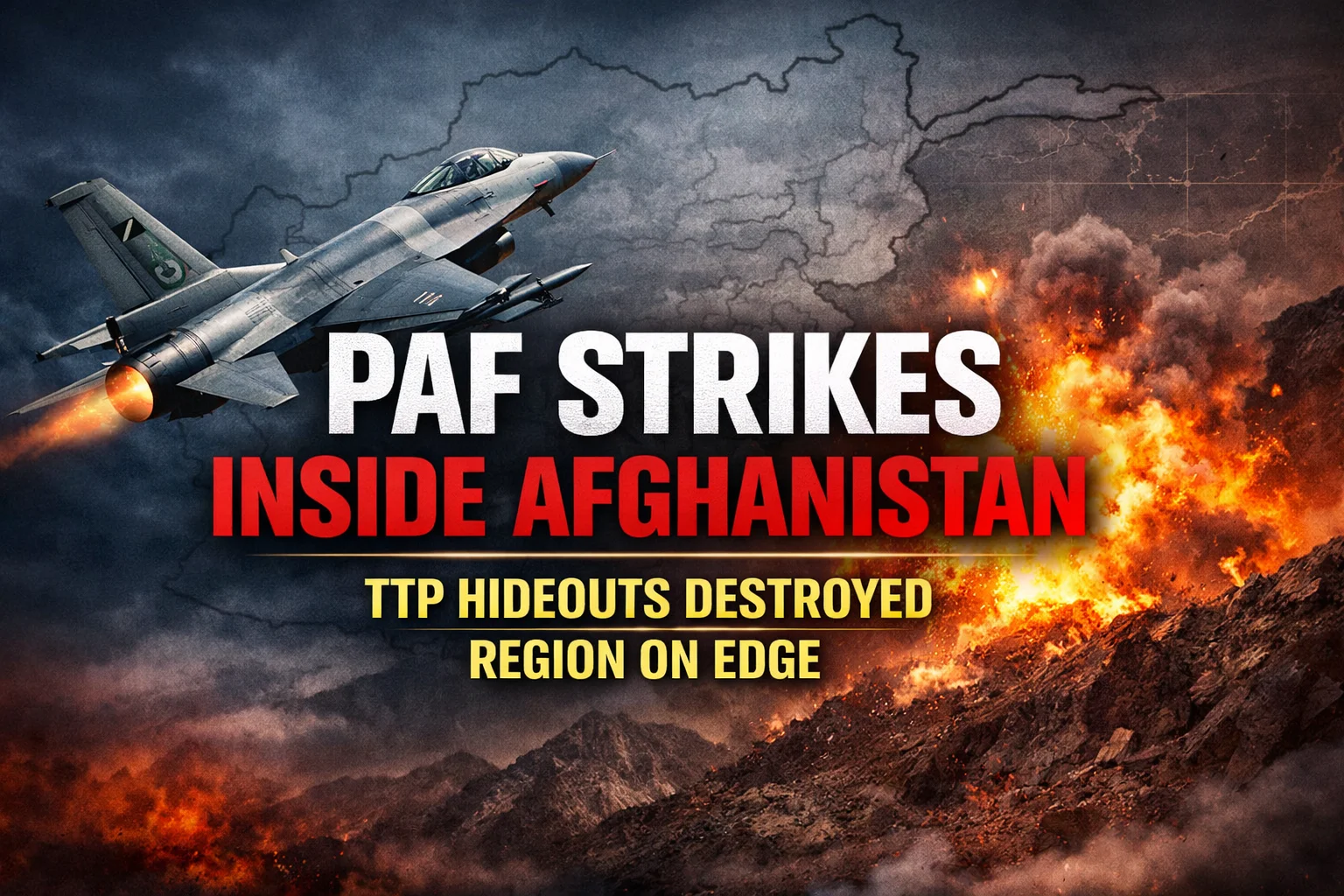
Within hours, it was confirmed: the Pakistan Air Force (PAF) had launched precision airstrikes inside Afghanistan, targeting what Islamabad described as Tehreek-i-Taliban Pakistan (TTP) safe havens and terrorist training camps in Nangarhar and Paktika provinces.
For Pakistan, it was an act of self-defense.
For Afghanistan, it was a violation of sovereignty.
For the region, it was a reminder that South Asia’s security crisis remains dangerously fragile.
But beyond official statements and political reactions lie human lives, grieving families, soldiers on edge, and a region struggling to escape decades of mistrust.
The Trigger: Cross-Border Terrorism Returns
Pakistan has faced a sharp spike in cross-border terrorism over the past year. Suicide bombings in Islamabad, Bajaur, and Bannu, targeted killings of security personnel, and attacks on mosques and police stations have once again placed the country on high alert.
According to Islamabad, intelligence traced the planners of several recent attacks to TTP hideouts operating from Afghan soil. The group, banned in Pakistan and internationally recognized as a terrorist organization, has long used rugged border terrain as sanctuary.
For many Pakistanis, especially those in Khyber Pakhtunkhwa, this is not abstract geopolitics — it is personal trauma. It is funerals of soldiers. It is children afraid to walk to school. It is the return of memories from the darkest years of insurgency.
The Pakistan Air Force Afghanistan strikes 2026 were presented as a message: Pakistan will not allow militant sanctuaries across the border to destabilize its cities.
What Happened on 22 February 2026?
Before dawn, Pakistani aircraft carried out targeted strikes on seven alleged terrorist camps. Islamabad described the operation as “intelligence-based, limited, and precise.”
Officials claimed 70–80 militants were eliminated, including mid-level commanders linked to recent attacks.
However, Afghan authorities reported that at least 18 civilians, including women and children, were killed when residential structures were hit. Kabul condemned the strikes as a violation of Afghan sovereignty and warned of consequences.
This is the tragic duality of modern conflict:
•One side claims counter-terrorism success.
•The other counts civilian casualties.
And in between are ordinary people — farmers, shopkeepers, children — who neither planned attacks nor ordered airstrikes.
The Human Cost: Civilians in the Crossfire
Every Afghanistan–Pakistan border conflict has a similar pattern. The terrain is unforgiving. Intelligence is imperfect. Militants embed themselves among civilian populations.
For families living in Nangarhar and Paktika, geopolitics does not matter as much as survival.
•Homes reduced to rubble.
•Fear spreading across villages.
•Parents burying children.
•Young men vulnerable to radical recruitment fueled by anger.
This humanitarian dimension is critical. Civilian casualties — whether unintended or not — can deepen resentment and perpetuate cycles of retaliation.
Security operations must always balance military necessity with civilian protection. Failure to do so risks turning tactical gains into strategic setbacks.
Afghanistan–Pakistan Relations: A Trust Deficit
The Afghanistan Pakistan border conflict is not new. It is rooted in decades of mistrust, disputed narratives, and fragile diplomacy.
Pakistan argues that Kabul has failed to prevent its territory from being used by TTP safe havens.
Kabul argues that Pakistan externalizes its internal security problems.
Since the Taliban takeover of Afghanistan, Islamabad expected stronger action against anti-Pakistan militant groups. But governance challenges, internal factionalism, and limited resources have made comprehensive counter-terrorism enforcement difficult for Kabul.
Attempts at dialogue, including ceasefires and mediated talks, have repeatedly collapsed. The February 2026 airstrikes demonstrate how quickly diplomacy can give way to force.
India’s Role in Not Letting the Issue Settle
No analysis of South Asia security is complete without examining India’s role in Afghanistan.
India has historically invested heavily in Afghan infrastructure, development projects, and diplomatic engagement. Roads, dams, hospitals — these are tangible contributions.
However, from Pakistan’s strategic viewpoint, Indian involvement in Afghanistan carries deeper geopolitical implications.
1. Strategic Encirclement Perception
Islamabad has long viewed India’s presence in Afghanistan as part of a broader strategy to create strategic pressure on Pakistan’s western and eastern fronts simultaneously.
Even when direct evidence of operational collaboration with militant actors is debated or limited, the perception alone shapes Pakistani security calculations.
In geopolitics, perception can be as powerful as reality.
2. Diplomatic Positioning
Following the PAF airstrikes in Afghanistan 2026, India condemned Pakistan’s action, emphasizing civilian casualties and sovereignty concerns.
While humanitarian concerns are valid, critics argue that such diplomatic positioning:
•Weakens Pakistan’s counter-terrorism narrative internationally.
•Avoids strong condemnation of TTP cross-border terrorism.
•Reinforces Kabul’s resistance to acknowledging militant safe havens.
From Islamabad’s perspective, this diplomatic pressure complicates efforts to establish joint mechanisms against terrorism.
3. Prolonged Instability Benefits Strategic Rivalry
A stable Afghanistan aligned in security cooperation with Pakistan would reduce Islamabad’s internal vulnerability. Continued instability, however, keeps Pakistan preoccupied.
Strategic analysts often argue that regional instability indirectly benefits rival powers by constraining Pakistan’s focus and resources.
Whether deliberate or circumstantial, India’s influence in Afghan affairs remains a central variable in the equation.
Regional and International Implications
The South Asia geopolitical crisis triggered by these strikes has broader consequences:
1. Risk of Escalation
If Afghanistan responds militarily, the situation could escalate into sustained border clashes.
2. Militant Recruitment
Civilian casualties can be exploited by extremist groups for propaganda and recruitment.
3. Diplomatic Fallout
International actors — including China, the Gulf states, and Western powers — may push for de-escalation to prevent regional destabilization.
4. Economic Impact
Border instability affects trade routes, regional connectivity projects, and investor confidence.
Security vs Sovereignty: The Legal Debate
Under international law, cross-border strikes are controversial. States invoke the right to self-defense against non-state actors when the host country is “unable or unwilling” to act.
Pakistan appears to justify its action under this doctrine.
Afghanistan rejects that framing, asserting that sovereignty must not be violated.
This legal grey zone increasingly defines modern counter-terrorism conflicts worldwide.
The Way Forward: Breaking the Cycle
Airstrikes may disrupt militant networks temporarily. But lasting stability requires:
1.Joint intelligence mechanisms between Kabul and Islamabad.
2.Clear verification of militant presence in border zones.
3.Confidence-building measures to rebuild trust.
4.Humanitarian protection protocols to minimize civilian harm.
5.Regional dialogue including India, to prevent proxy competition.
Without these steps, the Afghanistan Pakistan crisis will remain cyclical.
A Human Reflection
For policymakers, this is strategy.
For generals, it is doctrine.
For diplomats, it is leverage.
But for families on both sides of the border, it is grief.
The mother in Bajaur who lost her son in a suicide bombing.
The father in Nangarhar who lost his daughter in an airstrike.
Neither designed regional geopolitics. Yet both pay its price.
Conclusion
The Pakistan Air Force strikes on Afghan terrorist hideouts on 22 February 2026 are more than a military operation. They represent the intersection of:
•Counter-terrorism imperatives
•Sovereignty disputes
•India-Pakistan rivalry
•Afghanistan’s internal fragility
•The broader South Asia security crisis
Whether this moment becomes a turning point toward cooperation — or another chapter in prolonged instability — depends on leadership, restraint, and strategic maturity across the region.
History shows that wars are easy to start.
Peace requires courage.