
Power in modern warfare is no longer measured only by how many aircraft a country flies.
It is measured by who trusts you with their best technology, who plans with you behind closed doors, and who is willing to share not just platforms — but intent.
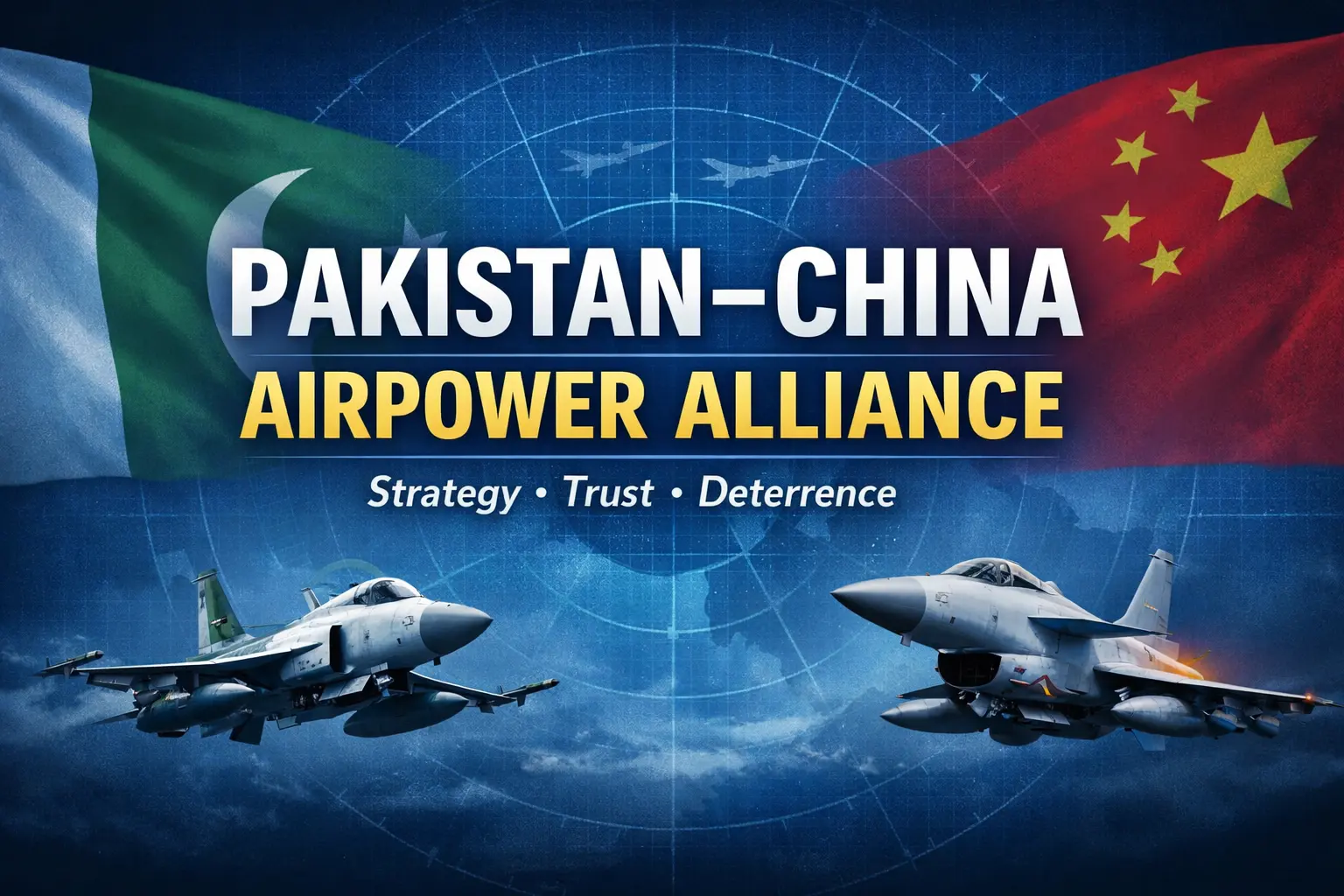
In this evolving reality, Pakistan’s growing role as China’s primary international operator of combat aircraft is far more than a defence procurement story. It is a window into a deeper strategic alignment that blends military necessity, long-term planning, and psychological warfare.
This partnership did not emerge overnight.
It has been shaped deliberately — over decades.
China’s Arms Strategy: Selling Systems, Building Influence
China today stands among the world’s leading arms exporters. But unlike traditional Western suppliers, Beijing’s defence exports are not driven by profit alone. They are part of a broader strategic play.
Chinese military platforms offer:
•Competitive pricing
•Modern, combat-relevant technology
•Flexible financing
•Fewer political strings
For many countries, this makes China an attractive alternative.
For Pakistan, it makes China a strategic enabler.
What separates Pakistan from other recipients is not volume — it is depth of trust. Pakistan is not treated as a customer on the periphery. It is treated as a core partner, one trusted to operate sensitive systems in a high-threat environment.
That distinction matters.
The J-10C: More Than a Fighter Jet
When the Pakistan Air Force inducted the J-10C multirole fighter, it sent a message — even without saying a word.
Today, Pakistan remains the only country outside China to operate the J-10C. That fact alone carries strategic weight.
Militarily, the aircraft enhances Pakistan’s air combat capability through:
•Advanced radar and sensor fusion
•Modern electronic warfare systems
•Network-centric operations
•Long-range air-to-air engagement
But the real impact lies elsewhere.
The J-10C introduces uncertainty into adversary planning. It forces rival air forces to reassess assumptions, revisit doctrines, and question timelines. In air warfare, uncertainty is power.
From a psychological warfare perspective, the J-10C is not just an aircraft — it is a signal of confidence from Beijing and a deterrent narrative tool for Islamabad.
JF-17 Thunder: The Backbone of Resilience
If the J-10C represents elite capability, the JF-17 Thunder represents endurance.
The JF-17 is often discussed in technical terms, but its true value is strategic. Jointly developed with China, the aircraft allows Pakistan to maintain combat strength without being hostage to foreign political pressure or economic shocks.
It delivers something rare in the developing world:
controlled self-reliance.
For Pakistan, the JF-17 ensures:
•Sustainable fleet numbers
•Indigenous maintenance and upgrades
•Continuous modernization
•Export credibility
Each new block, each upgrade, quietly challenges the narrative that Pakistan’s airpower is stagnant or dependent. Instead, it projects continuity, which is crucial in long-term deterrence.
And continuity is something adversaries cannot ignore.
Unmanned Systems: The Silent Force Multiplier
Not all power flies with a pilot onboard.
Pakistan’s growing inventory of Chinese unmanned aerial vehicles (UAVs) adds a quieter but decisive layer to its airpower strategy. These systems extend Pakistan’s reach in surveillance, targeting, and precision strike — without the political and operational risks associated with manned aircraft.
UAVs change the psychology of conflict.
They shorten reaction times.
They blur escalation thresholds.
They force constant vigilance.
In modern hybrid warfare, this kind of pressure can be as effective as kinetic force. China’s willingness to provide such systems further highlights the depth of strategic confidence between the two states.
Beyond the Air: Joint Domain Thinking
The Pakistan–China defence relationship is not confined to the skies. Chinese naval platforms operating alongside Pakistani forces, supported by air and surveillance assets, point to integrated, multi-domain planning.
This matters because modern conflicts are not fought in isolation.
Air power influences naval outcomes.
Naval presence shapes air strategy.
Information warfare ties it all together.
For regional rivals, this creates a complex deterrence puzzle. Planning against Pakistan now requires factoring in Chinese-origin systems operating seamlessly across domains.
That complexity is intentional.
Psychological Warfare: The Unspoken Layer
Perhaps the most important aspect of Pakistan’s position as China’s leading combat aircraft partner is one rarely discussed openly: psychological warfare.
Every induction, every joint exercise, every controlled disclosure serves multiple audiences:
•Domestic reassurance
•Regional deterrence
•Global signalling
Unlike dramatic press conferences or exaggerated claims, this approach relies on quiet credibility. Capabilities are demonstrated just enough to be noticed — but not fully revealed.
This form of PsyWar is subtle, mature, and effective.
It shapes perception without provoking escalation.
What This Means for the Region
Pakistan’s deep aerospace integration with China produces several long-term effects:
•Reduced exposure to sanctions or supply disruptions
•Sustained qualitative balance despite numerical gaps
•Greater freedom to adapt doctrine and tactics
•Enhanced deterrence through ambiguity
For India, it complicates air dominance narratives.
For external powers, it challenges assumptions about alignment and influence.
For Pakistan, it provides strategic breathing space.
And in South Asia, breathing space is stability.
Conclusion: A Partnership Built for Time, Not Headlines
Pakistan’s emergence as China’s principal international combat aircraft partner is not a headline-driven development. It is the result of patient strategy, mutual trust, and shared threat perception.
This relationship is not about chasing the latest platform or matching adversaries plane for plane. It is about staying relevant, resilient, and unpredictable — qualities that matter far more in modern warfare.
In an age where perception often precedes conflict, Pakistan’s airpower partnership with China ensures one critical thing:
It is never underestimated.