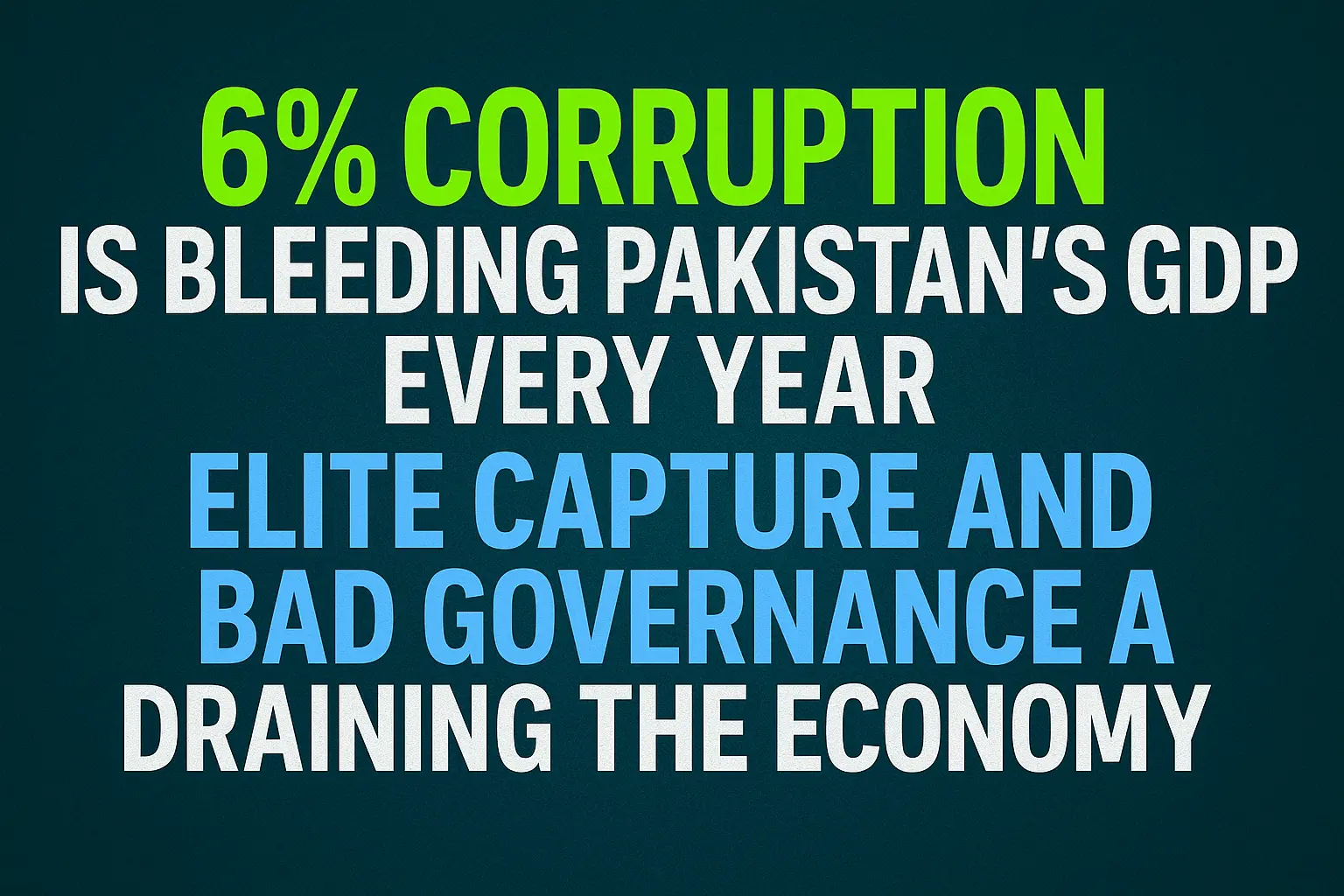
For years, Pakistanis have lived with a quiet suspicion that corruption was costing them more than bad policies or external shocks ever could. Now the International Monetary Fund (IMF) has put a number—finally—on what this decay actually looks like. According to the IMF’s 2025 Governance and Corruption Diagnostic Assessment, Pakistan’s economy is losing the equivalent of 5% to 6.5% of its GDP because of corruption, institutional breakdown, and elite capture.
This finding isn’t a political slogan. It isn’t opposition rhetoric. It’s a blunt conclusion from the world’s most influential financial institution. And it tells a story we’ve avoided for far too long: Pakistan’s economic crisis is homemade.
A Country That Works for a Few, at the Cost of Millions
The IMF uses a term that explains everything: elite capture.
This is not a metaphor—it is a system. A tightly knit web of political families, influential business lobbies, real-estate empires, bureaucratic networks, cartels and regulatory insiders who shape policies to benefit themselves first and the country last.
According to the IMF, these elites secure:
•special tax exemptions
•regulatory waivers
•subsidies and bailouts
•sweetheart contracts
•exclusive access to public resources
When the most powerful people in the country extract benefits without contributing their fair share, the state collapses inward. Pakistan’s fiscal crisis, debt troubles and stagnant economic growth are not accidental. They are the inevitable outcome of a system built around privilege.
What the “6% GDP Loss” Really Means
Many headlines simplify the IMF conclusion into “Pakistan loses 6% of GDP every year.” The truth is slightly more nuanced — but equally alarming.
The IMF estimates that if Pakistan fixes corruption, strengthens institutions, and shuts down elite privileges, the economy could grow 5% to 6.5% more over the next five years than it currently does.
In other words:
Corruption is not just stealing money. It is blocking national growth.
The economy is effectively being held underwater, forced to breathe through a straw while a handful of groups enjoy clean air at full capacity.
The Tax System: Built to Punish the Weak and Protect the Powerful
At the center of Pakistan’s economic dysfunction is a tax system deliberately shaped to favour the well-connected.
The IMF notes that Pakistan’s tax exemptions, concessions and loopholes drain an estimated 2%–3% of GDP — much of it benefiting large landowners, industrial families, investment groups, and politically influential sectors. Meanwhile:
•Retail and wholesale traders — one of the largest sectors — remain barely taxed.
•Agricultural income escapes meaningful taxation.
•Wealthy groups negotiate “special treatment” based on connections.
So who pays the price? Ordinary citizens.
Every time fuel prices rise, electricity tariffs jump, or indirect taxes increase, it is because the powerful refused to carry their share of the national load.
Pakistan doesn’t have a revenue problem. It has an equality problem.
Public Procurement: Where Corruption Becomes a System
One of the IMF’s most stinging observations concerns Pakistan’s public procurement — from construction contracts to energy deals. Billions of rupees flow through opaque channels where favoritism decides winners, not competition or merit.
Inflated costs, manipulated tenders and politically chosen contractors have turned procurement into a playground for the privileged. This is one of the most direct drains on public resources — money meant for hospitals, schools, transport and development.
When roads crack within months, when infrastructure collapses, when projects stall halfway — it isn’t an accident. It is corruption made visible.
SOEs: Black Holes in the National Budget
State-Owned Enterprises (SOEs) like PIA, Steel Mills, Railways and DISCOs drain hundreds of billions annually. The IMF highlights the same core issues:
•political appointments
•bloated payrolls
•sweetheart contracts
•chronic mismanagement
•almost zero accountability
These enterprises survive only through taxpayer bailouts. That means you — not the politicians who staffed them — pay their losses.
Until SOEs are restructured, depoliticized, or shifted to public-private partnership models, they will remain some of Pakistan’s most expensive mistakes.
A Justice System That Moves Slowly Enough for Corruption to Win
Corruption thrives when consequences are rare.
The IMF cites a justice system where:
•cases drag on for decades
•politically exposed persons rarely face conviction
•investigative agencies overlap, interfere, and contradict each other
•prosecutions collapse due to poor preparation or external pressure
In such an environment, corruption is not just possible — it becomes rational.
Those who loot face no fear. Those who expose wrongdoing face danger. Those who play by the rules face obstacles.
A nation cannot develop when honesty is punished and corruption is a career path.
The Real Cost of Corruption: Pain in Every Household
The 6% GDP loss isn’t an abstract number. It shows up in daily life:
Electricity bills rising faster than salaries
Circular debt, theft, inefficiency and political interference push tariffs higher every year.
Inflation that crushes the poor first and the middle class next
When elites avoid taxes, the government turns to indirect taxes, which hit ordinary people the hardest.
Low-quality education and healthcare
When corruption eats the development budget, children and patients pay the price.
Brain drain
Talented Pakistanis leave because a system that rewards connections instead of merit leaves no room for them.
Unemployment and stagnant wages
Foreign investors avoid markets where corruption distorts competition and contracts are unreliable.
Corruption is not just a moral issue — it is a national economic emergency.
Why This IMF Report Matters More Than Previous Warnings
Pakistan has heard talk of “corruption” for decades. What makes this report different is its scale and its timing.
1. It is the most comprehensive governance review ever conducted on Pakistan.
It examines everything from tax policy to procurement to enforcement.
2. It connects corruption directly to GDP and growth — not just governance.
3. It uses Pakistan’s own data, not external estimates.
4. It offers a detailed roadmap for real reforms, not vague suggestions.
5. Future IMF programs may require measurable anti-corruption actions — not mere promises.
The message is unmistakable:
Pakistan cannot stabilize its economy without fixing the system that governs it.
The Way Forward: What Pakistan Must Do Now
The IMF’s reform blueprint is clear:
•Remove elite tax exemptions
•Digitize and modernize tax administration
•Ensure transparent, open-access public procurement
•Professionalize and restructure loss-making SOEs
•Strengthen judicial independence and speed up corruption cases
•Streamline and empower anti-corruption bodies
None of these require foreign aid.
They require political courage.
Conclusion: Pakistan’s Greatest Enemy Is Not Foreign — It Is Internal
For decades, Pakistan blamed its crisis on global markets, geopolitics, external pressure, or unfriendly neighbors. But the IMF’s latest assessment cuts through all noise:
Pakistan is losing billions because corruption has become part of the operating system.
The real conflict is not between Pakistan and the IMF —
It is between 240 million people and a small class that has shaped the economy around itself.
If Pakistan wants to rise, it must confront the truth the IMF has finally said out loud:
No country can grow when its wealth flows upward instead of outward.
And no reform will succeed until corruption becomes costly and honesty becomes rewarding.
The future of Pakistan’s economy depends on one choice:
Continue protecting the few — or finally build a system that serves the nation.