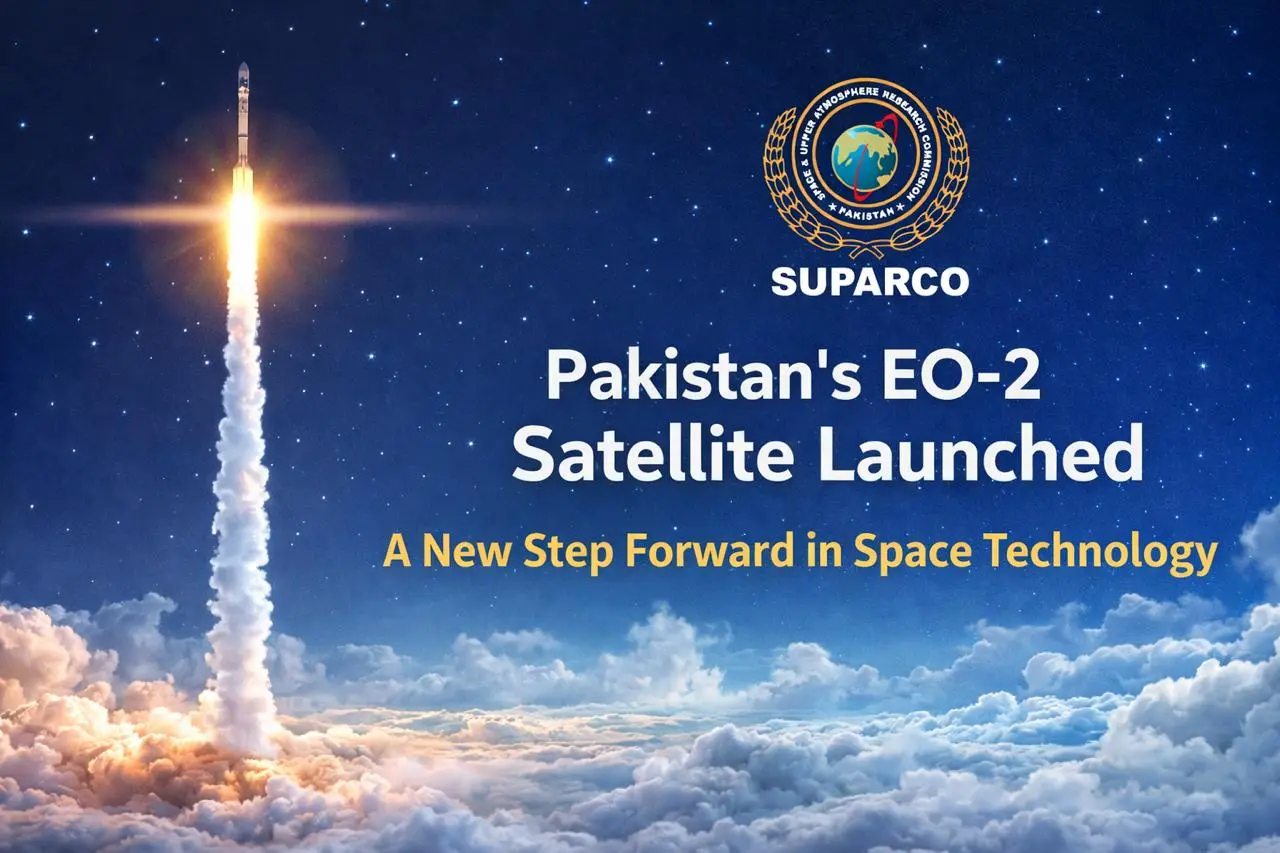

On 12 February 2026, Pakistan reached another meaningful milestone in its national space journey with the successful launch of its second indigenous Electro-Optical Satellite (EO-2) by the Pakistan Space & Upper Atmosphere Research Commission (SUPARCO).
Beyond the technical achievement, EO-2 symbolizes something far more important: space technology being used to improve everyday life, protect the environment, strengthen disaster response, and enhance national security.
This is not merely a satellite in orbit it is a practical national asset serving farmers, planners, rescuers, and defenders of the country.
Civil Applications Space Technology in Everyday Life
Supporting Agriculture and Food Security
Pakistan’s economy and food supply depend heavily on agriculture. EO-2’s high-resolution Earth-observation capability allows experts to monitor crop health, soil moisture, irrigation patterns, and seasonal changes from space.
For farmers across Punjab, Sindh, Khyber Pakhtunkhwa, and Balochistan, this means:
•Early warning of crop disease or water stress
•Smarter use of fertilizer, irrigation, and resources
•Improved crop yield forecasting and food planning
In simple human terms, EO-2 helps ensure greater food security for millions of households.
Faster Disaster Response and Protection of Lives
Pakistan frequently faces floods, earthquakes, landslides, and extreme weather events.
EO-2 enables rapid satellite mapping that can:
•Identify flooded villages and damaged infrastructure within hours
•Locate blocked roads and isolated communities
•Guide rescue and relief teams to the most urgent areas
This shift from delayed assessment to real-time informed response can significantly reduce loss of life and human suffering during emergencies.
Smarter Urban Planning and Environmental Care
As cities expand, challenges such as unplanned construction, pollution, traffic congestion, and shrinking green spaces continue to grow.
EO-2 imagery supports:
•Evidence-based smart city planning
•Monitoring of deforestation, water bodies, and air pollution
•Protection of wetlands, rivers, and natural ecosystems
The long-term impact is clear: cleaner environments, safer cities, and healthier communities for future generations.
Strategic Applications — Security Through Knowledge and Independence
Independent National Observation Capability
In the modern world, access to reliable geospatial information is a pillar of sovereignty.
EO-2 provides Pakistan with locally controlled satellite imagery, reducing dependence on foreign sources during sensitive situations.
This capability enables:
•Continuous situational awareness of borders and strategic regions
•Monitoring of critical infrastructure and regional developments
•Timely decision-making based on trusted national data
Such independence is essential for security, stability, and strategic confidence.
Strengthening Preparedness and Coordination
Today’s security environment depends not only on equipment, but on information, speed, and coordination.
EO-2 supports:
•Better defensive planning and emergency preparedness
•Monitoring of remote and difficult terrain for security management
•Improved coordination between civilian authorities and national institutions
In essence, EO-2 contributes to peace through preparedness and awareness.
The Human Story Behind EO-2
Every satellite represents years of dedication by scientists, engineers, technicians, and students.
EO-2 reflects Pakistan’s growing investment in:
•Local scientific talent and research capability
•Advanced engineering education and innovation
•A national vision built on knowledge, technology, and self-reliance
For young Pakistanis watching this achievement, EO-2 carries a powerful message:
the future of the nation can be shaped through science, learning, and determination.
Why EO-2 Matters for Pakistan’s Future
EO-2 is more than a technological success.
It is a step toward:
•Stronger food and water security
•Faster disaster resilience and humanitarian response
•Better environmental protection and urban planning
•Greater strategic independence in space technology
Simply put, EO-2 connects space science with human wellbeing and national progress.
Conclusion
The successful launch of Pakistan’s EO-2 electro-optical satellite is not merely a scientific milestone; it is a practical national achievement with real human impact. From helping farmers protect crops and enabling faster disaster relief to strengthening environmental monitoring and national preparedness, EO-2 brings the benefits of space technology directly into the lives of ordinary citizens.
At the same time, the satellite enhances Pakistan’s strategic independence in Earth observation, ensuring that critical decisions—whether humanitarian, developmental, or security-related—can be guided by reliable, locally controlled data.
Most importantly, EO-2 reflects a broader national direction: investing in knowledge, innovation, and self-reliance as the foundation for future progress. Sustained commitment to space science and technology will not only expand Pakistan’s capabilities in orbit but also create opportunities on the ground through education, research, and economic development.
In this sense, EO-2 is more than a satellite circling the Earth—it is a symbol of confidence in Pakistan’s scientific future and a step toward a more secure, resilient, and forward-looking nation.