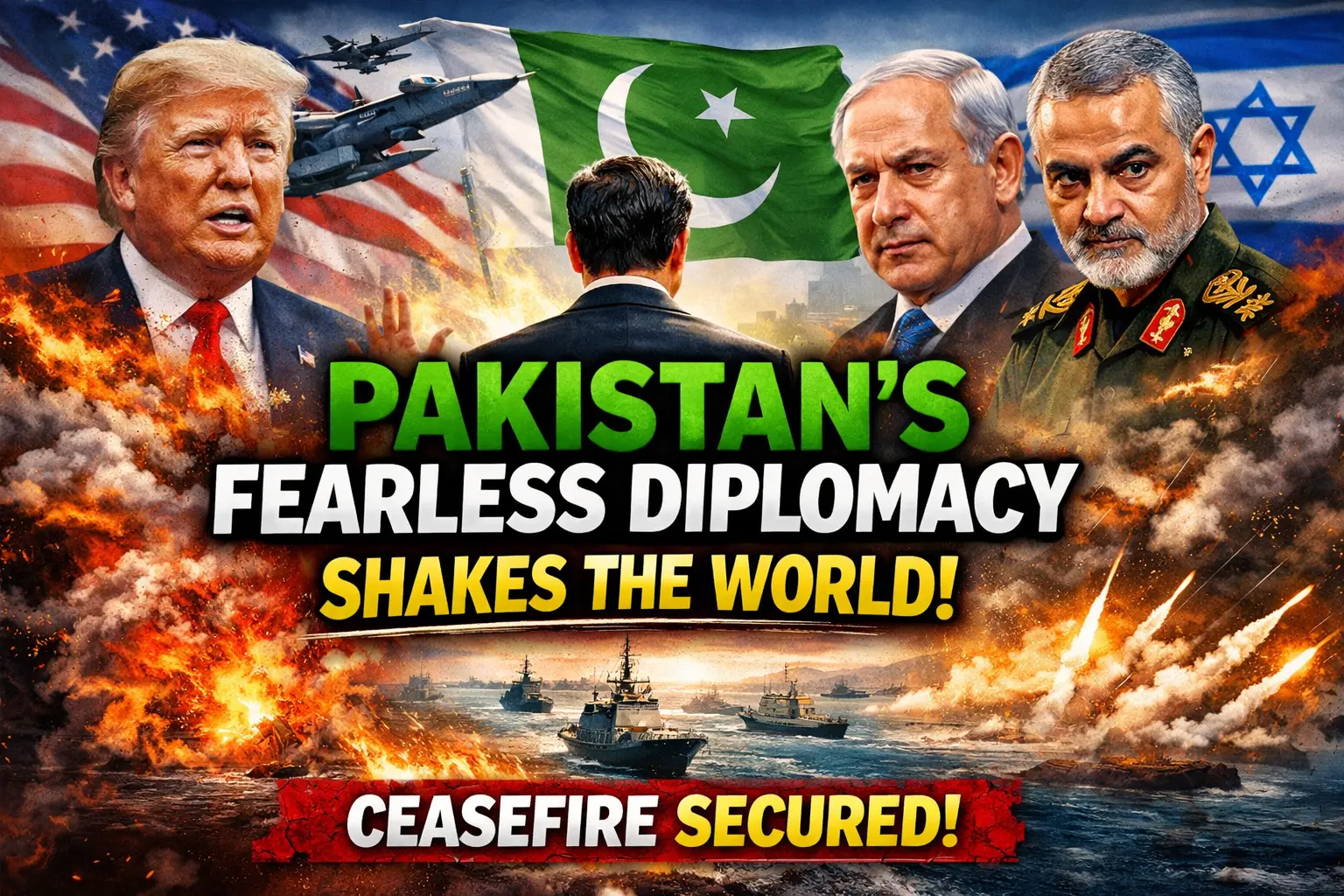
How Pakistan Helped Pause a US–Israel–Iran War—and Won Global Praise
A Moment When the World Held Its Breath
There are moments in history when everything seems to hang by a thread.
The recent tensions involving United States, Iran, and Israel felt exactly like that. Military alerts were rising, oil routes were under threat, and the possibility of a wider Gulf war was no longer distant—it was imminent.
And then, unexpectedly, Pakistan stepped forward.
Not with noise. Not with threats.
But with calm, calculated diplomacy.
Pakistan’s Quiet Move That Changed Everything
Behind the scenes, Pakistan initiated urgent diplomatic outreach:
•Direct communication with Washington
•Strategic engagement with Tehran
•Coordination with Gulf leadership
What Pakistan proposed was simple but powerful:
👉 A temporary ceasefire to stop the spiral before it became a war
This wasn’t just another diplomatic suggestion. It came at the exact moment when escalation seemed inevitable.
And it worked.
A fragile but critical pause was achieved—giving the region something it desperately needed: time.
Why This Ceasefire Matters More Than It Seems
To the average observer, a short ceasefire may not sound like a major victory.
But in geopolitics, timing is everything.
This pause:
•Prevented immediate military strikes
•Reduced pressure on global oil supply routes
•Allowed backchannel talks to resume
•Lowered global market panic
In simple terms, Pakistan didn’t just help stop a conflict
👉 It interrupted a war before it could fully begin
How the World Reacted: A Rare Moment of Recognition
Pakistan’s role did not go unnoticed.
Across capitals and policy circles, there was a subtle but clear acknowledgment:
Islamabad had made a difference.
🌍 Middle East Response
Countries in the Gulf, especially Saudi Arabia and United Arab Emirates, viewed Pakistan as a trusted and balanced voice—someone who could speak to all sides without escalating tensions.
🌍 Global Powers Take Note
•The United States saw Pakistan’s role as constructive and stabilizing
•China quietly supported efforts that reduced regional volatility
•European observers described the move as “timely and responsible diplomacy”
🌍 A Shift in Tone
What stood out was not loud praise—but respect.
Pakistan was increasingly described as:
•A bridge between rivals
•A credible mediator
•A country capable of acting when it matters most
Why Pakistan Succeeded Where Others Didn’t
This success was not accidental.
Pakistan holds a rare position in global politics:
•Strong ties with the United States
•Deep cultural and geographic understanding of Iran
•Long-standing strategic relationships with Gulf states
This allows Pakistan to do something very few countries can:
👉 Talk to everyone and be heard by everyone
Equally important, Pakistan avoided taking sides publicly.
Instead, it chose balance over bias and dialogue over dominance.
A Human Perspective: Why This Matters
Beyond strategy and politics, there’s a human side to this story.
If the conflict had escalated:
•Thousands of lives could have been at risk
•Entire economies could have suffered
•The region could have plunged into prolonged instability
Pakistan’s intervention, even if temporary, helped delay that reality.
And sometimes, delaying a crisis is exactly what prevents it.
Not a Final Peace But a Crucial Pause
Let’s stay grounded.
This is not the end of tensions.
The ceasefire is temporary. The risks are still real.
But what Pakistan achieved is significant:
👉 It created space for peace
👉 It slowed down momentum toward war
👉 It reminded the world that diplomacy still works
What This Means for Pakistan’s Global Image
This moment may mark the beginning of a new perception:
Pakistan is no longer seen only through a regional lens.
It is emerging as:
•A responsible diplomatic actor
•A crisis stabilizer
•A country capable of influencing global events
Conclusion: A Voice That Was Heard
In a world where conflicts escalate quickly and diplomacy often comes too late, Pakistan did something different.
It acted early.
It acted smart.
And most importantly it acted when it mattered.
Pakistan didn’t end a war.
But it helped stop one from beginning.