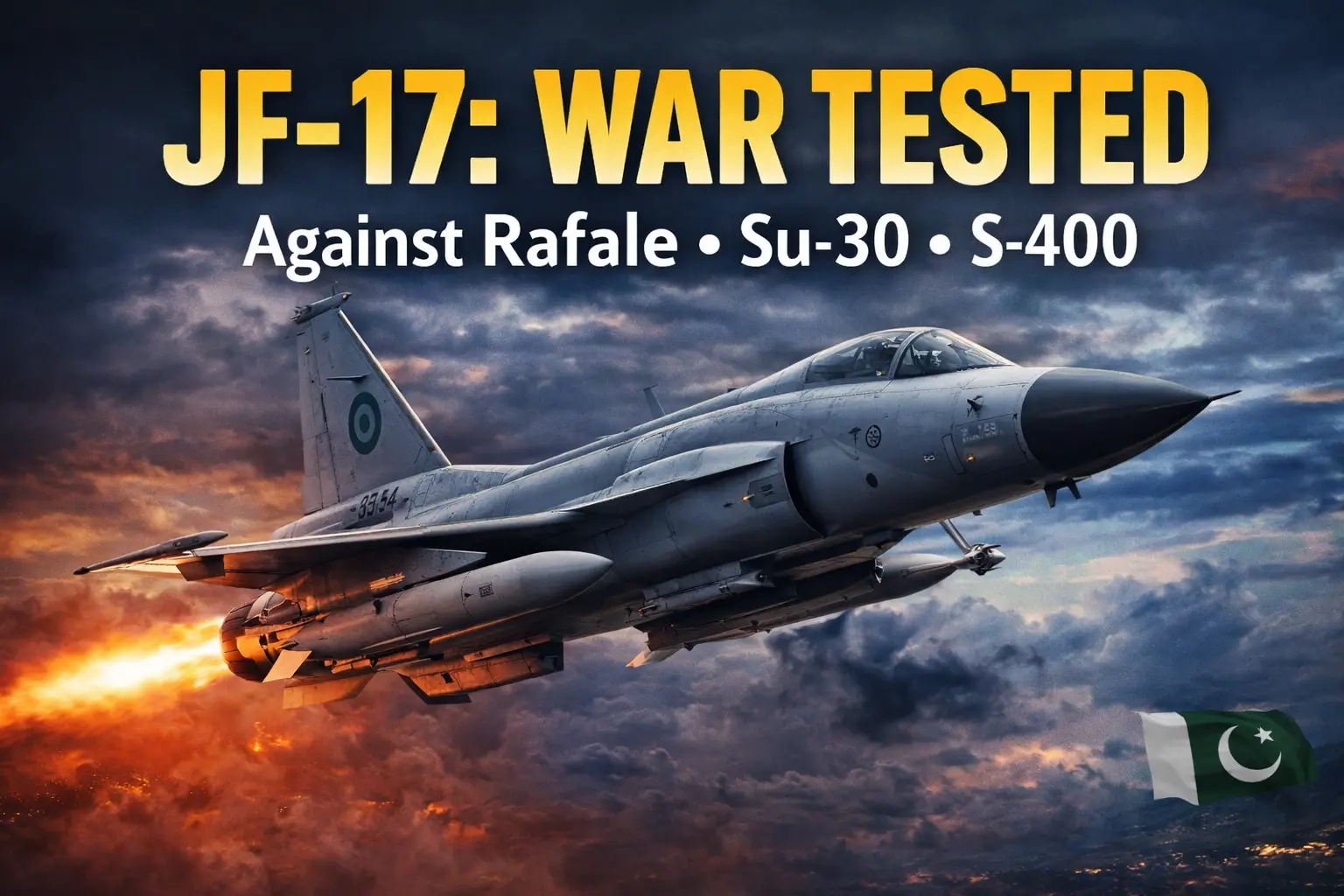

For years, Pakistan’s JF-17 Thunder was discussed mainly in the context of affordability and necessity. It was seen as a practical solution for fleet replacement rather than a disruptive force in modern air warfare.
That perception has changed.
Defense analysts, military observers, and strategic planners are now reassessing the JF-17 not because of promotional claims, but because it has been exposed to real combat conditions. Unlike many contemporary fighter jets that derive their reputations from exercises and controlled simulations, the JF-17 has operated in live, contested airspace against frontline adversaries.
What has drawn global attention is not whether the JF-17 is the “best” fighter, but whether it has redefined what credible air power looks like in the 4.5-generation category.
From Sanctions to Sovereignty: The Origins of the JF-17 Program
The JF-17 program emerged from a strategic constraint rather than ambition. Following sanctions and supply disruptions, Pakistan faced an urgent need to replace aging aircraft without remaining hostage to political pressure or external approvals.
The solution was a fighter designed around:
•Operational independence
•Upgrade flexibility
•Cost control across its service life
•Integration with modern sensors and weapons
Rather than chasing prestige platforms, the Pakistan Air Force focused on doctrine, integration, and sustainability. This approach laid the foundation for what would later become a significant shift in regional air-power dynamics.
Block-III: The Point Where the Narrative Changed
The real transformation came with the JF-17 Block-III variant. This version moved the aircraft decisively into the 4.5-generation fighter category.
Key upgrades include:
•Active Electronically Scanned Array (AESA) radar
•Enhanced data-link and sensor fusion
•Modern glass cockpit and helmet-mounted display
•Improved electronic warfare integration
These features place the JF-17 in operational proximity to aircraft such as the Rafale, Eurofighter Typhoon, and Gripen, while remaining significantly more affordable.
War-Tested Deterrence: Performance That Altered Assumptions
What truly elevated the JF-17’s global standing was operational exposure during regional air confrontations.
Unlike many export fighters that have never faced peer adversaries, the JF-17 operated in environments where it encountered aircraft such as the Su-30MKI, MiG-29, and Rafale under real escalation conditions.
These encounters were not about dramatic dogfights. They were about denial, restraint, and uncertainty—the core elements of modern deterrence. JF-17 formations, operating within a network that included airborne early warning, ground-based radars, and electronic warfare coordination, demonstrated that air superiority could no longer be assumed.
From a deterrence perspective, this outcome mattered more than confirmed shootdowns. The aircraft succeeded in forcing caution, altering operational planning, and denying confidence.
Equally significant was the ground-domain impact. The conflict environment raised serious questions about the assumed invulnerability of advanced air-defense deployments, including the presence of the S-400. While technical details remain contested, the psychological and doctrinal impact was clear: high-end air-defense systems are not immune to integrated strike and electronic warfare strategies.
In modern warfare, perception shapes deterrence as much as physical damage.
Beyond-Visual-Range Combat and First-Strike Logic
Air combat today is dominated by beyond-visual-range (BVR) engagement, not close-in maneuvering.
With AESA radar, modern data-links, and long-range air-to-air missiles, the JF-17 operates effectively within this framework. The aircraft’s ability to detect, track, and engage targets early forces adversaries into defensive postures long before visual contact.
This compresses decision-making timelines and increases escalation risks—outcomes that favor deterrence rather than aggression.
Electronic Warfare and Survivability in Contested Airspace
The JF-17 does not rely on stealth alone. Its survivability is built on electronic warfare, coordination, and adaptability.
Modern radar warning receivers, jamming support, and missile approach warning systems allow it to function in environments where legacy fighters would struggle. This reinforces the aircraft’s role as part of a networked combat ecosystem, rather than a standalone platform.
Cost Versus Capability: Why the Market Took Notice
One of the most disruptive aspects of the JF-17 is economic.
With Western fighters often exceeding $100 million per unit, the JF-17 delivers essential 4.5-generation capabilities at a fraction of the cost. For many air forces, this translates into:
•Larger fleet sizes
•Sustainable readiness
•Reduced dependency on foreign political approvals
This is not cheap power—it is strategically affordable power.
Why Developing Air Forces Are Reconsidering Their Options
For many countries in Asia, Africa, and the Middle East, the JF-17 offers a rare combination:
•Political neutrality
•Freedom from sanctions leverage
•Local maintenance and upgrade pathways
•Combat-validated performance
In a multipolar world, these factors increasingly outweigh prestige branding.
Limitations That Strengthen Credibility
The JF-17 is not a fifth-generation stealth fighter. It does not replace platforms designed for deep penetration missions, and its engine and payload constraints are real.
But it was never designed to do everything.
Its strength lies in credible deterrence, operational denial, and cost-effective relevance.
Conclusion: A Fighter That Changed the Rules, Not the Rankings
The JF-17’s achievement is not about outperforming elite Western aircraft in isolation. It is about reshaping how air power is evaluated.
By combining war-tested behavior, modern sensors, networked doctrine, and economic realism, Pakistan has demonstrated that effective deterrence is no longer the exclusive domain of the wealthiest militaries.
In modern air warfare, dominance is expensive.
Denial is sustainable—and often decisive.
That is why the world is paying attention.