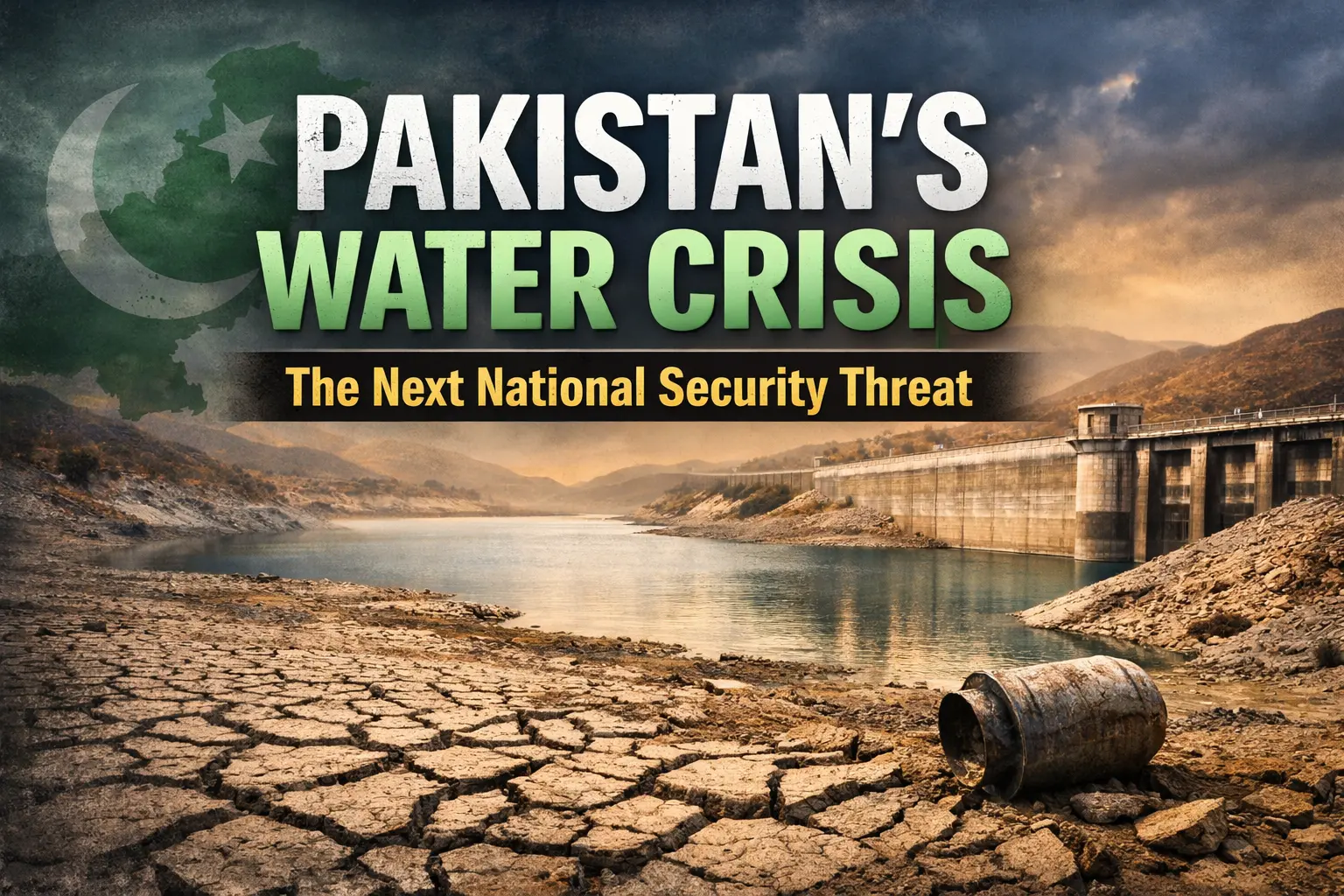

Pakistan is confronting a crisis that advances quietly without the visibility of political turmoil or the immediacy of military conflict yet carries consequences that may prove far more enduring.
Water scarcity, once viewed primarily as an environmental or agricultural concern, is now evolving into a core national security challenge shaped by climate stress, governance limitations, and demographic pressure.
From a strategic perspective, the stability of states in the 21st century increasingly depends not only on territorial defense, but on the sustainable management of essential natural resources with water at the center of this transformation.
A Measurable Decline in Water Availability
Pakistan is widely categorized among the world’s most water-stressed countries, a condition reflected in the long-term collapse of per-capita water availability.
National availability has fallen from more than 5,000 cubic meters per person at independence to below 1,000 cubic meters, placing the country firmly within the internationally recognized water-scarce category.
Some forward projections warn that availability could approach 500 cubic meters per person, the threshold of absolute scarcity, within the present decade if current trends persist.
Recent hydrological patterns reinforce this trajectory.
Between September 2024 and March 2025, Pakistan received around 40 percent less rainfall than normal, with deficits of over 60 percent in Sindh and more than 50 percent in Balochistan.
Such shortfalls directly reduce groundwater recharge, weaken winter crops, and accelerate drought conditions across already vulnerable regions.
These are not theoretical risks—they represent current structural stress signals.
Climate Volatility as a Threat Multiplier
Climate change is reshaping Pakistan’s water cycle through extreme variability rather than simple decline.
The country increasingly experiences:
•Severe winter dryness reducing soil moisture and aquifer recovery
•Erratic monsoon behavior alternating between drought and destructive flooding
•Accelerated glacial melt producing short-term flood surges but weakening long-term river sustainability
•Rising temperatures intensifying evaporation and agricultural water demand
In some years, rainfall extremes have reached historic levels such as record precipitation months exceeding 160 percent above average—yet these intense bursts fail to compensate for prolonged dry periods.
Scientific assessments further indicate that climate change may have increased the intensity of extreme rainfall events in Pakistan by roughly 50–75 percent, deepening the pattern of flood destruction followed by water shortage.
This volatility undermines planning across agriculture, infrastructure, and disaster management simultaneously, transforming climate stress into a security-relevant destabilizer.
Structural Weakness: Storage and Wasted Water
Pakistan’s vulnerability is intensified by limited water storage capacity.
The country can store only about 30 days of water, far below the international resilience benchmark of roughly 120 days.
As a result:
•Large volumes of monsoon runoff flow unused into the sea
•Groundwater becomes the emergency substitute, accelerating depletion
•Dry-season shortages intensify despite seasonal rainfall
Estimates suggest that tens of millions of acre-feet of rainwater remain uncaptured each year—a quantity theoretically capable of meeting domestic water needs nationwide if adequate storage and management systems existed.
This confirms that Pakistan’s crisis is driven as much by infrastructure and governance gaps as by climate itself.
Economic Transmission of Water Stress
Water scarcity directly threatens Pakistan’s economic foundation, particularly agriculture, which consumes nearly 90 percent of national freshwater resources and sustains a large share of employment.
Declining water availability therefore produces cascading effects:
•Reduced crop yields and rural income instability
•Rising food prices and urban inflationary pressure
•Migration from drought-affected rural districts to major cities
•Additional strain on housing, services, and governance capacity
Such dynamics create a resource-driven instability pathway, where environmental degradation translates into economic fragility and social tension a pattern increasingly recognized in global security analysis.
Expanding the Meaning of National Security
Modern strategic doctrine now incorporates non-traditional threats including water scarcity, food insecurity, and climate disruption—into national security planning.
For Pakistan, unmanaged water stress could contribute to:
•Inter-provincial disputes over allocation and dam construction
•Urban unrest linked to shortages and rising living costs
•Transboundary diplomatic tensions tied to river systems
•Public-health and livelihood crises affecting human security
Historically, such pressures erode state resilience more slowly than war but more deeply over time, making them strategically decisive.
Governance Constraints at the Core
While climate change intensifies risk, Pakistan’s water emergency is equally a governance and policy challenge.
Persistent structural issues include:
•Continued reliance on inefficient flood irrigation
•Delayed expansion of reservoirs and recharge systems
•Weak regulation of groundwater extraction in major cities
•Fragmented coordination between federal and provincial institutions
International experience demonstrates that effective governance—not rainfall alone—determines whether water stress becomes manageable scarcity or systemic crisis.
The Narrowing Strategic Window
Hydrological and demographic projections warn that over 200 million Pakistanis could face severe water stress within the coming years if corrective action remains slow.
Yet the trajectory is not irreversible.
Practical mitigation pathways already exist:
•Precision irrigation and water-efficient agriculture
•Expanded storage dams and aquifer recharge programs
•Urban wastewater recycling and conservation systems
•Climate-resilient crop selection
•Cooperative regional water diplomacy
The decisive factor is policy urgency, not technical capability.
Conclusion: The Quiet Battlefield of the Future
Water crises rarely erupt with the visibility of armed conflict.
Instead, they advance silently—through dry winters, shrinking reservoirs, failing harvests, rising prices, and social strain.
For Pakistan, water scarcity is no longer merely an environmental concern.
It is an emerging national security determinant that will shape economic stability, internal cohesion, and regional diplomacy in the decades ahead.
The country still possesses the expertise, institutional memory, and technological options required to respond effectively.
What remains uncertain is whether action will occur within the rapidly narrowing strategic timeframe.
In the security landscape of the 21st century,
the management of water may prove as decisive as the defense of borders.