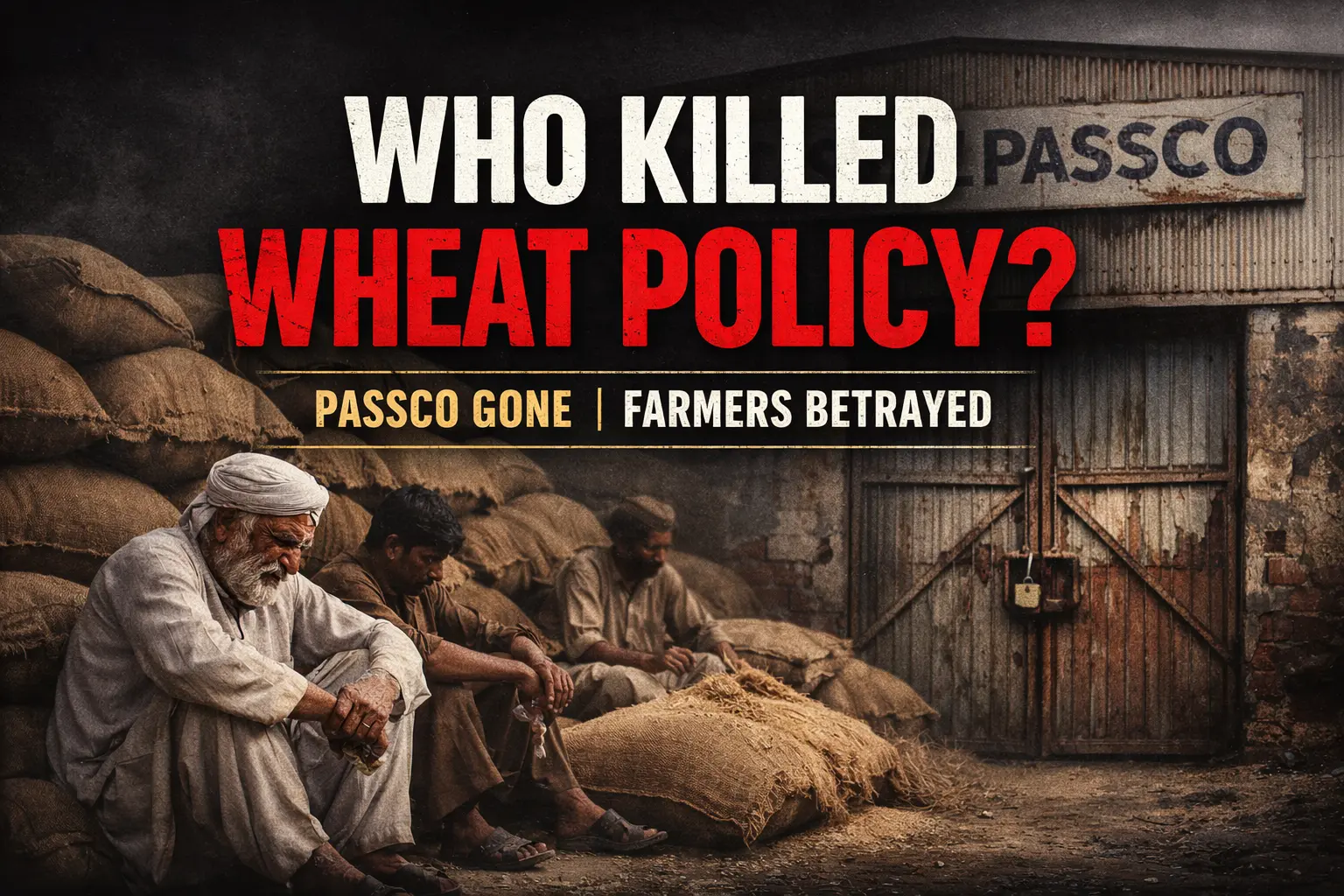

Pakistan is not facing a food crisis because wheat is unavailable.
Pakistan is facing a food crisis because governance failed — and those responsible were never held to account.
The federal government’s decision to exit wheat procurement and dismantle the operational role of PASSCO is being presented as reform. In reality, it is an admission of failure — wrapped in technical language and justified through external pressure — while its consequences are borne by farmers and consumers, not by policymakers.
This crisis did not emerge overnight. Its roots, warning signs, and structural failures were already laid out in my earlier article on Pakistan’s food crisis, which the government chose to ignore.
This is not how reform looks.
This is how responsibility is avoided.
An Agricultural Country Without an Agricultural Policy — The Ultimate Dilemma
Pakistan proudly calls itself an agricultural country. Yet today, it stands exposed as a state with no clear agriculture policy.
In a country where millions depend on farming, where wheat is the staple food, and where food security should be treated as national security, the absence of planning is striking.
There is no reliable support mechanism for farmers, no credible buffer stock strategy, no protection against market shocks, and no long-term vision for agriculture. What exists instead is silence — and silence is not policy.
No serious country leaves food security to chance. Pakistan has done exactly that, not because it had no alternatives, but because governing agriculture properly requires discipline, competence, and political will.
Corruption Was Known. Accountability Was Avoided.
Corruption in wheat procurement was never a secret. Everyone knew the system had problems — inflated costs, questionable contracts, delayed payments, and weak oversight.
PASSCO accumulated debts worth hundreds of billions of rupees. But debt does not appear on its own. It is created by decisions, approvals, and signatures.
The obvious questions were never answered:
Who approved the contracts?
Who benefited from them?
Who delayed payments?
Who guaranteed loans?
There was no forensic audit. No judicial inquiry. No punishment.
Instead of fixing the system and prosecuting those responsible, the state chose the easier route: dismantle the institution and move on. That is not reform — it is escape.
IMF Compliance Became an Excuse for Governance Abdication
The government repeatedly cites IMF conditions to justify its withdrawal from wheat procurement.
But IMF programmes do not require governments to abandon farmers, surrender market regulation, or destroy food security mechanisms. They require fiscal discipline — not policy emptiness.
Other countries reform their food institutions. Pakistan dismantles them because reform exposes corruption, while withdrawal protects it.
IMF compliance was achieved.
National responsibility was not.
PASSCO’s Real Role: Controlling Prices Through Supply
PASSCO’s real strength was never paperwork. It was simple and practical: it controlled prices by controlling supply.
When prices rose, wheat was released to flour mills. That presence alone was enough to calm markets. Hoarders stepped back. Artificial shortages collapsed. Prices stabilised.
Today, the government has no procurement, no buffer stock, and no emergency release mechanism. Statements have replaced stock, and notifications have replaced action.
You cannot control prices without wheat in hand.
The Last Harvest Was the Warning — and It Was Ignored
The last wheat harvesting season should have been a wake-up call.
The Afghan border closed. External buyers disappeared. PASSCO did not step in. Provincial food departments remained inactive. Private traders filled the vacuum — and dictated prices.
Farmers were trapped. Many sold below cost. Many could not sell at all.
That was not theory. That was reality. And instead of learning from it, the government chose to make that failure permanent.
A State That Could Not Run PIA, Food Departments, or PASSCO — Claims It Can Run Pakistan
This is the most uncomfortable contradiction of all.
A government that failed to manage PIA, failed to clean up food departments, and allowed PASSCO to collapse under debt and mismanagement now claims it can run a country of over 240 million people.
These were not impossible challenges. They were contained institutions with defined systems and chains of command.
Every failure followed the same pattern: political interference, corruption without punishment, institutional collapse, public suffering, and elite immunity.
Instead of fixing problems, the state adopted a dangerous habit — abolish institutions, never punish individuals.
A state that cannot manage its core institutions cannot be trusted to manage a nation.
Who Pays — and Who Walks Free
The cost of these decisions is not theoretical.
Farmers pay through distress sales.
Consumers pay through higher flour prices.
The poor pay through inflation.
And those who made the decisions remain untouched.
No resignations.
No prosecutions.
No recoveries.
Pain is always passed downwards. Accountability never is.
Conclusion: This Is Not Reform — It Is Strategic Negligence
What is being presented as reform is, in reality, withdrawal without planning, markets without regulation, and fiscal relief purchased at public cost.
A state that cannot punish corruption has no moral authority to dismantle institutions.
Pakistan’s food crisis was not inevitable. It was created — slowly, deliberately, and avoidably.
And unless accountability replaces excuses, the public will keep paying for failures it did not create.