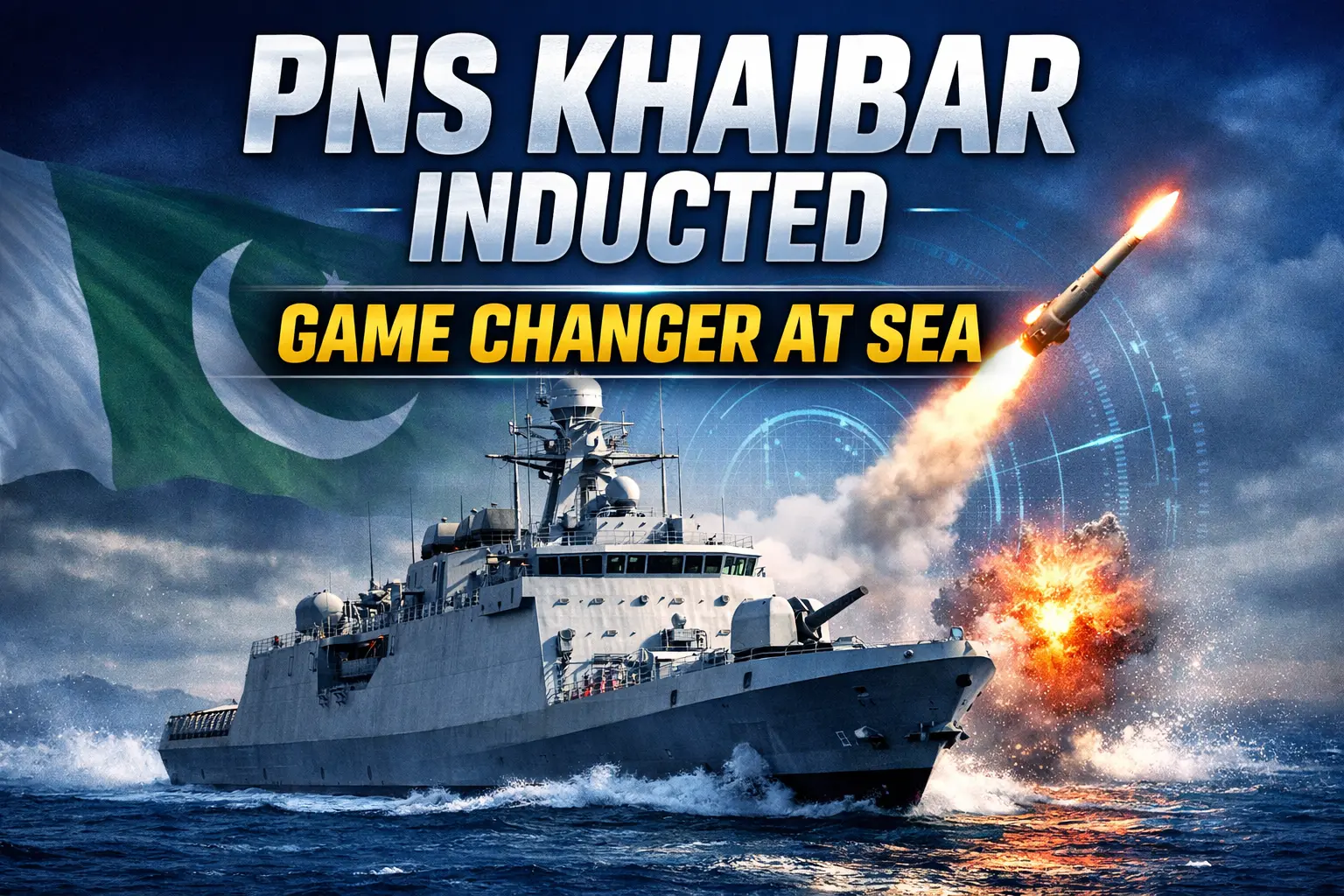

The induction of PNS Khaibar into the Pakistan Navy is not just another routine addition it’s a clear signal of transformation.
In simple terms, Pakistan is no longer thinking only about defending its coastline. It is now preparing to control, influence, and dominate its maritime space in the increasingly competitive Indian Ocean region.
What Makes PNS Khaibar Special?
Think of PNS Khaibar as a “smart warship” one that can see far, strike hard, and coordinate in real time.
It is part of the Babur-class corvettes developed with Türkiye, combining modern design with advanced combat systems.
This single ship can:
•Track multiple threats at once
•Engage targets on sea, air, and underwater
•Coordinate with other military platforms
👉 In practical terms: one ship doing the job of many older ones
Firepower That Changes the Game
At sea, survival depends on who can strike first and from the farthest distance.
PNS Khaibar is equipped with:
•Harbah cruise missiles – capable of hitting targets far beyond visual range
•Advanced air defense system (Albatros NG) – protects against incoming aircraft and missiles
•Close-in weapon system (CIWS) – last line of defense
•Anti-submarine torpedoes – to hunt underwater threats
👉 This layered setup means the ship can attack and defend at multiple levels simultaneously.
The Real Advantage: Smart Warfare (Not Just Firepower)
Modern wars are not fought by isolated units—they are fought by connected systems.
PNS Khaibar uses the ADVENT system developed by HAVELSAN, allowing it to:
•Share live battlefield data
•Coordinate with aircraft and other ships
•React faster than the enemy
👉 This gives Pakistan Navy a network-centric warfare edge, which is often more decisive than sheer numbers.
Why This Matters Strategically
1. Stronger Sea Denial Against Adversaries
Pakistan can now deny enemy ships easy access to its waters.
In simple words:
👉 Any hostile navy entering the region will now operate under constant threat.
2. A Serious Challenge to Aircraft Carriers
Aircraft carriers are symbols of power—but they are also high-value targets.
With long-range missiles and coordination with submarines:
👉 Pakistan is building a credible anti-carrier capability
3. From Defense to Controlled Offense
Earlier mindset:
•Protect coastline
New mindset:
•Project power beyond the coast
👉 This is a major doctrinal shift toward a blue-water capable navy
4. Protection of Economic Lifelines
Pakistan’s economy depends heavily on sea routes.
With projects linked to Gwadar and regional trade:
👉 PNS Khaibar helps secure Sea Lines of Communication (SLOCs)—the arteries of national survival.
5. Pakistan–Türkiye Strategic Bond
This project is more than a ship it reflects deep cooperation with Türkiye.
Key benefit:
•Technology transfer
•Growth of local shipbuilding capability
👉 Long-term outcome: greater self-reliance in defense production
Regional Impact: Balancing the Equation
Pakistan may not match numbers, but it is focusing on:
•Precision
•Technology
•Integration
PNS Khaibar represents this approach perfectly.
👉 The message is clear:
Quality + smart warfare can balance quantity
Conclusion: A Silent but Powerful Shift
The induction of PNS Khaibar is not loud—but its impact is deep.
It strengthens:
•Deterrence
•Operational flexibility
•Strategic reach
Most importantly, it signals that the Pakistan Navy is evolving into a modern, thinking, and adaptive force.
👉 In today’s world, wars are not won by size alone
they are won by speed, intelligence, and precision.
And PNS Khaibar brings all three.