
“A 33-kilometer waterway now holds the power to shake the global economy.”
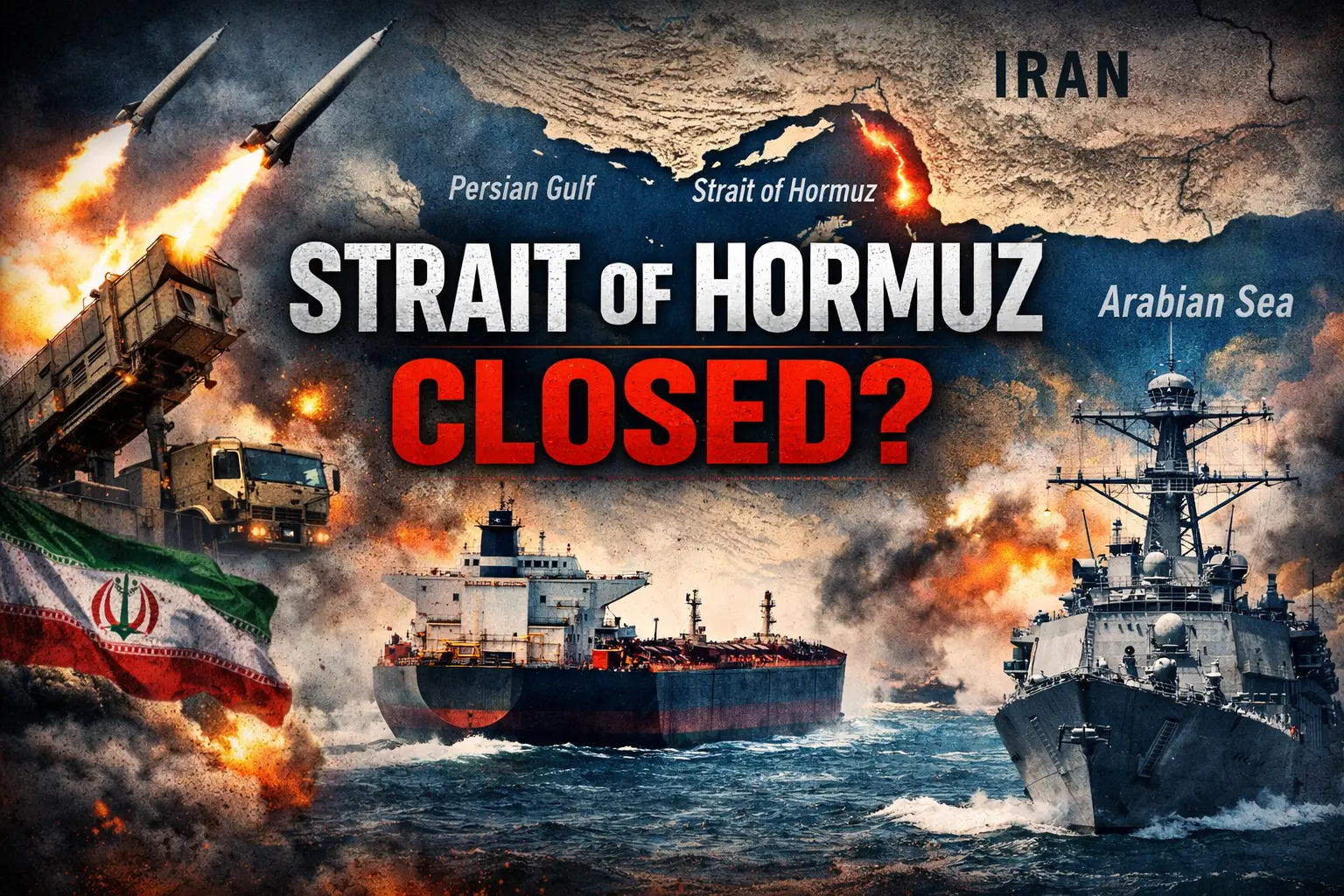
The Strait of Hormuz is widely regarded as the most important maritime chokepoint in the global energy system. Located between Iran and Oman, the strait connects the Persian Gulf to the Arabian Sea and ultimately the Indian Ocean.
At its narrowest point, the strait is only about 33 kilometers wide, while the designated shipping lanes used by oil tankers are roughly three kilometers wide in each direction. Despite this narrow geography, nearly one-fifth of the world’s oil supply — around 17 to 21 million barrels per day — passes through this corridor.
Because of this, any disruption to the Strait of Hormuz immediately becomes a global strategic event affecting energy markets, military stability, and international trade.
If Iran closes the strait and warns that vessels attempting to cross may face attack, the issue moves far beyond regional politics. It becomes a global security crisis with military, economic, and geopolitical consequences.
Immediate Global Energy Shock
The most immediate impact of a Strait of Hormuz closure would be felt in global energy markets.
Several major energy exporters rely heavily on this route, including:
•Saudi Arabia
•Iraq
•Kuwait
•United Arab Emirates
•Qatar
If the strait is blocked, oil shipments from the Gulf could be severely disrupted. Even the perception of risk in the region tends to push energy markets into volatility. Prices could spike dramatically, liquefied natural gas shipments from Qatar could slow or halt, and global fuel prices would rise.
For ordinary consumers around the world, this translates into higher transportation costs, increased electricity prices, and rising inflation.
From a strategic perspective, the vulnerability lies in the fact that modern economies operate on continuous energy flow rather than massive storage reserves. A sustained disruption at Hormuz could therefore ripple across financial markets, manufacturing sectors, and international trade routes.
Beginning of a Naval Conflict Zone
If Iran actively enforces the closure, the Strait of Hormuz could rapidly transform into a maritime conflict zone.
Iran has spent decades preparing for this exact scenario through the Islamic Revolutionary Guard Corps Navy, which specializes in asymmetric naval warfare rather than conventional fleet battles.
Key capabilities include:
•Naval mines capable of damaging or blocking shipping lanes
•Coastal anti-ship missile batteries positioned along the Iranian coastline
•Swarms of fast attack boats capable of harassing large vessels
•Armed drones and cruise missiles designed to target maritime assets
Unlike traditional naval warfare, the strategy here is not necessarily to defeat a stronger navy outright. Instead, the objective is to make the waterway too dangerous for commercial traffic, effectively shutting down shipping through risk and uncertainty.
Because the strait is geographically narrow, even a limited number of mines or missile strikes could disrupt tanker traffic for days or weeks.
Direct Confrontation with the United States Navy
The United States Navy maintains a strong presence in the region specifically to guarantee freedom of navigation through the Strait of Hormuz.
If Iran attempts to enforce a blockade, the likely responses could include:
•Escort operations for commercial oil tankers
•Mine-clearing missions conducted by specialized naval units
•Precision air or missile strikes against Iranian missile launch sites
•Direct naval engagements with Iranian vessels
However, despite the technological superiority of the U.S. Navy, the operational environment inside the Persian Gulf presents challenges.
Large naval platforms such as aircraft carriers and guided-missile destroyers are designed primarily for open-ocean warfare. In contrast, the confined waters of the Gulf make them more vulnerable to shore-based missile systems, drones, and fast-moving small craft.
This means that even a limited Iranian strike — for example damaging a tanker or warship — could have outsized psychological and economic effects, amplifying global panic in energy markets.
Risk of Regional War Expansion
A confrontation in the Strait of Hormuz would almost certainly extend beyond the sea.
Iran possesses missile and drone capabilities capable of targeting military installations across the Gulf region, including those in:
•Qatar
•Bahrain
•Kuwait
•United Arab Emirates
•Saudi Arabia
Any escalation could involve attacks on energy infrastructure, ports, and military bases.
Such developments would transform the crisis from a maritime security issue into a wider regional conflict, potentially drawing in multiple international actors and further destabilizing global energy supply.
Strategic Vulnerability of Asian Economies
The majority of oil transported through the Strait of Hormuz is destined for Asian markets.
Countries most dependent on Gulf energy imports include:
•China
•India
•Japan
•South Korea
A prolonged disruption would force these economies to rapidly seek alternative suppliers from regions such as North America, Africa, or Russia.
Such shifts could increase competition for global energy supplies and intensify geopolitical tensions around energy security.
Limited Alternative Routes
Some alternative pipelines exist that bypass the Strait of Hormuz. For example, Saudi Arabia operates pipelines leading to the Red Sea, and the UAE has infrastructure linking its oil fields to the Gulf of Oman.
However, these systems cannot handle the full volume of oil normally transported through the strait.
As a result, even partial disruption could leave millions of barrels of oil stranded in Gulf terminals, reinforcing the strategic importance of the strait as a global energy lifeline.
Strategic Implications for Pakistan
For Pakistan, the situation presents both economic challenges and strategic opportunities.
Higher global oil prices would increase Pakistan’s energy import costs, putting additional pressure on the national economy.
At the same time, the crisis could elevate the regional importance of Pakistani ports such as Gwadar Port and Karachi Port, particularly if alternative logistics and energy corridors become necessary for trade between the Middle East and Asia.
Over time, this could increase Pakistan’s relevance in regional energy and maritime security discussions.
Strategic Conclusion
The closure of the Strait of Hormuz would represent far more than a localized maritime disruption. It would be a strategic shock with global consequences.
Such a development could trigger:
•Naval confrontation in the Persian Gulf
•Sharp volatility in global energy markets
•Wider regional military escalation
•Strategic pressure on major energy-importing nations
In geopolitical terms, the Strait of Hormuz functions as a strategic valve controlling a significant portion of the world’s energy supply. Its stability therefore remains critical not only for the Middle East but for the global economy as a whole.