
Few places on the global map carry the strategic weight of the Strait of Hormuz. This narrow waterway, barely 33 kilometers wide at its narrowest point, is responsible for transporting nearly one-fifth of the world’s oil supply.
Whenever tensions rise in the Middle East, the Strait of Hormuz quickly transforms from a busy shipping route into a potential geopolitical flashpoint. Today, the stakes appear higher than ever.
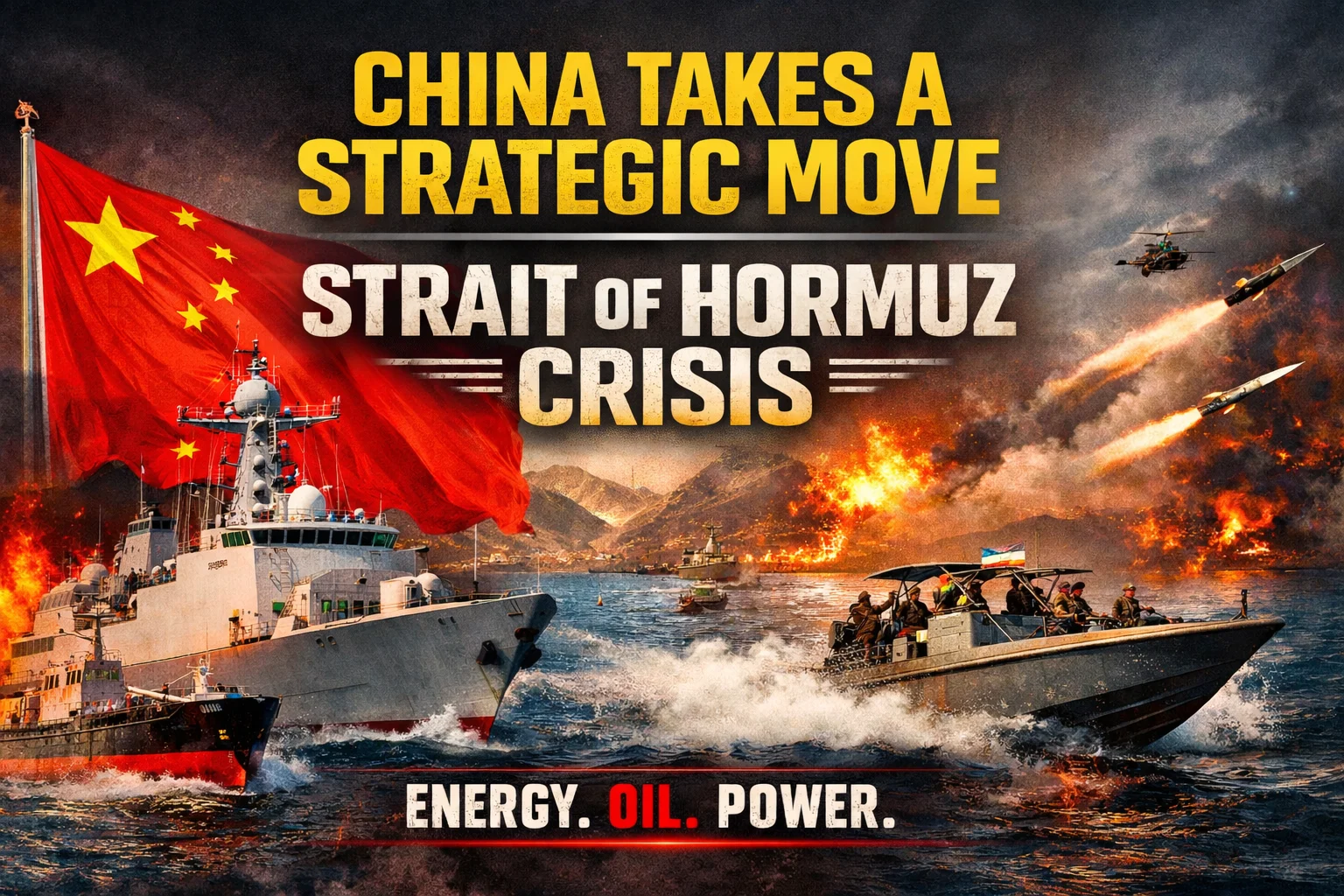
Escalating tensions between Iran, the United States, and Israel have created fears of disruption in global energy flows. Yet the most intriguing development is the growing strategic attention from China, a power whose economic lifeline runs directly through these waters.
The Strait of Hormuz crisis is no longer just a regional confrontation. It is becoming a strategic arena where global energy security and great-power competition intersect.
The World’s Most Critical Energy Chokepoint
The Strait of Hormuz sits at the heart of global energy logistics. Every day, millions of barrels of crude oil move from the Persian Gulf toward markets in Asia, Europe, and beyond.
Energy exports from Saudi Arabia, United Arab Emirates, Kuwait, Iraq, and Iran rely heavily on this maritime corridor.
In addition, Qatar—one of the world’s largest exporters of liquefied natural gas—ships most of its LNG cargo through this same route.
Because of this concentration of energy traffic, even a temporary disruption can send global oil prices soaring. Insurance costs for tankers increase, shipping companies reroute vessels, and international markets react instantly.
For decades, the security of this vital artery has been largely guaranteed by the naval dominance of the United States and its regional allies. But today, shifting geopolitical realities are beginning to challenge that long-standing order.
Rising Tensions in the Iran–US–Israel Triangle
The current instability around the Strait of Hormuz stems from a volatile strategic triangle involving Iran, the United States, and Israel.
Iran views American military presence in the Persian Gulf as a direct threat to its sovereignty. Meanwhile, Washington and its regional partners see Iran’s missile programs, drone capabilities, and regional alliances as destabilizing factors.
In such an environment, the Strait of Hormuz becomes a strategic lever.
Iran’s military doctrine emphasizes asymmetric naval warfare, relying on tactics designed to disrupt rather than dominate maritime operations. These capabilities include:
•Anti-ship missile systems positioned along Iran’s coastline
•Fast attack boats capable of swarm tactics
•Naval mines that can threaten commercial shipping
•Drone and missile strikes targeting strategic infrastructure
These tools allow Iran to create uncertainty and risk in one of the world’s most critical shipping lanes.
Importantly, Iran does not need to fully close the strait to achieve strategic leverage. Even the perception of danger can discourage commercial shipping and trigger volatility in energy markets.
Why China Is Watching Closely
While the Strait of Hormuz crisis directly involves Middle Eastern actors and the United States, another global power has a significant stake in its stability: China.
As the world’s largest importer of crude oil, China relies heavily on energy supplies from the Middle East. A substantial portion of these shipments travels through the Strait of Hormuz before reaching Chinese ports.
For Beijing, this waterway represents more than just a shipping route—it is a strategic economic lifeline.
Any prolonged disruption could have several consequences for China:
•Increased energy costs for its industrial sector
•Supply shortages affecting manufacturing output
•Economic instability caused by rising fuel prices
China also depends on natural gas imports from Qatar, which similarly transit the Strait of Hormuz.
Given these realities, Beijing cannot afford to remain indifferent to developments in the Persian Gulf.
Beijing’s Calculated and Quiet Approach
Unlike the United States, China does not maintain a large military presence in the Persian Gulf. Instead, its strategy relies primarily on diplomacy and economic engagement.
Beijing has cultivated balanced relationships across the region—maintaining energy partnerships with Gulf Arab states while also preserving strategic ties with Iran.
Reports indicate that Chinese officials have encouraged restraint and stability in maritime navigation, emphasizing the importance of keeping global energy routes open.
This approach reflects China’s broader geopolitical philosophy: protect economic interests without direct military confrontation.
By advocating de-escalation, China positions itself as a responsible stakeholder in global stability while safeguarding its energy supply chain.
A New Layer of Great-Power Competition
The growing attention of China toward the Strait of Hormuz reflects a larger shift in global geopolitics.
For decades, the Persian Gulf was firmly within the strategic orbit of the United States. American naval power ensured the security of maritime routes and provided stability for energy markets.
However, China’s economic rise and expanding global trade networks are gradually reshaping that equation.
Although Beijing has so far avoided direct military involvement, its diplomatic engagement and economic presence suggest that the Gulf may become another arena of strategic competition between the world’s two largest powers.
This does not necessarily mean immediate confrontation. Instead, it points toward a future where multiple global actors compete for influence in one of the most strategically vital regions on Earth.
Global Economic Consequences
Instability in the Strait of Hormuz carries consequences far beyond the Middle East.
A significant disruption could trigger a chain reaction across the global economy.
Possible impacts include:
•Sharp increases in global oil prices
•Higher shipping insurance and transport costs
•Supply chain disruptions across manufacturing industries
•Economic pressure on energy-importing nations
Because energy markets are deeply interconnected, events in a narrow stretch of water between Iran and Oman can affect consumers and industries thousands of kilometers away.
This reality explains why governments, financial markets, and energy companies around the world closely monitor every development in the Strait of Hormuz.
Conclusion
The Strait of Hormuz has long been one of the world’s most sensitive geopolitical fault lines. Yet the current crisis reveals a deeper transformation underway.
What was once primarily a regional security issue is evolving into a broader contest involving major global powers.
Rising tensions between Iran, the United States, and Israel have already heightened risks to global energy flows. Now, China’s growing interest in the stability of this vital corridor adds a new strategic dimension.
The result is a complex geopolitical landscape where energy security, military deterrence, and economic interests intersect.
In the years ahead, the future of the Strait of Hormuz may not only determine the stability of the Middle East—it could also influence the balance of power in the global order.