The beginning of Ramadan has always carried deep spiritual, social, and emotional significance for Muslims around the world. Traditionally, the sighting of the crescent moon has been associated with community testimony and religious observance. However, in the modern age, scientific astronomy has emerged as a powerful tool to complement this sacred tradition. Pakistan’s national space and atmospheric research organization, SUPARCO, has taken a commendable step in this direction through its scientific prediction for Ramadan 1447 AH.
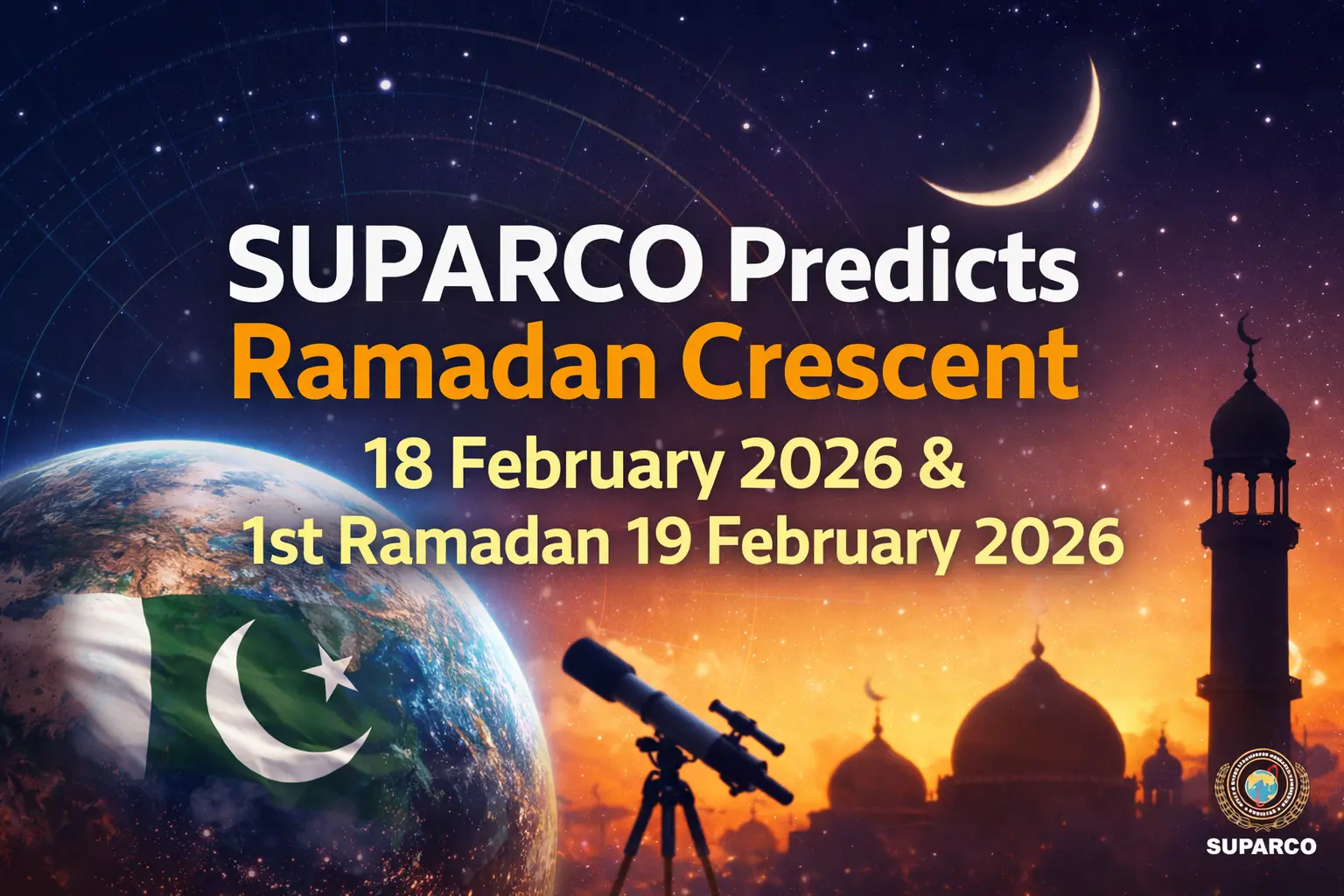
According to SUPARCO’s latest assessment, the crescent is expected to be visible on 18 February 2026, with the first day of Ramadan likely to fall on Thursday, 19 February 2026. This prediction is based on precise astronomical calculations, including the moon’s age, illumination, and coastal visibility duration. Such accuracy reflects years of dedicated research, technological development, and scientific expertise within the organization.
This achievement is not merely about predicting a date. It represents the growing role of science in serving religious and societal needs. By applying modern space science and observational astronomy, SUPARCO is helping reduce uncertainty and confusion that sometimes arise during moon-sighting announcements. Reliable scientific guidance strengthens national unity, promotes informed decision-making, and aligns Pakistan with global standards of astronomical research.
SUPARCO’s contribution also highlights Pakistan’s steady progress in the field of space science. From satellite development to atmospheric studies and astronomical forecasting, the organization has consistently worked to enhance the country’s scientific capacity. The Ramadan crescent prediction is a visible reminder of how scientific institutions can directly benefit everyday life, connecting advanced research with cultural and religious practices.
Equally important is the message this sends to the younger generation. Scientific achievements like these inspire students to pursue careers in astronomy, physics, engineering, and space technology. When national institutions demonstrate excellence and public relevance, they nurture confidence in local talent and encourage innovation. SUPARCO’s work shows that meaningful scientific progress is possible through persistence, discipline, and long-term vision.
It is also worth recognizing that scientific moon prediction does not replace religious tradition; rather, it supports it. Throughout Islamic history, knowledge and observation have gone hand in hand with faith. Early Muslim scholars were pioneers of astronomy, mathematics, and navigation. In this sense, SUPARCO’s efforts continue a rich intellectual heritage—using knowledge to serve worship and community harmony.
Furthermore, accurate forecasting allows governments, businesses, and families to plan ahead. From arranging religious gatherings to managing public holidays and travel schedules, clarity in the Ramadan calendar carries practical national benefits. Such planning becomes especially important in a fast-moving modern society where coordination and timing matter greatly.
The announcement for Ramadan 1447 AH therefore symbolizes more than a scientific calculation—it reflects institutional maturity and national confidence. Continuous investment in research, skilled professionals, and technological infrastructure has enabled SUPARCO to provide dependable astronomical guidance. This progress deserves appreciation and public recognition.
Looking ahead, the hope is that Pakistan will continue strengthening its scientific organizations and integrating research with societal needs. Space science, climate monitoring, satellite communication, and astronomical observation all hold immense potential for national development. SUPARCO’s work on moon-sighting prediction is one meaningful example of how science can illuminate both the skies above and the path forward for a nation.
As Ramadan approaches, this scientific clarity adds to the spirit of preparation and unity. Appreciating SUPARCO’s dedication is not only about acknowledging a single announcement—it is about valuing knowledge, discipline, and the pursuit of excellence. Such efforts remind us that when science and faith move together, they create harmony, confidence, and progress for society as a whole.