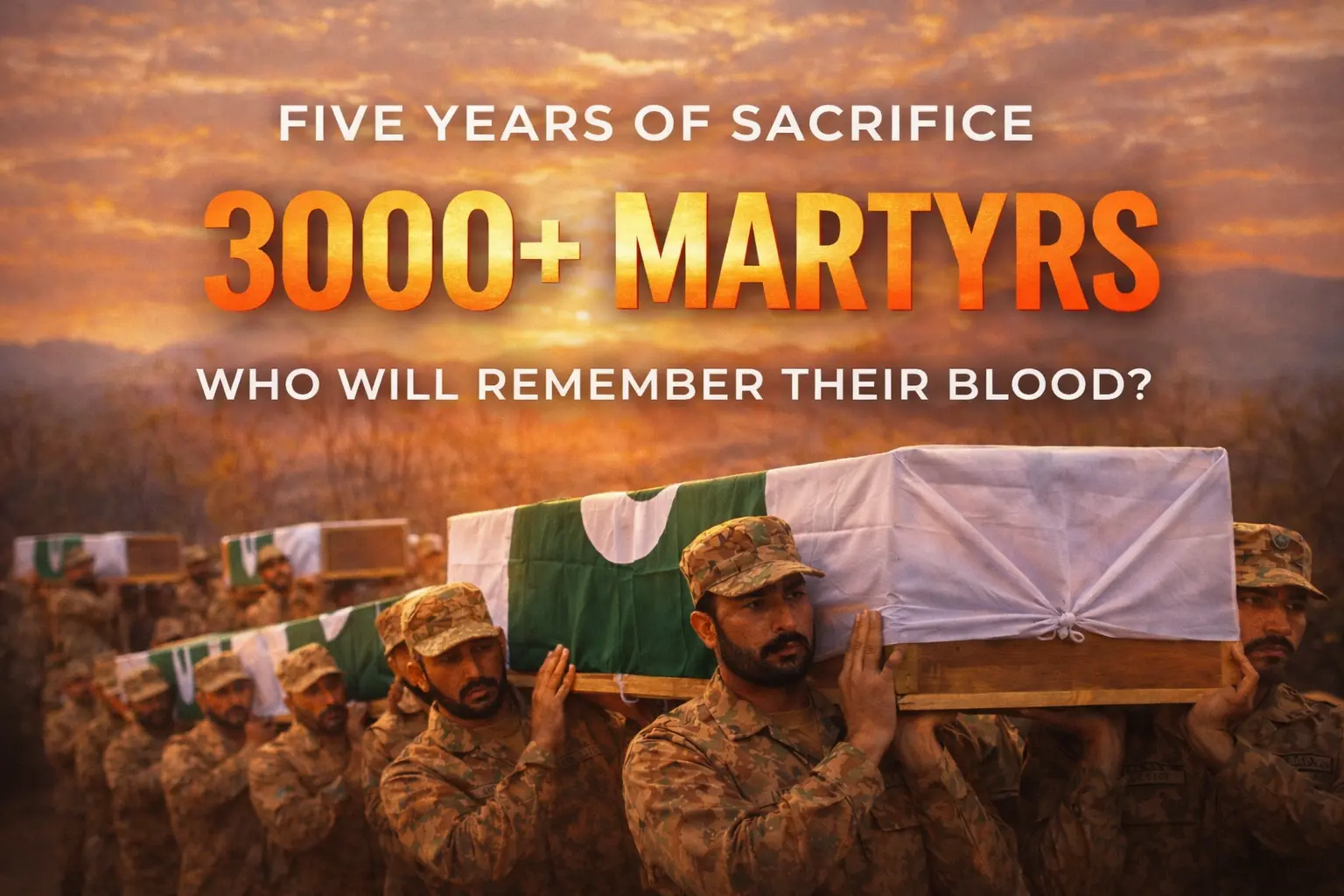

For nations facing prolonged internal conflict, statistics often become the language through which suffering is measured. Yet behind every number lies a human life, a grieving family, and a story of sacrifice that cannot be reduced to data alone. Over the past five years, Pakistan has endured one of the most intense phases of its long war against terrorism—an era marked by renewed militant activity, persistent security operations, and the martyrdom of more than three thousand soldiers of the Pakistan Army.
This period represents far more than a numerical milestone. It reflects the continuing cost of defending national stability in a conflict that has never fully disappeared, only transformed in shape and strategy. The bloodshed of these five years forces a difficult but necessary national reflection: what has been the true price of peace, and why does the struggle continue despite decades of counter-terror efforts?
A Conflict Without a Clear End
Pakistan’s war against terrorism did not begin in the last five years. Its roots stretch back more than two decades, shaped by regional instability, cross-border militancy, ideological extremism, and the geopolitical aftershocks of conflicts in neighboring Afghanistan. Major military operations in the past—particularly large-scale offensives in former tribal regions—successfully dismantled organized militant strongholds and restored the writ of the state across vast territories once beyond effective governance.
However, terrorism proved adaptive rather than defeated.Instead of holding territory, militant networks shifted toward:
Decentralized sleeper cells
Cross-border infiltration
Targeted ambushes on security forces
Hybrid psychological and propaganda warfare
The last five years therefore became a new phase of conflict—less visible than earlier wars, but equally deadly. Violence turned sporadic yet persistent, forcing security forces into continuous intelligence-driven operations rather than decisive battlefield engagements.
The Human Cost of Security
More than three thousand soldiers martyred within five years is not merely a military statistic; it is a national tragedy unfolding in slow motion. Each funeral wrapped in the national flag represents:
A household permanently changed
Children growing up without fathers
Parents burying sons who chose duty over safety
Communities reminded that peace is never guaranteed
Unlike conventional wars, where casualties occur in defined campaigns, Pakistan’s losses have been distributed across time and geography. Soldiers have fallen in remote mountainous patrols, roadside improvised explosive device (IED) attacks, intelligence-based operations, and border skirmishes. This steady rhythm of sacrifice creates a psychological burden not only on the armed forces but on the entire nation.
The persistence of casualties also challenges a common public assumption—that major military victories in the past permanently ended terrorism. The reality is harsher: counter-terrorism is not a single war but a continuous condition requiring vigilance across generations.
Evolution of Terrorist Strategy
During the last five years, militant groups operating against Pakistan have demonstrated significant tactical evolution. Rather than seeking territorial control, they increasingly rely on:
High-impact, low-frequency attacks designed to generate media attention.
Targeted strikes on security personnel to weaken morale and project strength.
Cross-border safe havens and mobility, complicating pursuit and deterrence.
Information warfare, using digital platforms to amplify fear and propaganda.
This transformation reflects a broader global trend in insurgency, where non-state actors prioritize psychological influence over battlefield dominance. Even limited attacks can create disproportionate political and emotional impact if they successfully shape public perception.
For Pakistan, this means the conflict is no longer purely military—it is strategic, psychological, and societal.
Intelligence, Persistence, and Invisible Victories
While public attention often focuses on tragic losses, the unseen dimension of the past five years is the large number of attacks prevented through intelligence coordination and pre-emptive operations. Counter-terror success is frequently invisible; when an attack fails to occur, it rarely becomes national news.
Security forces have increasingly relied on:
Integrated intelligence networks
Precision-based operations instead of large offensives
Border management and surveillance
Urban counter-terror monitoring
These measures reduce large-scale violence but cannot eliminate risk entirely.Thus, the continued martyrdom of soldiers should be understood alongside the far greater violence that has been prevented—a silent success measured in lives saved rather than headlines.
National Resilience and Public Memory
One of the defining features of Pakistan’s five-year struggle is the resilience of its society. Despite repeated attacks and ongoing security operations, national institutions, education systems, economic activity, and civic life have continued to function. Markets reopen after tragedy. Schools resume classes. Cities refuse paralysis.
This resilience is not accidental.It is sustained by the confidence that security forces remain engaged, absorbing the primary shock of violence to protect civilian life. In this sense, the martyrdom of soldiers forms an unspoken social contract: their sacrifice preserves the continuity of normal life for millions.
However, resilience also depends on memory.If society normalizes the loss of thousands of soldiers without reflection, the moral foundation of national unity weakens. Remembering the fallen is therefore not symbolic—it is essential for sustaining collective resolve against extremism.
Regional and Geopolitical Dimensions
Pakistan’s internal security cannot be separated from its regional environment. Instability in neighboring Afghanistan, shifting militant alliances, and great-power geopolitical competition all influence the trajectory of terrorism within Pakistan’s borders. The last five years have demonstrated that counter-terrorism success inside one country cannot remain isolated from regional dynamics.
Cross-border militancy, refugee flows, and ideological networks create a security landscape where military action alone is insufficient. Durable peace requires:
Regional diplomatic engagement
Border stability mechanisms
Counter-extremism narratives beyond force
International recognition of Pakistan’s sacrifices
Without these elements, the burden of security continues to fall disproportionately on Pakistani soldiers.
The Moral Weight of Martyrdom
In Pakistani society, martyrdom carries profound spiritual and cultural meaning. Soldiers who fall in defense of the nation are remembered not only as casualties but as guardians of collective survival. Yet honoring sacrifice must go beyond ceremonial tribute.
True recognition requires:
Long-term support for martyrs’ families
Transparent national security policy
Investment in counter-extremism education
Social unity against sectarian and ideological violence
Only then does sacrifice translate into lasting national strength rather than recurring tragedy.
Why the Bloodshed Persists
The most difficult question remains:Why, after decades of war and thousands of sacrifices, does terrorism still claim lives?
Several structural realities explain this persistence:
Extremist ideology cannot be eliminated solely through military force.
Regional instability continually regenerates militant networks.
Economic and governance gaps create vulnerability to radicalization.
Modern communication technologies accelerate propaganda and recruitment.
These factors ensure that the struggle against terrorism is prolonged rather than decisive. The last five years are therefore not an isolated chapter but part of a longer historical continuum.
The Strategic Meaning of Five Years
Viewed collectively, the martyrdom of over three thousand soldiers in five years conveys three strategic truths:
First, Pakistan remains actively engaged in defending internal stability, disproving any illusion that the threat has disappeared.
Second, the scale of sacrifice demonstrates the depth of commitment by the armed forces, who continue to confront danger largely outside global attention.
Third, lasting peace will require whole-of-nation transformation, not only military endurance.
Thus, the five-year bloodshed report is not merely about loss—it is about unfinished responsibility.
Toward a Future Beyond Sacrifice
Despite the gravity of the past five years, the future is not predetermined. Terrorism declines where states successfully combine:
Security strength
Political stability
Economic opportunity
Educational reform
Social cohesion
Pakistan possesses the institutional experience and societal resilience to move in this direction. The sacrifices of thousands of soldiers have already created the security space necessary for long-term progress. The challenge now is ensuring that this space is not wasted.
Conclusion: The True Price of Peace
Peace in Pakistan has never been free.It has been defended in remote mountains, uncertain borders, crowded cities, and silent intelligence operations. Over the last five years, more than three thousand soldiers have given their lives so that millions may live without fear.
Their bloodshed is not only a record of tragedy it is a measure of national endurance.It reminds the country that stability must be protected continuously, unity must be preserved deliberately, and extremism must be confronted collectively.
History will judge nations not only by the wars they fight, but by the sacrifices they honor and the peace they build afterward. Pakistan’s fallen soldiers have already written their chapter in blood.
The responsibility to complete the story by turning sacrifice into lasting peace now rests with the nation they died to protect.