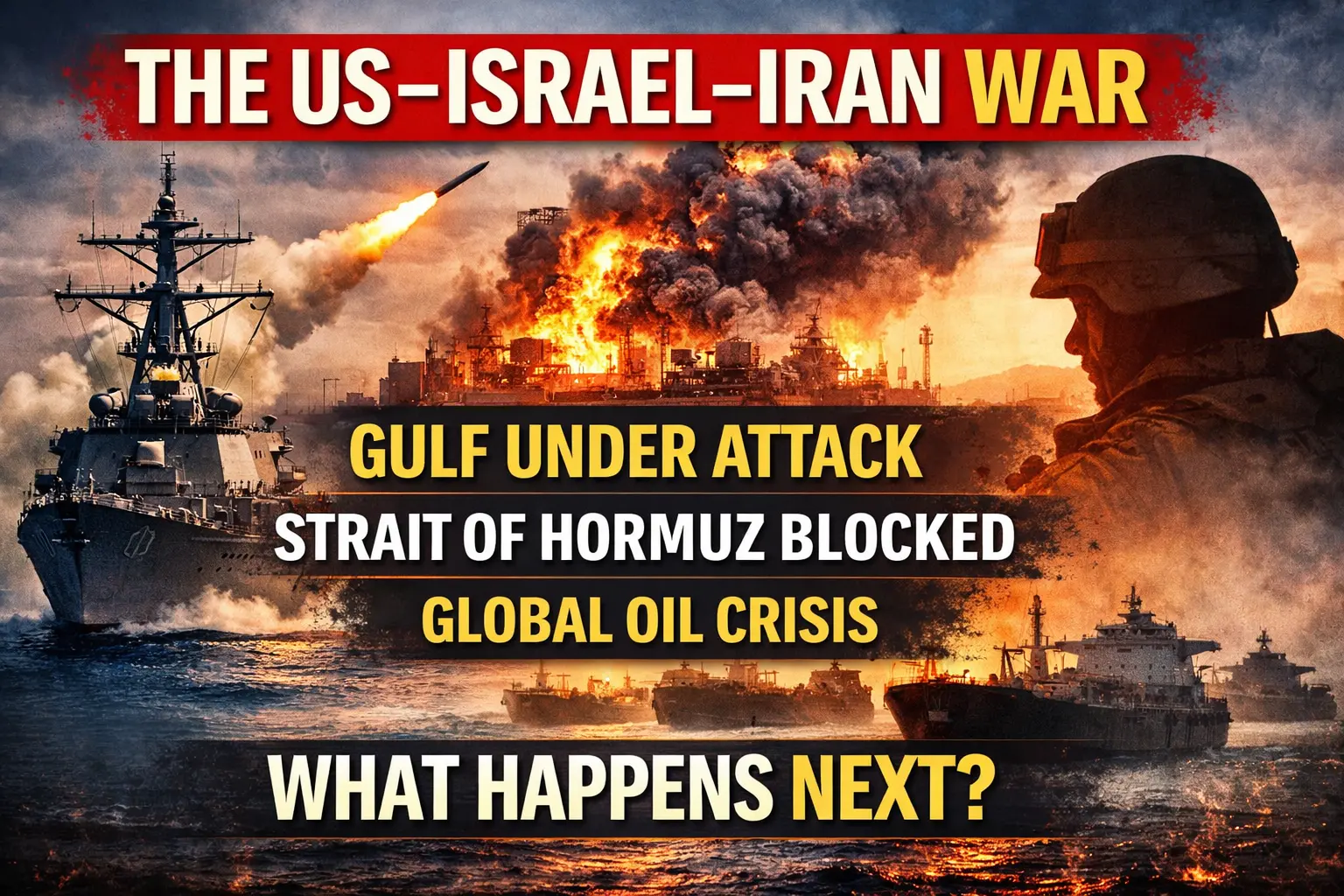

The war involving the United States, Israel, and Iran has entered a dangerous phase that few analysts predicted only weeks ago. What initially appeared to be a limited military campaign aimed at weakening Iran’s strategic capabilities has rapidly expanded into a regional confrontation affecting the entire Gulf and the global economy.
Instead of collapsing under military pressure, Iran has widened the battlefield across the Middle East. Missile strikes, drone attacks, and disruptions in maritime trade have dragged Gulf states into the conflict — despite the fact that these countries did not initiate the war.
Most critically, the crisis has shifted toward the world’s most sensitive energy chokepoint: the Strait of Hormuz. The closure or disruption of this narrow waterway has sent shockwaves through global oil markets and raised fears of a major economic crisis.
This war is no longer simply a military confrontation. It has become a geopolitical struggle over energy routes, regional alliances, and economic leverage.
The Strategic Miscalculation
The United States and Israel appeared to believe that rapid and decisive airstrikes against Iran’s military infrastructure would quickly weaken Tehran’s ability to respond. There were also expectations that targeting Iran’s command structure — possibly even its senior leadership — could destabilize the regime and shorten the conflict.
However, this assumption underestimated the core foundation of Iran’s military doctrine: asymmetric warfare.
Unlike conventional armies that rely heavily on battlefield dominance, Iran has spent decades preparing for conflict through indirect methods. These include missile saturation, drone warfare, proxy networks, and the ability to disrupt vital global supply routes.
Rather than confronting superior U.S. air power head-on, Iran shifted the conflict into areas where it holds strategic leverage.
Why Gulf States Became Targets
One of the most striking developments of the war is Iran’s decision to strike across multiple Gulf states, including Saudi Arabia, the United Arab Emirates, Qatar, and Oman.
Tehran’s position on this matter has been consistent for years. Iranian officials have repeatedly warned that any country allowing its territory to be used for attacks against Iran would be treated as a legitimate military target.
Many Gulf countries host American military installations that play a key role in U.S. regional operations. Important bases include Al Udeid Air Base in Qatar, Al Dhafra Air Base in the UAE, and naval facilities in Bahrain.
From Iran’s perspective, these installations form part of the operational network supporting strikes against Iranian territory. Consequently, Tehran has framed its attacks on Gulf soil not as aggression against those states, but as retaliation against U.S. military infrastructure.
This has created a difficult strategic situation for Gulf governments. They are now exposed to military retaliation despite not being direct participants in the initial conflict.
The Energy Infrastructure Battlefield
Another major dimension of the conflict is the deliberate targeting of energy infrastructure.
Missile and drone attacks have been reported against oil storage facilities, refineries, and export terminals in several Gulf states. Energy hubs such as Ras Tanura in Saudi Arabia and Fujairah in the UAE have become potential targets because they serve as critical nodes in the global oil supply chain.
Iran’s strategy appears designed to create economic deterrence.
The message is clear: if Iranian oil infrastructure is attacked, the broader Gulf energy system will also face disruption. This approach spreads the economic consequences of war far beyond Iran’s borders.
In essence, Iran is attempting to transform a localized military conflict into a global economic crisis.
The Strait of Hormuz: The World’s Energy Chokepoint
Perhaps the most powerful tool in Iran’s strategic arsenal is geography.
The Strait of Hormuz is a narrow maritime passage connecting the Persian Gulf to the global ocean system. It is widely regarded as the most important oil transit route in the world.
Approximately one-fifth of global oil trade moves through this strait each day. Major exporters such as Saudi Arabia, Iraq, Kuwait, Qatar, and the United Arab Emirates rely on it to transport their energy supplies to international markets.
Iran has repeatedly threatened to disrupt shipping through the strait during times of conflict. In the current war, that threat has become a reality.
Reports of naval mines, drone attacks on tankers, and harassment of commercial vessels have significantly reduced maritime traffic. Even limited attacks can halt shipping because insurance companies refuse to cover vessels traveling through high-risk zones.
As a result, the Strait of Hormuz has effectively become the central pressure point of the war.
The Global Economic Shock
The consequences of disruption in the Strait of Hormuz extend far beyond the Middle East.
Energy markets react immediately to any threat to supply. Even small interruptions can trigger dramatic price fluctuations. Oil prices have already surged amid fears that exports from the Gulf could be severely reduced.
Higher energy prices inevitably ripple across the global economy. Transportation costs increase, manufacturing becomes more expensive, and food production is affected because fertilizers and agricultural supply chains depend heavily on energy.
For developing countries already struggling with inflation and economic instability, such disruptions could be devastating.
This is why the conflict in the Gulf has rapidly transformed into a global economic concern.
Why the United States Appears Short of Options
Despite its overwhelming military superiority, the United States now faces a difficult strategic dilemma.
A large-scale ground invasion of Iran is widely considered unrealistic. Iran’s size, mountainous terrain, and population of nearly ninety million would make such a campaign extremely costly and politically controversial.
Escalating airstrikes against Iranian infrastructure may weaken Tehran but also risks provoking wider retaliation across the Middle East.
Meanwhile, Iran’s strategy of economic disruption does not require battlefield victory. Its objective is to raise the cost of the war for everyone involved.
This leaves Washington with limited options beyond continued strikes, diplomatic pressure, and attempts to stabilize shipping lanes.
The Real Battlefield: Global Economics
Modern wars increasingly extend beyond traditional military engagements. Control over trade routes, energy supplies, and financial systems has become just as important as control over territory.
Iran’s approach reflects this reality.
By threatening global energy supply chains, Tehran has shifted the battlefield from Iranian soil to the international economic system.
The objective is not necessarily to defeat the United States militarily but to create enough economic and political pressure to force negotiations.
Possible Future Scenarios
Several outcomes remain possible as the conflict evolves.
One scenario is a negotiated ceasefire driven by economic pressure and international mediation. Rising oil prices and fears of global recession could push major powers to seek a diplomatic solution.
Another possibility is broader regional escalation. Groups allied with Iran across the Middle East could intensify attacks, opening multiple fronts across the region.
A third scenario involves a prolonged war of attrition. In this case, maritime disruption, proxy warfare, and periodic strikes could continue for months or even years.
Conclusion
The US–Israel–Iran war has revealed a critical lesson about modern conflict. Military superiority alone does not guarantee rapid victory.
Iran has responded to overwhelming military pressure by shifting the war into the domains of economics, maritime security, and global energy supply.
The result is a conflict that now affects not only the Middle East but the entire global economy.
Whether the war moves toward escalation or negotiation will depend not only on military developments but also on the ability of the world’s energy system to withstand continued disruption.
In an interconnected world, the battle for oil routes and economic stability may ultimately prove more decisive than the battlefield itself.