
Introduction: A Global Setback in Full Public View
The fatal Tejas fighter jet crash at the Dubai Airshow 2025 was not just a technical failure — it was an international embarrassment broadcast live to the defence world.
India had hoped to use this high-profile platform to showcase the HAL Tejas as a worthy indigenous fighter jet, capable of attracting export buyers and proving the strength of the Indian Air Force Tejas program.
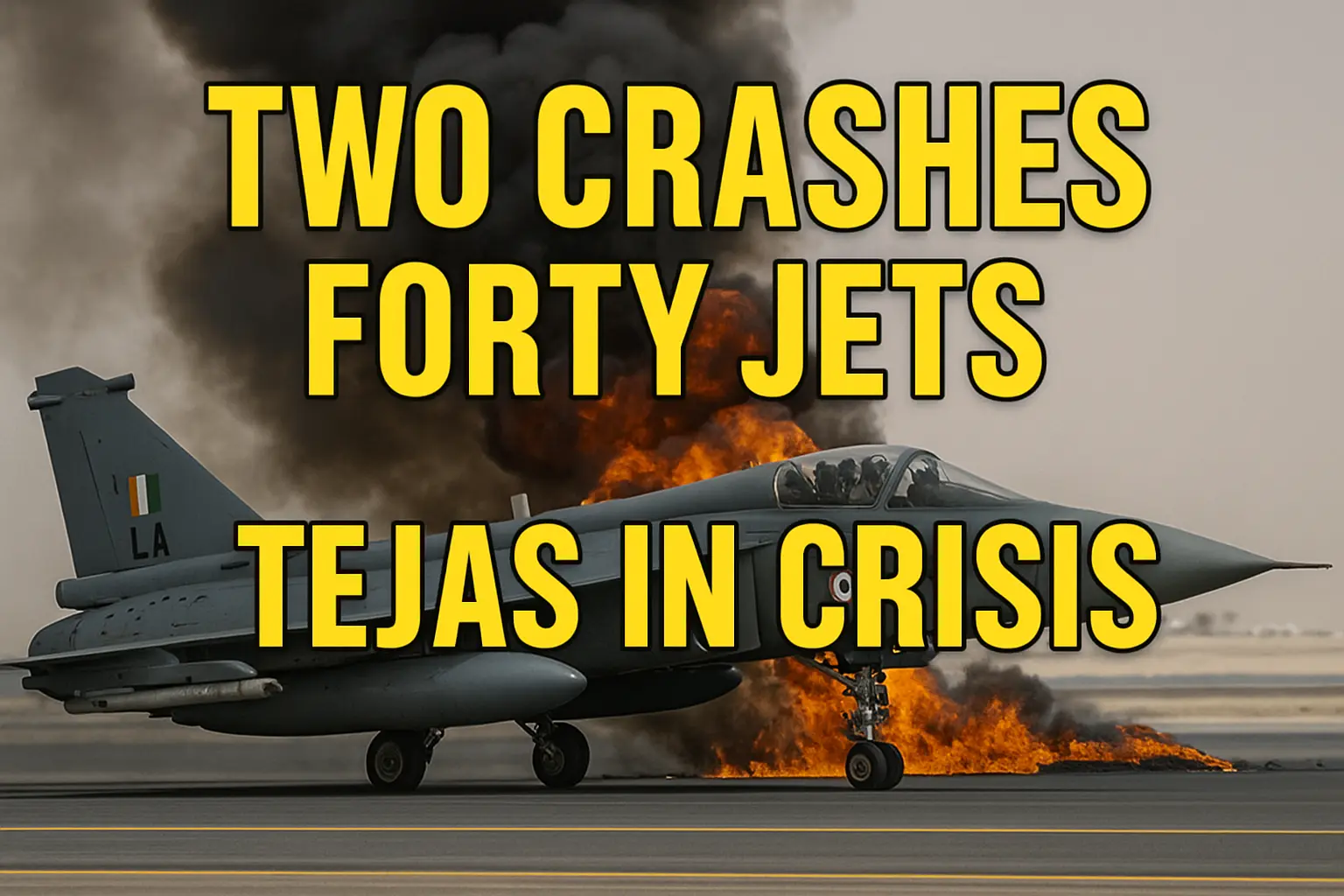
Instead, the crash reignited long-standing doubts about the aircraft’s reliability, engineering maturity, and suitability for demanding operations. With only around forty aircraft produced and two already lost, the numbers paint a disturbing picture that India’s official statements cannot easily explain away.
A Small Fleet With Big Ambitions
The HAL Tejas was introduced as the face of India’s “Make in India” defence initiative. It was promoted as a cost-effective, combat-ready platform meant to replace older Soviet-era fighters and eventually compete in foreign markets.
But ambition alone cannot hide the facts:
• ≈ 40 jets produced so far
• 2 confirmed crashes (2024 & 2025)
• 5% of the entire fleet lost
For a fighter still in its early operational life — and yet to prove itself in real combat — this ratio is troubling. It puts Tejas in a difficult position internationally, especially when India is actively trying to market it to countries in Asia, Africa, and the Middle East.
Dubai Airshow Crash: A Blow India Couldn’t Afford
Airshows are carefully choreographed. They are not combat environments — they are sales pitches.
A crash during such a flight reflects one of two possibilities:
• A fundamental design or reliability weakness, or
• A mishandled manoeuvre that the aircraft was not robust enough to survive
Either way, the reputational damage is severe.
The Dubai crash was dramatic and fatal, undermining the Tejas jet’s image at precisely the moment India was trying to prove that it is a safe, modern machine worthy of global consideration.
Crash-to-Fleet Ratio: The Hard Reality
The crash count alone doesn’t tell the full story — the ratio does.
Two crashes in a fleet of about 40 = 5% loss rate
This is alarming by modern aviation standards.
Now compare that with established fighter programs:
• F-16 Fighting Falcon
• 4,600+ built
• Early loss rate extremely low
• Millions of flight hours before serious incidents
• JF-17 Thunder
• 150+ produced
• Only a few crashes
• No failures during major international airshows
• Gripen
• ~270 produced
• A small number of early crashes — but within a much larger fleet and test cycle
The Legacy Jet Comparison: MiG-21 — “The Flying Coffin”
The only fair legacy comparison is the MiG-21, operated in huge numbers by the Indian Air Force.
It became infamous as the “Flying Coffin” because hundreds were in service at once and many were already decades old.
But here’s the key point:
Its crash numbers were enormous because its fleet size was enormous.
Tejas’s situation is the opposite
• Small fleet
• New aircraft
• Already two losses
A 5% crash ratio in such a tiny fleet suggests deeper structural, mechanical, or software vulnerabilities.
Technical and Structural Concerns Behind Tejas Credibility Issues
The Tejas program has wrestled with a long list of engineering challenges since the 1980s. The Dubai crash revived many previously flagged issues.
1. Single-Engine Risk
Like the F-16 and Gripen, Tejas uses a single engine.
But unlike those mature platforms, Tejas has already experienced engine-related failures, including the 2024 crash caused by a suspected seizure.
2. HAL’s Quality Control Problems
For years, experts have highlighted:
• inconsistent manufacturing
• supply chain gaps
• delays in delivering upgraded variants
• excessive reliance on imported components
3. Flight Control and Software Instability
Test pilots have raised concerns about continual patching of the flight control system — a sign that the aircraft may not yet be fully stable under high-stress manoeuvres.
4. Airframe Stress Concerns
The Dubai flight involved aggressive aerobatics.
Many analysts believe the Tejas may have hit stress limits that more mature aircraft can tolerate safely.
Export Dreams in Trouble
Before Dubai, India promoted Tejas to:
• Malaysia
• United Arab Emirates
• Sri Lanka
• Egypt
• Argentina
Now, every potential customer will re-evaluate:
• safety record
• maintenance costs
• long-term reliability
• risk of grounding fleets due to technical flaws
It is difficult to justify purchasing a fighter jet that has already lost 5% of its fleet during peacetime operations.
Meanwhile, competing platforms — especially the JF-17 Block III — now appear more reliable by comparison.
India’s Response: Predictable Damage Control
India’s official reaction followed the expected pattern:
• declare the crash an “isolated incident”
• praise the departed pilot
• announce a Court of Inquiry
• highlight “successful past demonstrations”
• promise improvements in upcoming Mk-1A and Mk-2 versions
But international analysts and air forces remain skeptical. A crash in such a controlled, non-combat environment raises far more questions than answers.
The burden is now on India and HAL to prove that Tejas is not a fragile or immature airframe.
Regional Impact: Advantage Pakistan
The crash has significant strategic implications for South Asia.
Pakistan, which co-produces the JF-17 with China, benefits in several ways:
• strengthens JF-17’s reputation as a stable, proven platform
• undermines Indian claims of Tejas superiority
• gives Pakistan a psychological and narrative edge in regional airpower discussions
In the region’s sensitive balance of military perception, optics matter — and right now, the optics favor Pakistan.
Conclusion: A Program at a Crossroads
The Tejas program has reached its most critical moment.
To restore credibility, India must:
• carry out a transparent crash investigation
• admit root causes (not hide them)
• tighten HAL’s quality control
• mature the flight control system
• stop rushing production to meet political timelines
Until then, the Tejas credibility issues will overshadow India’s efforts to promote the aircraft globally.
The harsh truth is:
Two crashes in a forty-jet fleet is not just unfortunate — it is a warning.
A warning that the Tejas program needs structural reform, deeper engineering scrutiny, and honest evaluation before it can claim to be a reliable, world-class fighter jet.