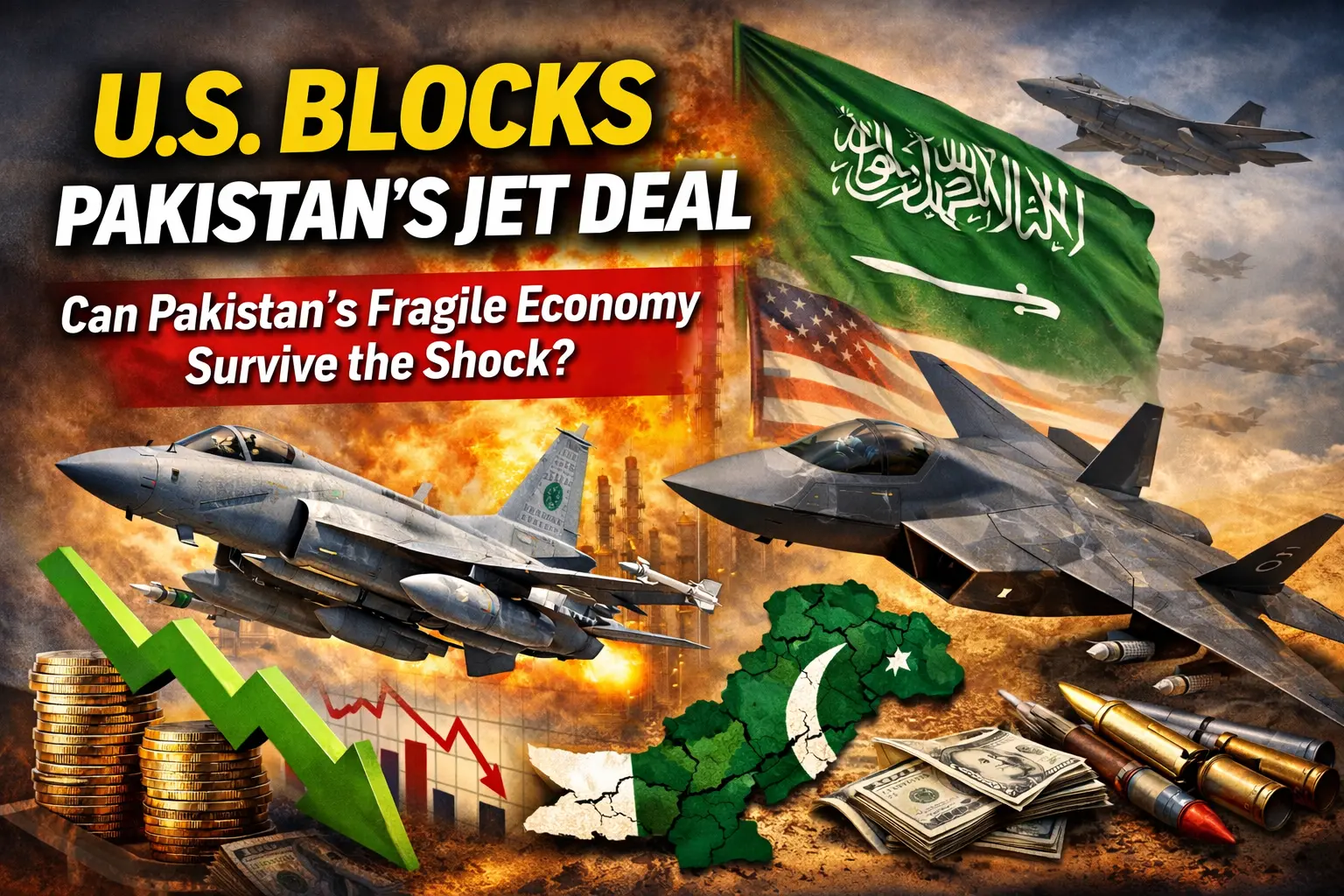

Reports that the United States is pressuring Saudi Arabia to step back from potential fighter-jet cooperation with Pakistan and Turkey highlight a deeper geopolitical reality: global arms deals are rarely just commercial transactions. They are instruments of influence, alliance management, and economic leverage.
For Pakistan already navigating fiscal stress, external debt obligations, and reliance on foreign partners—such developments raise a critical question: can Pakistan’s fragile economy absorb the strategic and financial shock of losing a potential Saudi defense partnership?
Understanding this issue requires examining three dimensions:
1.Why Washington is intervening
2.What Pakistan economically stands to lose
3.Whether the country’s economy can withstand the impact
Why the United States Is Pressuring Saudi Arabia
1. Preserving Strategic Dominance in Gulf Security
For decades, the U.S.–Saudi security partnership has been the backbone of Gulf defense architecture. American fighter jets, missile systems, training programs, and maintenance ecosystems bind Saudi military capability to Washington’s strategic umbrella.
If Saudi Arabia begins diversifying toward Pakistani-Chinese platforms like the JF-17 or Turkey’s KAAN fifth-generation project, the U.S. risks:
•Reduced military interoperability
•Loss of intelligence influence
•Weakening of long-standing defense dependence
From Washington’s perspective, preventing diversification is not protectionism alone—it is geopolitical risk management.
2. Containing China’s Expanding Defense Footprint
Pakistan’s flagship fighter program is co-developed with China.
Any Saudi acquisition would indirectly:
•Expand Chinese defense penetration into the Gulf
•Challenge U.S. technological supremacy
•Undermine sanctions and export-control leverage
Thus, U.S. pressure on Riyadh is also part of the broader U.S.–China strategic competition, not merely a bilateral U.S.–Saudi dispute.
3. Protecting the Global Arms Market
The Gulf is one of the most lucrative defense markets in the world.
American defense exports:
•Support hundreds of thousands of jobs
•Sustain research and development ecosystems
•Reinforce dollar-denominated military trade
Allowing Pakistan or Turkey to enter this market would create:
•Precedent for diversification
•Pricing competition
•Political erosion of U.S. defense dominance
Therefore, U.S. intervention reflects economic statecraft as much as security policy.
Economic Stakes for Pakistan
1. Lost Defense Export Revenue
Pakistan’s defense industry—particularly aircraft manufacturing—relies heavily on exports for sustainability.
A Saudi fighter-jet deal could have delivered:
•Billions in long-term revenue
•Technology investment
•Production line continuity
•Foreign exchange inflows
For an economy frequently facing balance-of-payments crises, such inflows are strategically vital.
Loss of this opportunity means:
•Continued dependence on IMF-linked financing
•Limited industrial scaling
•Reduced defense-sector employment growth
2. Strategic Signaling to Other Buyers
Defense purchases are also signals of confidence.
If Saudi Arabia—Pakistan’s long-time partner—steps away under U.S. pressure, other potential buyers may interpret it as:
•Political risk in dealing with Pakistan
•Uncertain long-term support ecosystems
•Vulnerability to sanctions pressure
This could shrink Pakistan’s future export pipeline, not just one deal.
3. Impact on Pakistan–Saudi Economic Relations
Saudi Arabia is not merely a defense customer. It is:
•A major oil supplier on deferred payments
•A source of deposits supporting Pakistan’s foreign reserves
•A key investor in mining, energy, and infrastructure
If defense divergence signals strategic distancing, Pakistan could face:
•Tighter financial assistance conditions
•Delayed investment timelines
•Reduced diplomatic leverage
Such outcomes would directly affect macroeconomic stability.
Can Pakistan’s Shaky Economy Absorb the Shock?
1. Structural Fragility
Pakistan’s economy currently faces:
•High external debt servicing
•Persistent fiscal deficits
•Currency volatility
•Dependence on multilateral bailouts
In this environment, losing a multi-billion-dollar defense opportunity is not catastrophic alone—but it removes a rare pathway toward self-generated foreign exchange.
Thus, the shock is manageable tactically but damaging strategically.
2. Limited Industrial Diversification
Countries resilient to geopolitical shocks usually possess:
•Strong export diversification
•High manufacturing competitiveness
•Robust technology sectors
Pakistan’s export base remains narrow and low-value, dominated by textiles.
Defense exports offered a high-technology alternative—and losing momentum here deepens structural weakness.
3. Dependence on External Political Alignments
Pakistan’s economic stability is closely tied to:
•Gulf financial backing
•Chinese investment
•Western financial institutions
Any geopolitical shift affecting one pillar increases pressure on the others.
If Saudi strategic alignment tilts more firmly toward Washington’s preferences, Pakistan’s room for economic maneuvering narrows.
Strategic Interpretation: Crisis or Turning Point?
Scenario 1 — Short-Term Setback, Long-Term Stability
Pakistan could absorb the impact if:
•Chinese defense cooperation deepens further
•New buyers in Africa or Southeast Asia emerge
•Domestic reforms stabilize macroeconomics
In this case, the Saudi setback becomes temporary.
Scenario 2 — Gradual Strategic Marginalization
Risk increases if:
•Gulf partners fully align with U.S. defense ecosystems
•Pakistan’s economy remains IMF-dependent
•Defense exports fail to scale globally
This would lead to reduced geopolitical leverage over time.
Scenario 3 — Opportunity for Strategic Reset
Paradoxically, pressure could push Pakistan toward:
•Indigenous technological acceleration
•Export diversification beyond traditional allies
•Economic reform urgency
Historically, external pressure sometimes triggers internal transformation.
The Real Motive Behind U.S. Actions
Beyond economics or China containment, the deeper motive is system preservation.
The United States seeks to maintain a world where:
•Security alliances are technology-dependent on Washington
•Defense trade reinforces political alignment
•Strategic regions remain within U.S. influence architecture
Saudi diversification threatens this entire framework, not just one arms deal.
Therefore, U.S. pressure is predictable, structural, and long-term—not situational.
Conclusion
The reported U.S. push for Saudi Arabia to abandon Pakistani and Turkish fighter-jet options is far more than a defense procurement dispute. It reflects great-power competition, alliance control, and economic statecraft operating simultaneously.
For Pakistan, the immediate financial loss from a canceled or stalled Saudi deal is serious but survivable.
The deeper concern lies in strategic signaling, export credibility, and long-term economic resilience.
Whether Pakistan’s shaky economy can withstand such shocks depends less on external pressure and more on internal reform, industrial modernization, and diversified diplomacy.
In the end, this episode may prove to be either:
•A warning sign of strategic marginalization,
or
•A catalyst for overdue economic transformation.
The direction Pakistan chooses will determine which of these futures becomes reality.