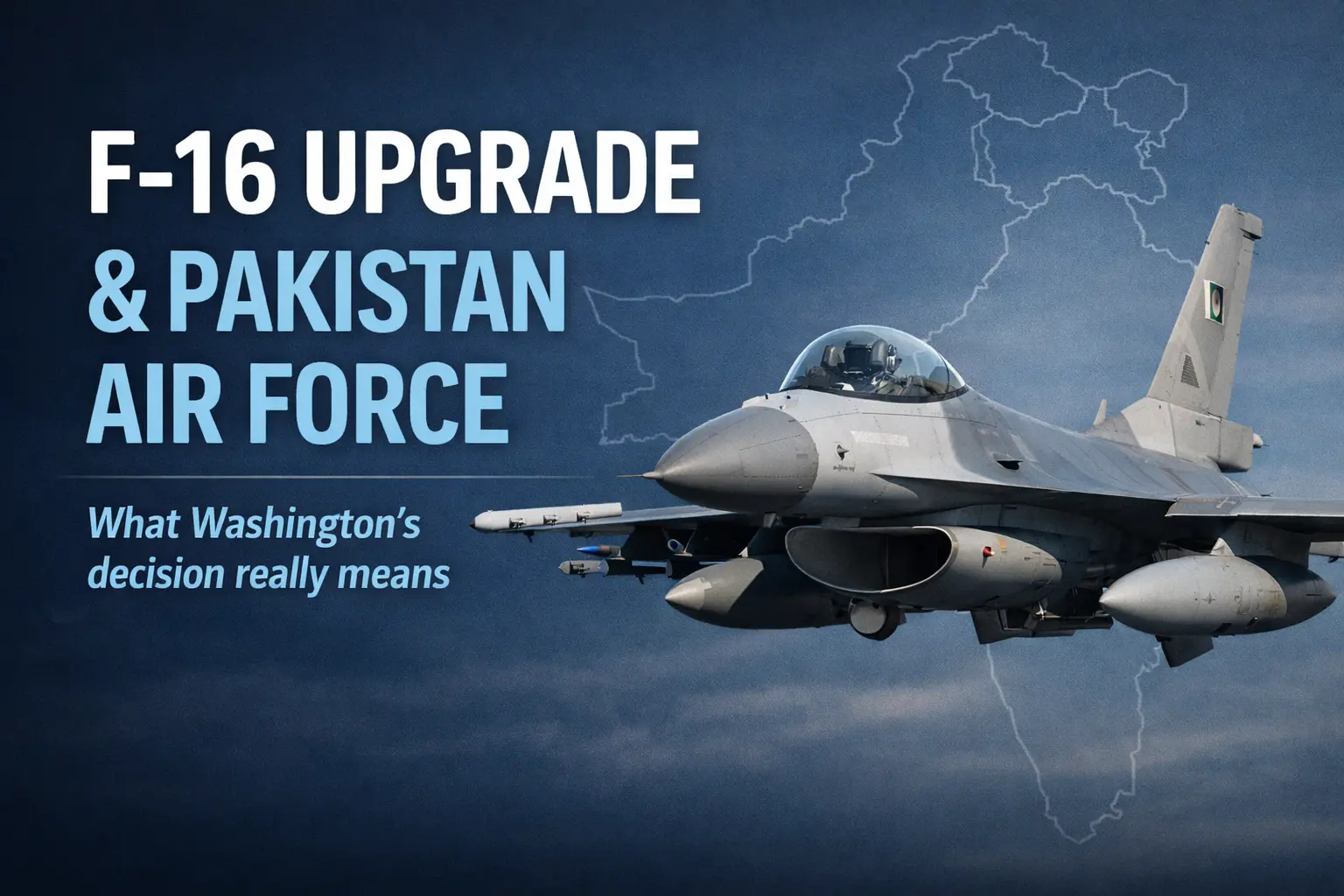

At first glance, Washington’s approval of a $686 million upgrade and sustainment package for Pakistan’s F-16 fleet looks unremarkable. No new aircraft. No dramatic weapons. No flashy announcements. Yet this decision quietly addresses one of the most dangerous problems in military planning: capability decay through neglect.
In modern air warfare, losing relevance is often more damaging than losing numbers. This upgrade is not about growth; it is about preventing decline. And in South Asia’s fragile strategic environment, that distinction matters.
The F-16 and Pakistan: A Relationship Shaped by Politics, Not Just Performance
Since its induction in 1983, the F-16 has occupied a unique place in Pakistan Air Force doctrine. It was never just another fighter. It symbolised access to Western technology, training standards, and operational thinking that shaped the PAF’s professional culture for decades.
That relationship, however, was never smooth. The sanctions era of the 1990s left a deep scar. Aircraft paid for were withheld. Fleet growth stalled. Long-term planning suffered. Pakistan was forced to stretch airframes, improvise sustainment, and compensate with doctrine rather than numbers.
This history matters because it explains why the current upgrade is not viewed inside Pakistan as a “gift” — but as belated maintenance of a long-standing obligation.
Operational Reality: Why the F-16 Still Matters
Over the years, the F-16 became the workhorse for high-value missions. Air defence alerts. Interceptions. Precision strikes. Counter-terrorism operations. It was trusted because it was understood — by pilots, engineers, and planners alike.
Attrition occurred, as it does in any long-serving fleet, mostly through accidents rather than combat. But what made each loss more serious was the fact that the fleet was never large enough to absorb attrition easily. Every aircraft mattered.
More importantly, sustainment became increasingly fragile. Spare parts delays, political uncertainty, and rising maintenance costs created a slow but visible strain. The risk was not sudden collapse — it was gradual irrelevance.
The Real Problem Was Never the Airframe
By the early 2020s, the F-16’s biggest vulnerability was not age or performance. It was isolation.
Air combat today is not won by individual aircraft acting alone. It is won by networks — fighters linked to airborne early warning aircraft, ground command centres, and other shooters in real time. An aircraft without secure data links and modern identification systems becomes tactically blind, no matter how capable it is aerodynamically.
Without intervention, Pakistan’s F-16s were heading toward that fate: capable machines slowly slipping out of the modern fight.
What Washington Actually Approved — and What It Deliberately Did Not
The approved package focuses on connectivity, safety, and sustainment. Secure communications, modern data links, updated identification systems, refreshed avionics, training infrastructure, and long-term logistics support form the core of the deal.
Just as important is what was excluded. There is no conversion to the latest variants. No new strike weapons. No attempt to leapfrog regional competitors. This was a conscious choice. The message is clear: preserve, don’t provoke.
For Pakistan, this framing is acceptable. For Washington, it is politically defensible. For the region, it is stabilising.
Strategic Impact: Buying Time Is Sometimes the Strategy
From a force-planning perspective, the most valuable outcome of this upgrade is time. It keeps a proven platform operational until roughly 2040, giving Pakistan breathing space to plan its next steps without facing immediate capability gaps.
More importantly, the networking upgrades reposition the F-16 as a coordinator rather than just a shooter. In a mixed fleet that now includes JF-17 variants and J-10CEs, the upgraded F-16 can act as a command-and-control enabler, stitching different platforms into a coherent operational picture.
This is how modern air forces extract value — not by replacing aircraft every decade, but by redefining their roles.
Deterrence, Stability, and the Misunderstood Narrative
Critics will argue that any upgrade fuels competition. This view misses the point. Deterrence fails not when capabilities exist, but when they erode unevenly and unpredictably.
Better communications, clearer identification, and stronger situational awareness reduce the risk of miscalculation in fast-moving crises. In South Asia, where air incidents can escalate quickly, this matters more than marginal gains in speed or payload.
In this sense, the upgrade contributes more to crisis stability than to escalation.
Washington’s Signal: Limited, But Not Meaningless
This decision should not be overstated. It does not represent a strategic realignment or a revival of Cold War-era defence ties. It does, however, signal that Pakistan is not being written off as a military partner whose core capabilities can be allowed to decay.
For Pakistan, that signal has value — not as leverage, but as reassurance. For regional observers, it reinforces a simple reality: Pakistan’s air power will remain functional, integrated, and credible, even if it is not expanding dramatically.
Conclusion: Quiet Decisions Often Matter the Most
The F-16 upgrade approved by Washington will not dominate headlines, and it will not dramatically shift the balance of power. That is precisely why it matters.
It prevents decline. It preserves options. It stabilises force structure. And it buys time — the most precious commodity in military planning.
In an age obsessed with dramatic acquisitions and headline-driven comparisons, this decision reflects something more mature: the recognition that staying relevant is often more important than trying to leap ahead.