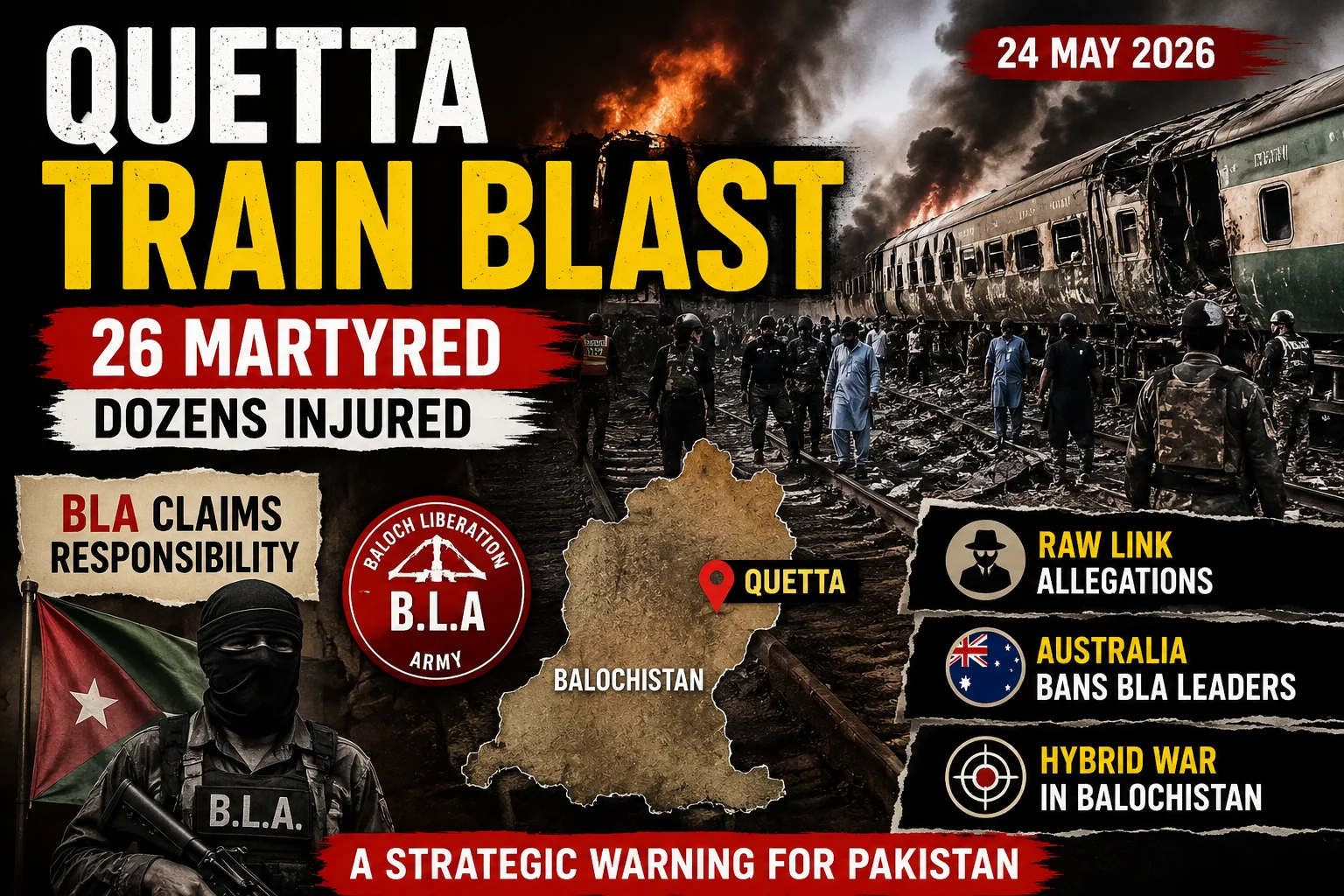

The city of Quetta woke up to another day of grief and smoke as a devastating terrorist attack ripped through a passenger train near Chaman Phatak on 24 May 2026. In a matter of seconds, lives were shattered, families torn apart, and an entire nation once again reminded of the brutal cost of terrorism in Balochistan.
According to initial reports, at least 26 people embraced shahadat (martyrdom), while dozens more were injured after a massive explosion targeted a train carrying security personnel along with civilians and family members. Rescue workers rushed toward the flames and twisted metal as cries for help echoed across the railway crossing.
For many Pakistanis, this was not just another news headline. It was another painful reminder that the war against terrorism is far from over.
What Happened in Quetta?
The attack took place near the Chaman Phatak railway crossing in Quetta when an explosives-laden vehicle reportedly detonated close to the railway track as the train passed through the area.
The force of the explosion derailed multiple coaches, damaged nearby vehicles and buildings, and turned the railway line into a scene of destruction. Witnesses described panic, smoke, and bodies scattered near the tracks as emergency teams and local residents desperately tried to rescue survivors.
Hospitals across Quetta declared emergency conditions while security forces sealed the area for investigation.
Shortly after the attack, the banned militant organization Baloch Liberation Army (BLA) claimed responsibility, describing it as a “fidayeen” operation.
A Nation Tired of Burying Its People
Behind every casualty number is a human story.
Among the martyrs were fathers, sons, security personnel, railway passengers, and ordinary citizens who had left home expecting another routine day. Instead, their families received heartbreaking phone calls that would change their lives forever.
Pakistan has suffered decades of terrorism, yet every new attack reopens old wounds. From APS Peshawar to attacks in Quetta, Mastung, and Gwadar, the pain has become deeply embedded in the national memory.
The Quetta train blast is not merely a security incident. It is a human tragedy.
Why Are Railways Being Targeted?
Railways are not random targets.
In strategic terms, trains represent:
* national connectivity,
* economic movement,
* military logistics,
* and the visible presence of the state.
When militants attack trains, they are trying to send a larger message:
“The state cannot fully protect its infrastructure or its people.”
This is psychological warfare as much as physical violence.
The repeated targeting of railway systems in Balochistan appears aimed at creating fear, damaging public confidence, and disrupting both civilian and security movement routes.
The Changing Face of the BLA
The Baloch Liberation Army has evolved significantly over recent years.
What was once viewed largely as a separatist insurgent group now increasingly operates with tactics associated with hybrid terrorism:
* suicide attacks,
* coordinated assaults,
* infrastructure sabotage,
* hostage-taking,
* and media-focused operations.
The group’s so-called “Majeed Brigade” has been linked to several high-profile attacks, particularly targeting:
* Chinese nationals,
* China–Pakistan Economic Corridor (CPEC) projects,
* security installations,
* and transportation infrastructure.
The 2025 Jaffar Express hijacking already demonstrated a dangerous escalation in operational capability. The latest Quetta train bombing further reinforces concerns that militant networks in Balochistan are becoming more sophisticated and strategically focused.
The RAW Connection Debate
Pakistan has repeatedly alleged that hostile foreign intelligence networks, particularly India’s Research and Analysis Wing (RAW), support separatist militant groups operating inside Balochistan.
Pakistani authorities often reference:
* the arrest of Kulbhushan Jadhav,
* alleged foreign funding channels,
* intelligence facilitation,
* and broader hybrid warfare efforts against Pakistan.
India officially denies these accusations.
While international verification remains part of an ongoing geopolitical dispute, within Pakistan’s security circles there is a strong belief that Balochistan has become a battleground for proxy warfare and regional destabilization efforts.
The debate continues, but one reality is undeniable:
Pakistan’s enemies benefit whenever instability grows inside Balochistan.
Australia’s Recent Ban on BLA Leaders
A significant international development came recently when Australia imposed sanctions on BLA leaders and associated networks linked to terrorism financing.
The move is important because it reflects growing international concern over the organization’s violent activities and attacks on civilians and infrastructure.
For Pakistan, the sanctions strengthen its longstanding position that the BLA should be viewed internationally through the lens of terrorism rather than political separatism.
The decision may also increase global monitoring of militant funding channels and overseas support networks.
Why Balochistan Matters So Much
Balochistan is not just another province.
It is strategically vital because of:
* Gwadar Port,
* CPEC trade routes,
* massive mineral resources,
* its border proximity with Afghanistan and Iran,
* and access to the Arabian Sea.
Any instability in Balochistan affects:
* Pakistan’s economy,
* regional connectivity,
* foreign investment,
* and broader South Asian geopolitics.
This is why attacks in the province carry consequences far beyond local security concerns.
Pakistan’s Real Challenge
The challenge Pakistan faces today is not only military.
It is also:
* psychological,
* political,
* economic,
* informational,
* and strategic.
Terrorist organizations increasingly aim to create fear, division, and hopelessness inside society. Their goal is not only to kill people but also to weaken national confidence.
Winning this battle requires more than operations alone. It requires:
* stronger intelligence coordination,
* political stability,
* economic inclusion,
* regional diplomacy,
* and public resilience.
Conclusion
The Quetta train blast of 2026 is another heartbreaking reminder of the sacrifices Pakistan continues to endure in its fight against terrorism.
But beyond the smoke and destruction lies a deeper reality: Balochistan has become one of the central fronts of modern hybrid conflict in South Asia — where insurgency, geopolitics, psychological warfare, and regional rivalries increasingly overlap.
As Pakistan buries its martyrs once again, the nation faces an urgent question:
Can stability and long-term peace be secured before violence evolves even further?
For now, grieving families wait for answers while a wounded nation mourns yet another tragedy.